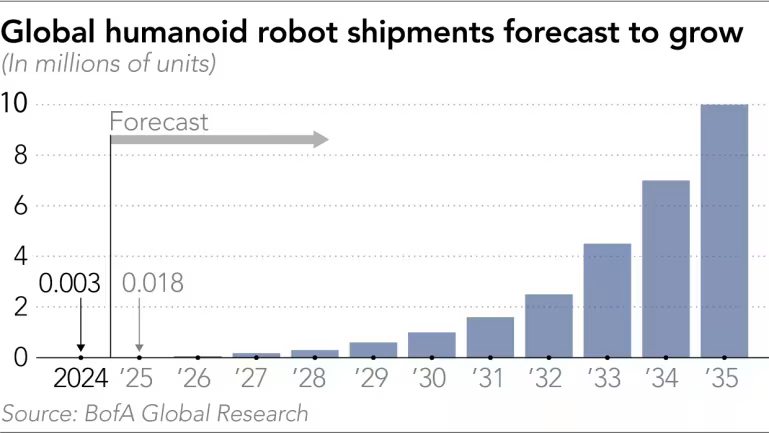
包括 Agibot、Galbot、优必选与 Dobot 在内的中国人形机器人厂商,虽然仍面临高成本与技术瓶颈,却正迅速扩大产能。2023 年成立的 Agibot 已累计生产约 5,000 台人形机器人,在 2024 年全球出货量仅约 3,000 台、2025 年预估仅 1.8 万至 2 万台的市场中占有重要份额。
Agibot 以多模态 ViLLA 模型训练通用型机器人,让其能从跳舞、打太极到巡检与工厂作业等任务中持续透过软体更新学习新技能。Galbot 则主攻零售货架操作与无人商店等场景,优先布署带轮人形机器人,并计划在中国多个一线城市大规模落地,同时多家中外厂商都依赖 Nvidia 平台。
分析师看好长期成长潜力,摩根士丹利预测到 2050 年全球人形机器人累计采用量可达 10 亿台,预计在 2030 年代中期前成长缓慢,其后随硬体与 AI 成熟而急速加速。然而,Moravec 悖论、灵巧手与致动器设计、脑部与关节与电池的散热,以及与人类近距离互动的安全风险,仍使消费级人形机器人前景遥远。
Chinese humanoid robot makers such as Agibot, Galbot, Ubtech and Dobot are rapidly scaling up production despite high costs and technical bottlenecks. Agibot, founded in 2023, has already produced about 5,000 humanoids, a meaningful share in a market where total global shipments were only about 3,000 units in 2024 and are forecast at 18,000–20,000 units in 2025.
Agibot is training general-purpose robots using multimodal ViLLA models so machines can learn tasks ranging from dancing and Tai Chi to inspections and factory work, with software updates supporting continuous skill growth. Galbot instead prioritizes wheeled humanoids optimized for retail shelf operations and unstaffed stores, planning large-scale deployments across major Chinese cities while many Chinese and foreign rivals build on Nvidia platforms.
Analysts see enormous long-term potential, with Morgan Stanley projecting cumulative humanoid adoption reaching 1 billion units by 2050, growing slowly until the mid-2030s before accelerating after 2035 as hardware and AI mature. Yet Moravec’s Paradox, actuator and dexterous-hand complexity, heat dissipation in brains, joints and batteries, and unresolved safety risks in close human interaction all keep consumer humanoids a distant prospect.