该研究指出,北京方面已将其在关键全球供应链中的主导地位视为反制西方制裁的重要杠杆,近期更透过限制关键零件出口造成欧美车厂产线停摆。尽管欧盟近年来试图去风险化并降低对中依赖,但收效甚微,例如西班牙对中国的进口翻倍,爱尔兰也吸纳了大量中国科技与医药投资。
智库分析人士呼吁西方政府在维护自身利益时,必须学会运用对抗北京的筹码并准备付出相应代价,否则最终将受制于以中国为中心的经济秩序。顾问机构估算,欧美与英国若要在制造及科技领域彻底结束对中国的依赖,至2050年需投入总计超过23兆美元的庞大资金。
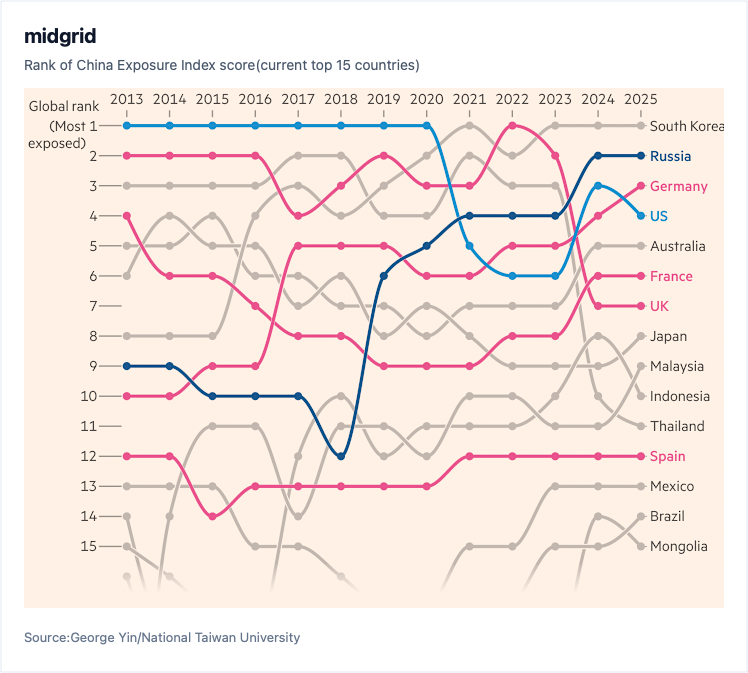
According to a new global influence index developed by National Taiwan University and published with European think tanks, Europe's largest economies—France, Germany, and the UK—rank among the top seven countries globally most exposed to Chinese economic coercion. The findings indicate that democratic nations are more vulnerable to Chinese leverage than autocracies, contradicting the traditional belief that Beijing's primary grip is concentrated in poorer regions across Asia, Africa, and South America.
The analysis reveals that Beijing strategically exploits its pivotal role in global supply chains as economic leverage against Western export controls, recently demonstrating its willingness to disrupt US and European automotive factories through component restrictions. Despite the EU's ongoing de-risking efforts, European exposure has experienced only modest reductions, with countries like Spain and Ireland actually deepening reliance through surges in imports and strategic foreign direct investment.
Policy analysts caution Western leaders that they must be prepared to exert their own leverage and absorb the associated economic costs, warning that hesitation could lead to submission under a Sino-centric economic order. Demonstrating the immense scale of decoupling, consulting estimates indicate that the EU, US, and UK would need to invest roughly $23.6 trillion by 2050 to fully eliminate critical industrial dependencies on China.