为了揭开这些违反常规的星系如何形成的谜团,2026 年 6 月发表于《天体物理学期刊》的研究提出了一个关键解释:远古时期曾发生过一场两个正常星系的迎面碰撞。由于暗物质仅与重力产生作用,在碰撞过程中几乎不受阻力而直接穿透并继续高速前行;相反地,受四种基本力作用的普通物质(气体与尘埃)则在撞击中纠缠并聚集在一起,最终留下了这三个被剥离了暗物质、难以形成新恒星的星系,尽管也有部分学者认为暗物质可能是被邻近的巨大星系群所剥离。
这三个缺乏暗物质的星系为「暗物质是真实存在的物理物质」提供了强而有力的间接证据,同时对修正牛顿动力学(MOND)等试图以修改重力法则来取代暗物质的替代重力理论造成了重大打击。专家指出,如果暗物质只是一种重力修正效应,它就不可能在星系碰撞或交互作用中与普通物质发生分离;因此,就像先前的子弹星系团以及 2015 年 LIGO 探测到的重力波证据一样,这三个星系再次证明透过碰撞剥离实体暗物质,远比「关闭自然重力法则」更能合理地解释观测数据。
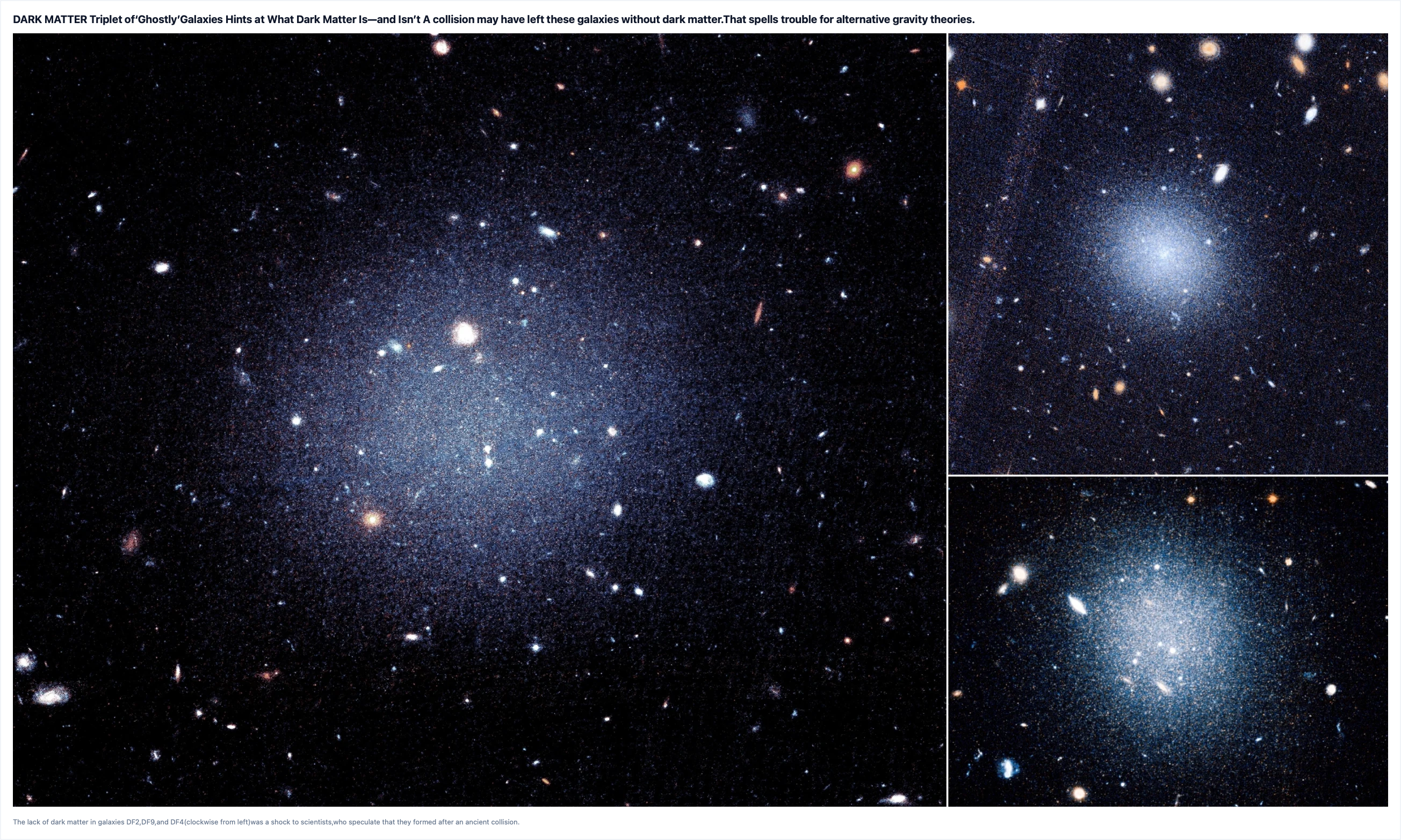
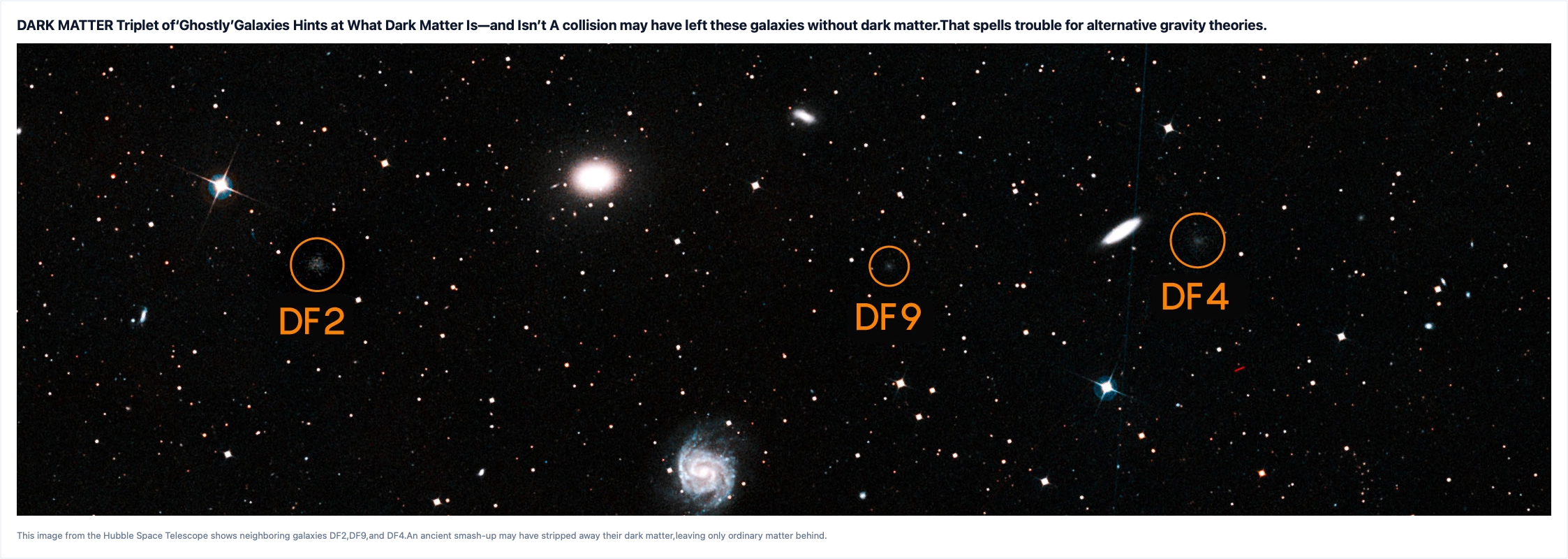
About 65 million light-years from Earth, astronomers have identified three bizarre, diffuse galaxies known as DF2, DF4, and DF9. While dark matter—which makes up 85% of all matter in the universe—normally acts as the invisible gravitational glue that holds galaxies together and enables star formation, mass estimates derived from tracking stellar motions at facilities like the Keck Observatory revealed a shocking anomaly. All three ghostly, dimly lit galaxies are nearly devoid of dark matter, consisting almost entirely of ordinary matter and sitting aligned as cosmic neighbors.
To explain how these rule-breaking galaxies formed, a June 2026 study published in The Astrophysical Journal proposed that an ancient head-on collision between two regular galaxies separated their components. Because dark matter only interacts via gravity, it experienced virtually no friction during the smash-up and rocketed straight through. Conversely, ordinary gas and dust—which interact through all four fundamental forces—became tangled and clumped together, leaving behind three dark matter-bereft galaxies struggling to form stars, though some researchers alternatively suggest a massive neighboring galaxy group may have stripped the dark matter away.
Ironically, the very absence of dark matter in this galactic trio provides compelling evidence that dark matter is a physical substance, dealing a severe blow to alternative gravity theories like Modified Newtonian Dynamics (MOND). Scientists emphasize that if the effects attributed to dark matter were merely a tweak to gravitational laws at large distances, those effects could not be physically segregated from ordinary matter. Alongside previous observations of the Bullet Cluster and LIGO's 2015 gravitational wave detections, DF2, DF4, and DF9 demonstrate that stripping away physical dark matter via cosmic collisions explains the universe far more accurately than attempting to turn off a law of nature.