过去一个多世纪以来,美国一直期望通过教育中国青年扩大自身影响力,但近年来其吸引力有所下降,在美中国留学生人数在2019年至2025年间骤降近三分之一,降至26.5万人。与此形成对照的是,中国领导人习近平展现出招揽外国学生的雄心,于9月24日提出希望在未来五年吸引10万名美国青年赴华访问或求学,这与2022年新冠疫情及两国关系低谷时期仅有350名留华美国学生的局面形成鲜明反差,官方媒体新华社亦称此类交流有助于打破“认知壁垒”。
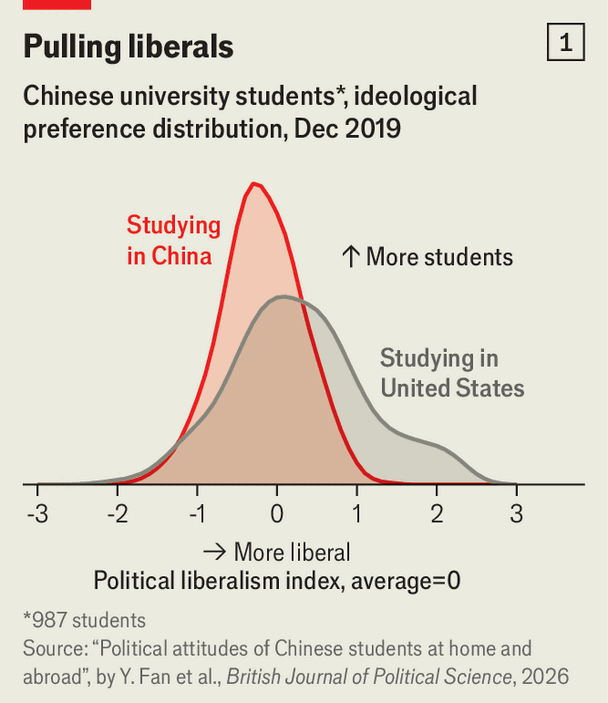
普林斯顿大学范英杰及其合作者自2019年起跟踪调查了近1000名中国大一新生,其中近400人在美留学,其余则作为对照组就读于中国公办高校。这项跨越四年的罕见实证研究表明,留学生的政治意识形态在美期间保持高度稳定,既未产生对西方自由主义的反弹,也未产生新的狂热。然而,选择赴美留学的群体在出国前就比国内同龄人明显更为自由派,他们更倾向支持自由市场,社会观念不那么保守,民族主义情绪也更弱;此外,海外女留学生比例较高且往往为逃避国内性别偏见而出国,也是观念差异的重要原因。
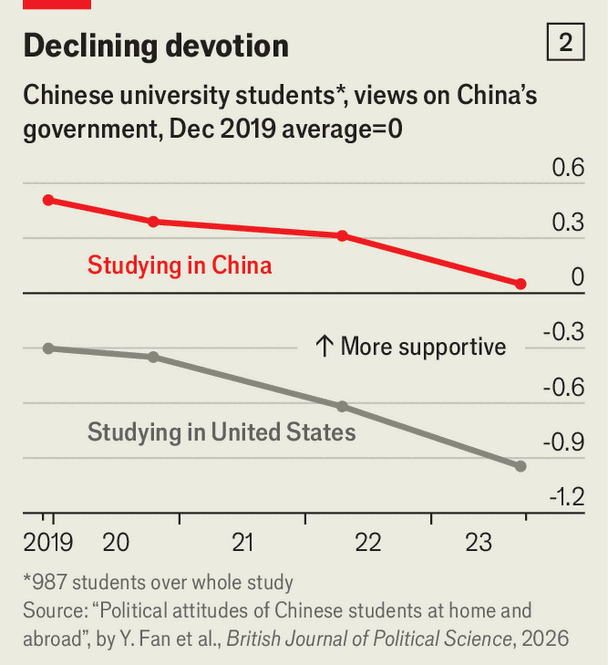
研究还显示,海外学子对中国共产党执政能力的评价显著动摇:留美学生的体制支持度起步更低,并在2020至2022年严苛的“动态清零”管控期间急剧下挫,其降幅远超国内大学同龄人。尽管西方基础设施的落后让部分习惯中国现代便利的学生产生落差,但面对国内激烈的职场竞争与青年高失业率,留美学生计划毕业后回国的比例从2020年的40%骤降至2023年的略高于10%。留学或许未能重塑两国的政治格局,却为中国青年提供了更多人生选择。
For more than a century, America sought to build moral and commercial influence by educating young Chinese, yet its hospitality has waned in recent years, causing Chinese enrollments in American universities to drop by nearly a third between 2019 and 2025 to 265,000. In contrast, Chinese leader Xi Jinping announced on September 24th an initiative aiming for 100,000 young Americans to visit or study in China over the next five years. This ambition represents a dramatic departure from 2022, when bilateral strains and the covid-19 pandemic reduced the count of resident American students in China to a mere 350, with state media Xinhua arguing that immersion dissolves cognitive barriers.
A landmark longitudinal study led by Fan Yingjie of Princeton tracked nearly 1,000 Chinese freshmen from 2019, comprising roughly 400 studying in America and a domestic public university control group. The findings revealed that students' core ideological inclinations remained remarkably stable throughout their stay abroad, exhibiting neither reactionary disillusionment nor newfound ideological zeal. However, those who elected to study in America were already demonstrably more liberal than their stay-at-home peers prior to departure, displaying greater support for free markets, lower social conservatism, and weaker nationalism, partly reflecting an overrepresentation of female students seeking escape from domestic gender biases.
While fundamental ideologies proved resistant to change, students' perceptions of the ruling party’s competence shifted markedly: starting from a lower baseline, overseas approval of the Chinese government plummeted during the draconian zero-covid lockdowns of 2020-22, dropping much faster than among domestic peers. Despite complaints that Western public amenities felt like a technological backwater compared with modern Chinese urban life, harsh workplace competition and soaring youth unemployment at home spurred a flight from returning: the share of Chinese students in America planning to return home after graduation collapsed from 40% in 2020 to just over 10% by 2023.
Source: Chinese students abroad are more liberal than at home
Subtitle: They see faults in China’s system as well as in democracies, surveys show
Dateline: Oct 1st 2026\n