在表面之下,多家公司录得双位数跌幅:CH Robinson 全周下跌 12%,且一度在 1 天内下挫约 15%;Charles Schwab 下跌 11%;CBRE 下跌 16%;Gallagher 下跌 13%;富时 100 的财富管理公司 St James’s Place 下跌 13%。一家位于佛罗里达、规模 3mn 美元的公司(前身为 Singing Machine、现为 Algorhythm Holdings)在宣称其 AI 平台可在不对应增加人力的情况下,将货运量扩大最多 400% 后,引发卡车运输股抛售,并使既有物流龙头蒸发数十亿市值。资金流向讯号也显示,软体板块几乎没有机构逢低买进,而资本转向硬体;Goldman Sachs 因此以多空配对交易回应,把较难自动化的软体与更暴露于 AI 替代风险的工作流程区分开来。
关键的市场型态是分化扩大:指数层级仅低个位数波动,但个股层级约有 11-16% 的震荡,且偶尔出现单日 15% 跌幅,显示不确定性溢价的重定价速度快于大盘基准所反映。软体股的估值压缩已经可见,例如本益比倍数从约 50x 降至 30x,但投资人对此是理性重置还是暂时过度反应仍有分歧。核心但书在于,AI 能力曲线与竞争护城河在即时状态下仍难以量化,因此即使少数人选择性捡便宜,许多经理人仍把风险控管放在反弹交易之前。
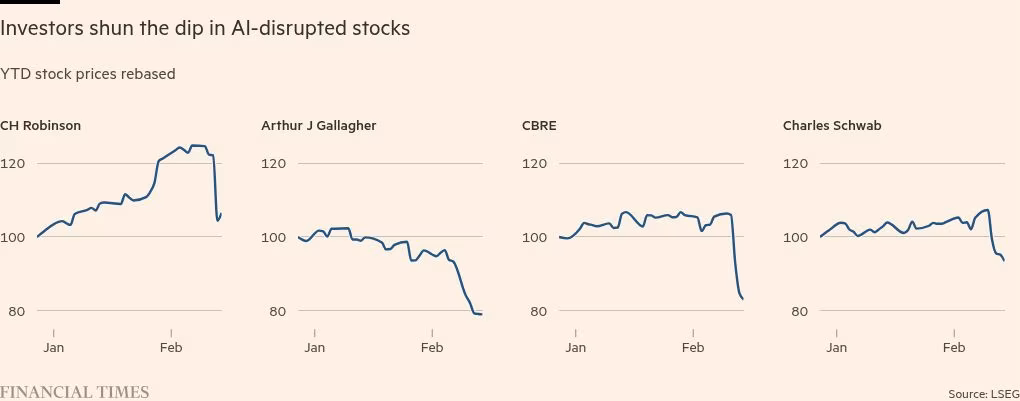
Investors are increasingly reluctant to buy sharp pullbacks in stocks seen as vulnerable to AI disruption, even after major declines, because model capabilities are improving quickly versus 6-12 months ago and visibility on business-model risk is low. In the latest week, headline indices looked moderate with the Nasdaq Composite down 2.1% and the S&P 500 down 1.4%, but those averages masked much steeper single-stock and sector shocks tied to fears of near-term AI displacement across trucking, wealth management, commercial real estate, insurance, and software.
Under the surface, several companies posted double-digit losses: CH Robinson fell 12% for the week and dropped about 15% in 1 day at one point, Charles Schwab fell 11%, CBRE lost 16%, Gallagher declined 13%, and FTSE 100 wealth manager St James’s Place dropped 13%. A $3mn Florida company, formerly Singing Machine and now Algorhythm Holdings, catalyzed a trucking rout after claiming its AI platform could scale freight volumes by up to 400% without matching headcount growth, wiping billions from established logistics names. Flow signals also showed little institutional dip-buying in software, while capital rotated toward hardware; Goldman Sachs responded with a long-short pair trade separating software considered hard to automate from workflows more exposed to AI substitution.
The key market pattern is widening dispersion: index-level moves in the low single digits versus stock-level swings of roughly 11-16% and occasional 15% single-day drops, indicating uncertainty premia are being repriced faster than broad benchmarks imply. Valuation compression is already visible in software, with examples of multiples moving from about 50x earnings to 30x, but investors disagree on whether this is rational reset or temporary overreaction. The central caveat is that AI capability curves and competitive moats remain hard to quantify in real time, so many managers prioritize risk control over bounce trading despite selective bargain-hunting by a minority.