2026年上半年,美国实际制造业产出按年率计算增长4.5%,创下自2011年以来的最快增速(剔除疫情后的反弹),供应管理协会(ISM)制造业采购经理人指数今年各月均显示扩张。唐纳德·特朗普将此归功于其关税政策,特别是对进口汽车和零部件征收25%的关税(并威胁自1月1日起对加拿大汽车加征至50%)。从2025年12月至2026年7月,美国汽车产量激增约9%,贡献了全部制造业增幅的约四分之一;福特、通用、本田和斯特兰蒂斯等车企也纷纷宣布将部分生产线转移至美国本土。
然而,制造业总产出的反弹并非主要由关税驱动,而是源于供应链修复及未受高关税保护的高科技行业繁荣。关税当前更多是在推高企业成本,通用汽车估计今年关税将造成25亿至35亿美元的损失。相反,受关税保护最弱的行业增长最为迅猛:得益于数据中心和能源基建需求,2025年12月至2026年7月半导体与电子元件产出增长超12%,冷却设备增长近4%,水泥增长近9%,数据中心建设贡献了上半年制造业增量的近三分之一。卡托研究所指出,航空和电子行业面临的实际关税税率低于5%,而受到重税保护的纺织和食品行业却几乎停滞不前。
在就业层面,特朗普所承诺的蓝领繁荣并未显现。今年前7个月制造业仅新增约3.1万个就业岗位,与2023年至2025年间流失的31.5万个工厂岗位相比微不足道。汽车行业就业增幅不足1%,芯片制造商甚至在产量大增的同时裁员,所有净增岗位几乎全由航空和AI基建行业贡献。现代制造业高度依赖自动化与机器人,且航空等高增长工厂中近60%的员工拥有本科以上学历,车间操作工仅占20%。这场复苏属于高科技与自动化资本,而非广大传统流水线工人。
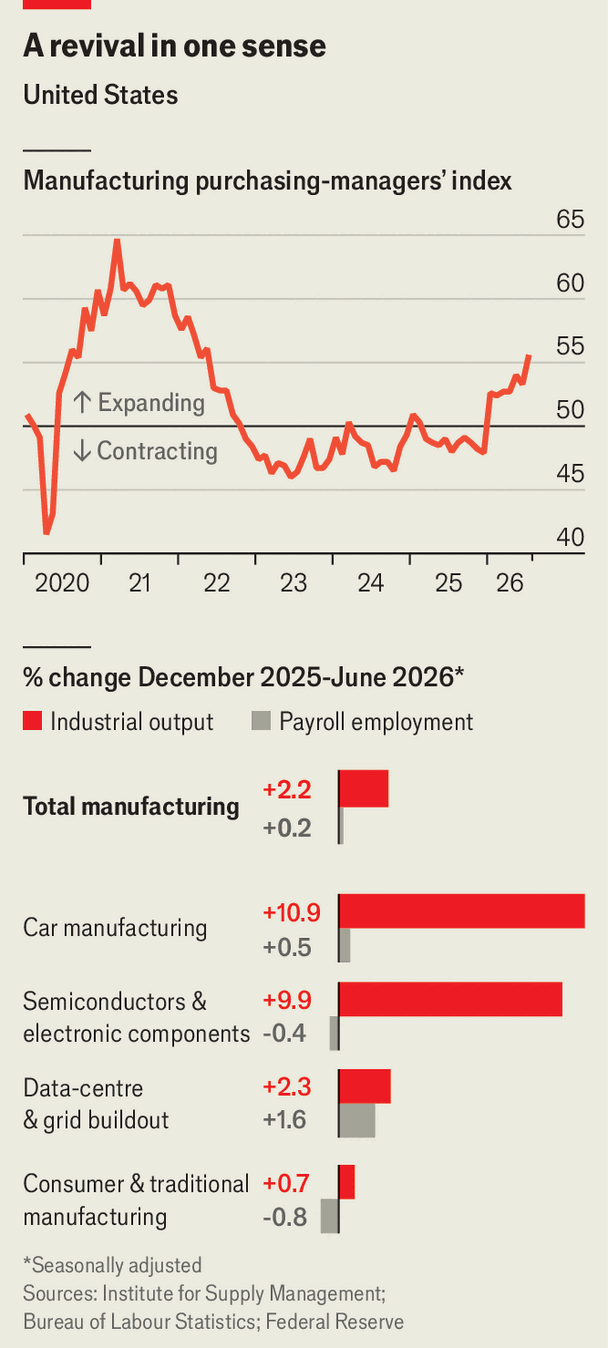
In the first half of 2026, real US manufacturing output grew at an annualized rate of 4.5%—its fastest pace since 2011, excluding post-pandemic rebounds—with the ISM purchasing managers' index signalling steady factory expansion. Donald Trump claims credit through his tariff regime, notably a 25% levy on imported automobiles and components, coupled with threats of 50% tariffs on Canadian imports starting January 1st. Between December 2025 and July 2026, domestic vehicle production jumped 9%, generating roughly a quarter of overall manufacturing growth as automakers like Ford, GM, Honda, and Stellantis announced production shifts to the United States.
However, this industrial rebound is largely decoupled from protectionist trade policies and stems instead from supply-chain normalization and an AI-driven infrastructure boom. Tariffs are primarily inflating costs; General Motors projects $2.5bn to $3.5bn in tariff-related expenses this year. Crucially, the strongest expansions have occurred in lightly protected sectors: output of semiconductors and electronics rose over 12%, cooling equipment nearly 4%, and cement nearly 9%, with data center buildouts driving almost a third of total H1 2026 output growth. According to the Cato Institute, aerospace and electronics face effective tariff rates below 5%, whereas heavily tariffed traditional sectors like textiles and food remain stagnant.
On the employment front, the promised blue-collar jobs renaissance remains largely absent. Manufacturing payrolls added merely 31,000 jobs in the first seven months of the year, a tiny fraction of the 315,000 factory jobs lost between 2023 and 2025. Auto employment rose by under 1%, while chipmakers cut headcount despite surging output. The modest job gains are concentrated in high-skilled aerospace and tech infrastructure, where nearly 60% of workers hold bachelor’s degrees and floor workers comprise only 20%. Driven by extensive robotics and automation, the current manufacturing revival is creating demand for engineers rather than assembly-line laborers.
Source: Does Donald Trump deserve credit for a manufacturing revival?
Subtitle: Assessing the president’s promise to bring back factory jobs
Dateline: Aug 27th 2026