长期以来,英语圈国家一直将购置房产视为积累财富的核心途径。在英国,到退休年龄时房主平均比租房者富有近80万英镑(约110万美元),房产贡献了近半数差距;在澳大利亚,约七分之一的纳税人拥有投资性房产。然而,经通胀调整后的房价仍处于历史高位附近,导致购房门槛奇高,爱尔兰有五分之三的18至34岁青年只能与父母同住。高利率打压下房产投资吸引力骤降,财富增量正迅速转向股票市场。麦肯锡全球研究院数据显示,在2025年全球家庭新增的40万亿美元财富中,股票贡献了57%,房产仅贡献15%,彻底逆转了此前25年间房产占比52%、股票占比26%的长期格局。
美国在这场资产大重组中尤为突出。高盛计算显示,今年7月股票在美国个人家庭财富中的比重自第二次世界大战以来首次超越房产。面对高不可攀的房价,年轻一代投资股票的浪潮尤为凶猛,摩根大通发现2015至2024年间开设投资账户的25岁群体比例激增了六倍。资产收益预期的分化进一步加速了资金转向:穆迪分析预计,美国2026至2035年年均房价涨幅将从过去十年的约5%放缓至2.1%;英格兰房屋经实际通胀调整后的平均价值甚至低于20年前。与此同时,企业股权市值与净资产账面价值之比创下历史新高,比互联网泡沫时期的峰值还高出50%。
政策层面的转向同样削弱了房产的投机吸引力。各国政府正逐步取消推高房价的税收优惠与补贴政策,例如英国在5月推出了保护租客的新法规以遏制竞价抢房与无过错驱逐,加拿大在2023年实施的外资购房禁令则将持续至2027年。受此影响,英国个人购房出租类房东正以创纪录速度抛售房产,多伦多公寓销量崩跌,美国炒房交易数量与利润率双双跳水。这一深刻的结构性调整降低了类似2008年式房地产金融海啸的系统性风险,同时也标志着年轻一代财富观念的重构:在目睹砖瓦难以企及后,他们正将金融资产视为实现未来财务安全的新基石。
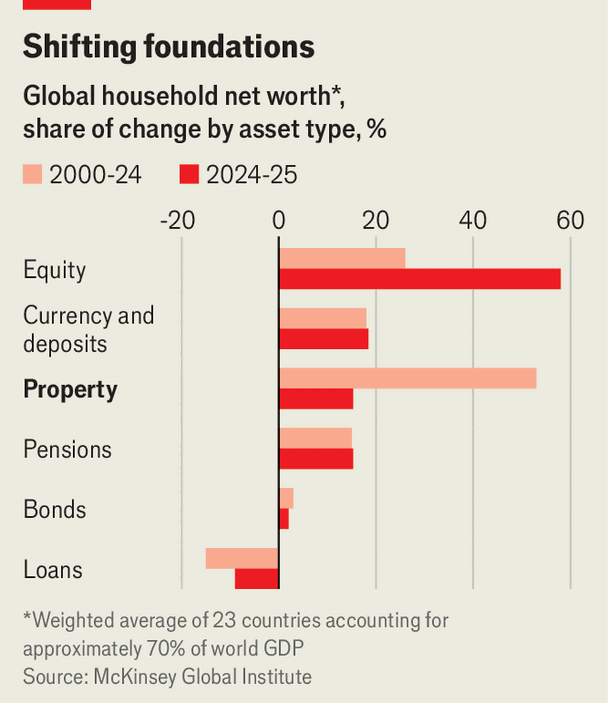
For decades across the Anglosphere, homeownership represented the primary engine of personal wealth generation. In Britain, lenders estimate homeowners are nearly £800,000 ($1.1m) wealthier than renters by retirement age, with housing driving half that disparity, while one in seven Australian taxpayers owns an investment property. Yet with real home prices lingering near record highs, affordability has evaporated: in Ireland, three-fifths of young adults aged 18 to 34 now live with their parents. As higher interest rates dampen housing appreciation, the McKinsey Global Institute reports that of the $40trn added to global household wealth in 2025, 57% came from equities and only 15% from property, dramatically reversing the previous 25-year trend where housing contributed 52% and equities 26%.
The shift is most pronounced in the United States, where Goldman Sachs calculated that stocks overtook residential real estate as a share of household balance sheets in July for the first time since the second world war. Priced out of physical housing, the share of 25-year-olds holding investment accounts expanded sixfold between 2015 and 2024 according to JPMorgan Chase. Asset momentum supports this divergence: Moody’s Analytics forecasts American annual home-price growth slowing to 2.1% over 2026-2035 from roughly 5% over the prior decade, while real home values in England sit below levels from two decades ago. Conversely, corporate market equity to net book value ratios have hit record highs, topping dotcom-era peaks by 50%.
Shifting regulatory frameworks are compounding this retreat from speculative real estate. Authorities are dismantling tax incentives, exemplified by Britain introducing sweeping renter protections in May against bidding wars and no-fault evictions, alongside Canada enforcing a foreign-buyer ban spanning 2023 to 2027. Consequently, British buy-to-let landlords are liquidating portfolios at historic rates, Toronto condominium transactions have crashed, and American house-flipping volumes and margins have slumped. While reducing vulnerability to 2008-style property collapses, this structural transition cements an ideological evolution among younger generations who now view liquid capital markets rather than bricks and mortar as their essential vehicle for long-term prosperity.
Source: Why shares are the new bricks and mortar
Subtitle: Household wealth is flowing from property to stocks
Dateline: Oct 8th 2026\n