在3月,卫星被用于重点拍摄Prince Sultan Air Base(沙特)3月13日至15日;美国总统Donald Trump在3月14日确认该基地有5架美国空军加油机受损。监视范围还覆盖了约旦Muwaffaq Salti、巴林Manama附近美军第五舰队海军基地、伊拉克Erbil机场、科威特Camp Buehring与Ali Al Salem、吉布提Camp Lemonnier、阿曼Duqm机场等军事目标,同时观察了阿联酋Khor Fakkan集装箱港、Qidfa电力与海水淡化设施、巴林Alba铝冶炼设施等民用基础设施。专家由此认为IRGC可提前锁定目标并在袭击后快速评估毁伤,从而实现“先侦察、后打击、再复核”的作战闭环。
TEE-01B的成像能力约为0.5米分辨率,可识别飞机、车辆和基地活动变化;这一指标相比IRGC此前自有Noor-3的约5米分辨率、Noor-2的12–15米分辨率高出一个量级,说明其情报价值是“质的跃升”。2024年9月的合同金额约为RMB 2.5亿(约3,660万美元),涵盖卫星、运载、技术支持、数据基础设施及“foreign counterparty”服务,由此推算其为持续作战体系投入的资本与技术门槛明显抬高。分析人士将此解读为“分散部署”策略:伊朗地面站曾在2025和2026年被命中,而中国端分布式控制网络相对难以全部摧毁。更广义看,文章强调中伊俄合作背景下的军民两用边界持续模糊,以及美国对中国提供与中东作战相关卫星能力持续关注。
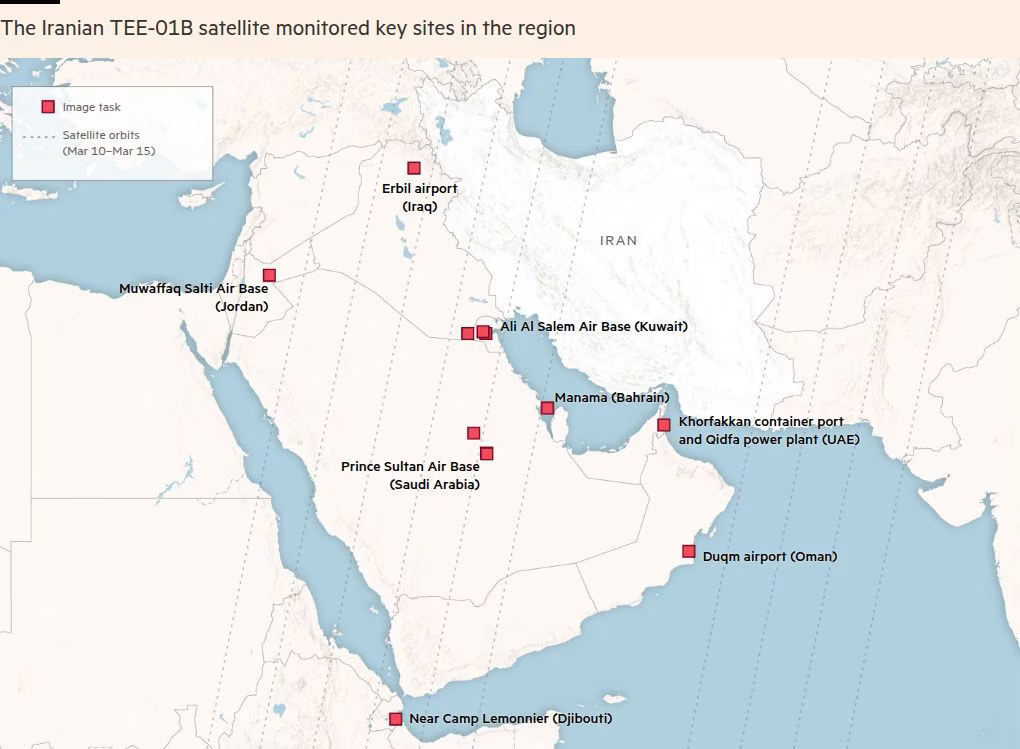
Leaked documents reviewed by the Financial Times indicate that the IRGC Aerospace Force acquired the Chinese-built satellite TEE-01B in late 2024 and used it during the March campaign as a recurring targeting and battle-assessment asset. The satellite was built and launched by Earth Eye Co from China, then transferred through an in-orbit model; Emposat provided ground-station services in multiple regions. With timestamped coordinates and orbit checks, the recorded passes aligned with attack timings, indicating operational reconnaissance rather than nominal civilian use.
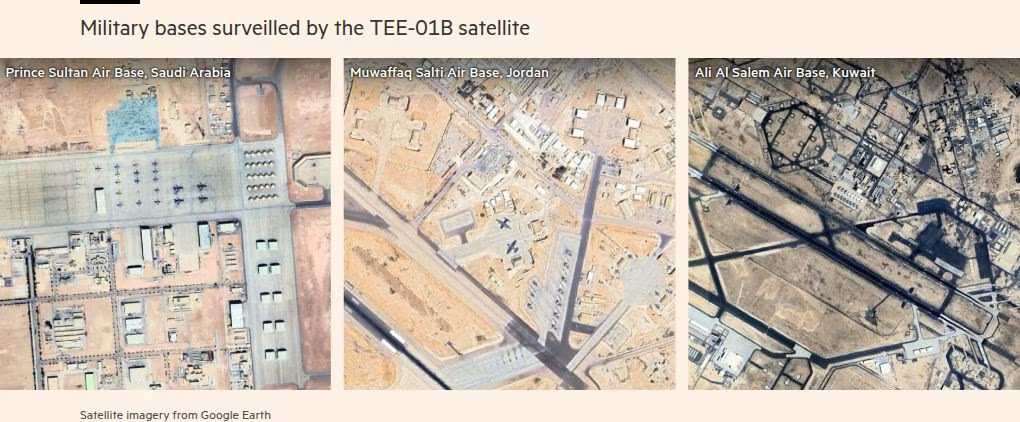
In March, TEE-01B monitored Prince Sultan Air Base on March 13, 14 and 15, and the U.S. side later confirmed that five U.S. Air Force refuelling aircraft were damaged on March 14. It also covered Muwaffaq Salti (Jordan), the area near the U.S. Fifth Fleet in Manama, Erbil airport (Iraq), Camp Buehring and Ali Al Salem in Kuwait, Camp Lemonnier in Djibouti, and Duqm airport in Oman, plus civilian nodes such as Khor Fakkan port, the Qidfa power/desalination plant, and the Alba aluminium plant. Experts said this enabled target pre-selection and post-strike verification, consistent with a surveillance-to-strike feedback cycle.
TEE-01B delivers about 0.5-metre imagery, significantly better than Noor-3 at roughly 5 metres and Noor-2 at 12–15 metres, enabling recognition of aircraft, vehicles, and infrastructure activity. In September 2024 the IRGC signed a contract of about RMB250 million (~US$36.6 million) for the system, launcher, technical support, and data services. The arrangement supports distributed control through Emposat’s software and network rather than only domestic Iranian facilities, which had reportedly been vulnerable in 2025 and 2026. The report frames the case as part of broader China-Iran/Russia-linked military-civilian integration and sustained U.S. concern over Chinese-enabled intelligence channels.