该文章发表于2026年1月7日,讨论不同人工智能模型是否在内部表示上趋于一致。研究背景指出,人类能够跨情境形成统一概念,而AI模型通常在单一数据类型上训练。近年来,多项研究发现,即使训练数据类型不同,不同模型仍可能形成相似的内部表示,并且随着模型能力提升,这种相似性在统计上呈增强趋势。2024年,麻省理工学院的四位研究者正式提出“柏拉图式表征假说”,认为这种趋同并非偶然,而是系统性现象。
该假说借鉴了柏拉图距今约2400年的洞穴寓言,但采用更技术化的解释:现实世界通过数据流投射“阴影”,而模型仅接触这些数据。研究者主张,不同模型在仅接触各自数据流的条件下,正在收敛到对同一现实世界的共享表征。支持者认为,这是因为所有模型面对的是同一统计结构的世界;反对者则指出,缺乏统一标准来选择、定位和比较跨模型的“代表性”内部表征,使该假说难以验证。
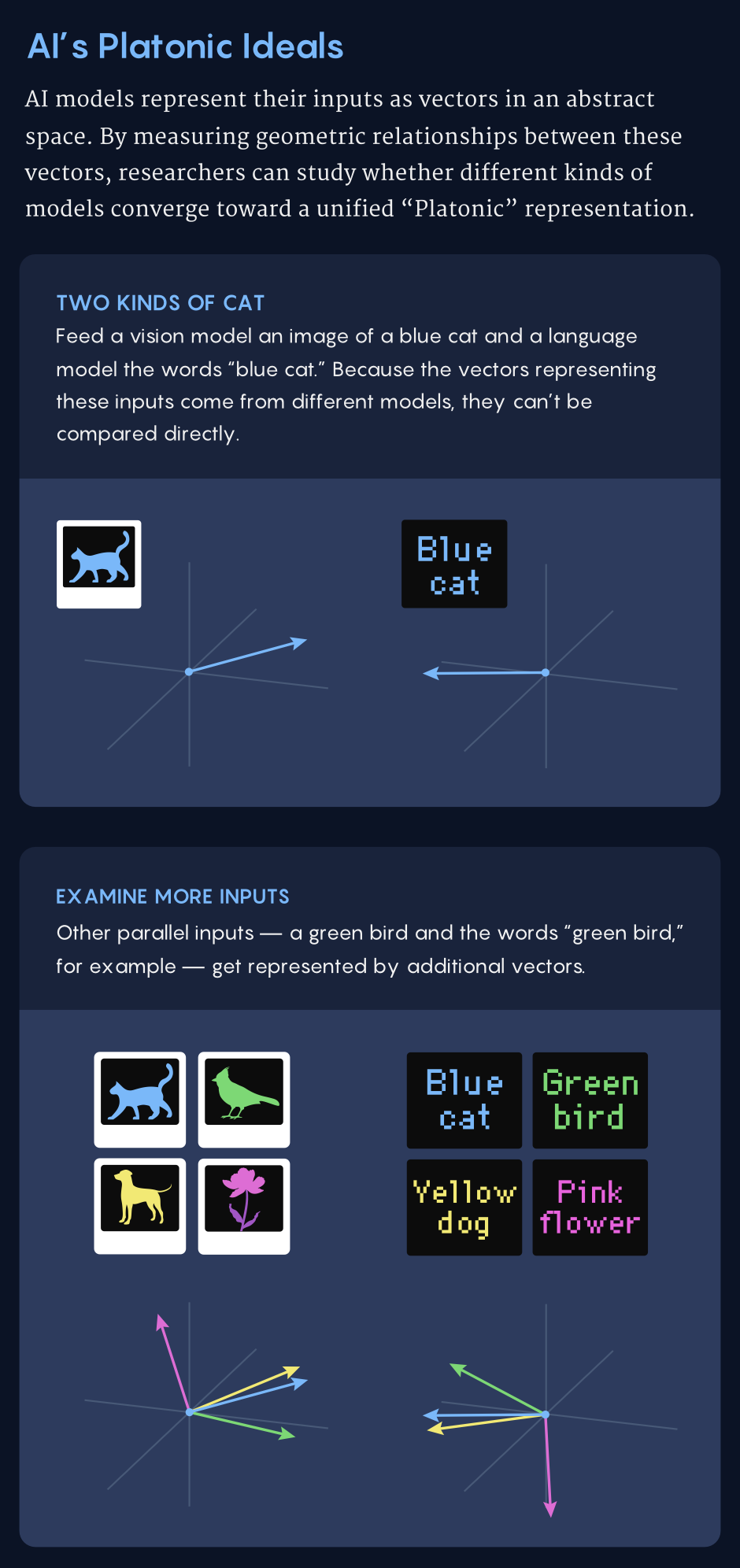
在方法层面,研究聚焦神经网络中的数值表示。每一层包含成千上万个神经元,其激活状态可表示为高维向量。向量方向的接近程度量化了表示相似性,这一思想可追溯到60多年前的分布语义学原则。由于不同模型的向量空间不可直接对齐,研究者转而比较“相似性的相似性”,即不同模型在同一输入集合上形成的向量簇形状是否一致,从而间接评估跨模型的表征趋同。
The article, published on January 7, 2026, examines whether different artificial intelligence models converge on similar internal representations. It contrasts human concept formation with AI systems trained on single data types and notes accumulating evidence that distinct models can develop similar representations. Several studies report that this similarity increases statistically as model capability grows. In 2024, four researchers at the Massachusetts Institute of Technology proposed the Platonic representation hypothesis, arguing that such convergence is systematic rather than accidental.
The hypothesis draws on Plato’s roughly 2,400-year-old cave allegory but reframes it technically: the real world projects data streams as shadows, and models access only those streams. The claim is that diverse models, despite differing inputs, are converging on a shared representation of the same underlying world. Proponents argue this follows from exposure to identical statistical structure, while critics emphasize the lack of agreed criteria for selecting, locating, and comparing “representative” internal states across models.
Methodologically, the research focuses on numerical representations in neural networks. Each layer contains many thousands of neurons, whose activations form high-dimensional vectors. Similarity is quantified by the alignment of vector directions, an idea aligned with distributional semantics articulated more than 60 years ago. Because vector spaces across models cannot be directly matched, researchers compare second-order structure by assessing whether models produce similarly shaped clusters for the same input sets, indirectly measuring representational convergence.