高层主管与劳动专家表示,AI agents 目前已能处理一些过去只留给入门级员工的任务,例如以初级开发者水平写程式码或评估销售潜在客户,但在判断、情境理解和基于经验的决策上仍然吃力。Oliver Wyman Forum 的 John Romeo 说,初级求职者发现进入劳动市场越来越困难,而公司则愈来愈需要能提升生产力的中级与资深员工。这项调查也与 Harvard University 的一项研究一致:采用生成式 AI 的企业削减了初级职位,同时让资深就业大致保持稳定;Helen Leis 也警告说,如果现在跳过聘用年轻人,未来可能会出现有经验劳工短缺。
这一趋势并非普遍适用:IBM 在 2 月表示,今年将把美国的入门级招聘规模增加到 3 倍,并为 AI 时代重写职位说明,显示仍有一些公司认为培养新员工管道有其价值。不过,文中引述的 Stanford 研究发现,在最受 AI 影响的领域,年轻劳工失业的可能性高出 16%,这强化了对初级就业的风险。即便如此,AI 也不能保证年长员工的安全,Teresa Ghilarducci 指出,企业对员工的承诺整体正在减弱,这意味著向资深人才倾斜的转变可能只是暂时的或不均衡的,而不是广泛的稳定承诺。
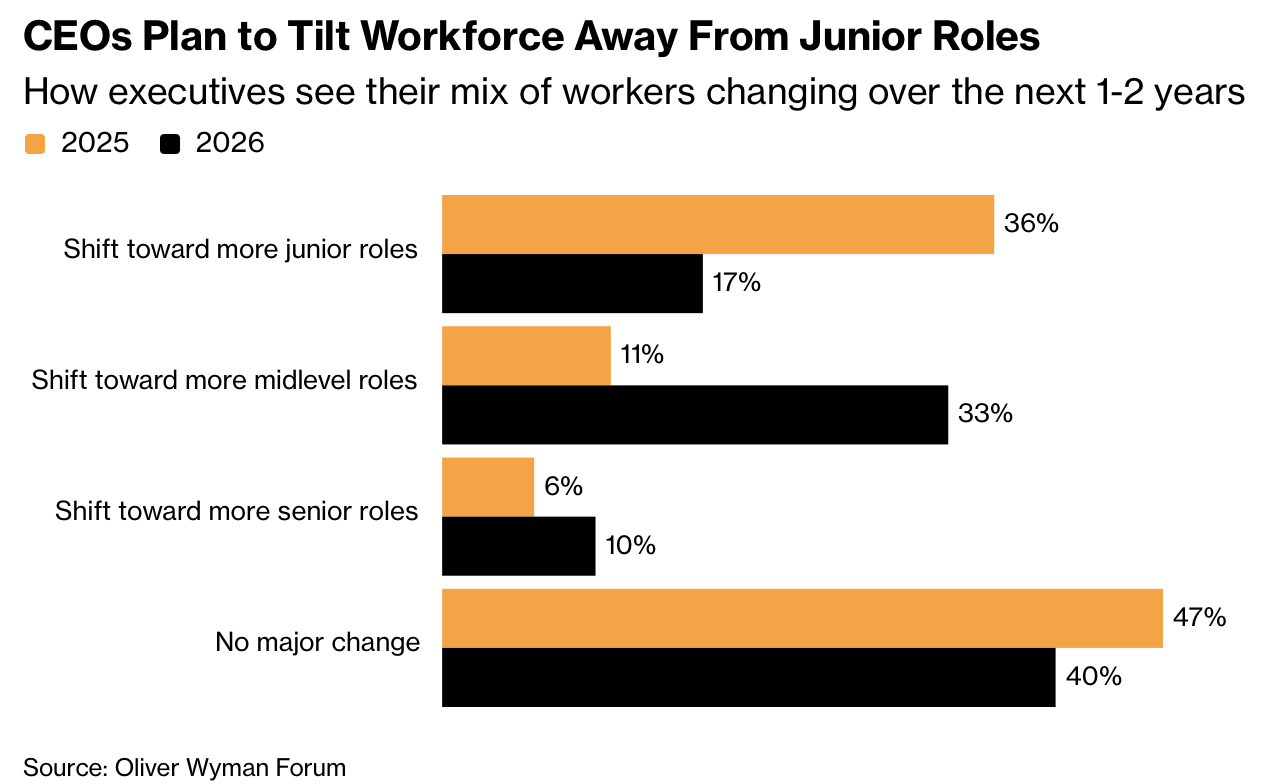
A new global survey of CEOs suggests artificial intelligence may change how companies cut and hire workers, but not in the usual way that layoffs hit older staff hardest. More than 40% of CEOs plan to reduce junior roles over the next 1 to 2 years and shift toward mid-level or senior employees, while only 17% expect junior roles to become a larger share of the workforce. That is essentially the reverse of the pattern seen just 1 year earlier, according to Oliver Wyman.
Executives and labor experts say AI agents can already handle tasks once reserved for entry-level workers, such as writing code at a junior-developer level or evaluating sales leads, while still struggling with judgment, context, and experience-based decision-making. John Romeo of the Oliver Wyman Forum said junior candidates are finding it harder to enter the labor market, while companies increasingly want mid- and senior-level employees who can drive productivity. The survey aligns with a Harvard University study finding that firms adopting generative AI have cut junior positions while keeping senior employment largely stable, and Helen Leis warned that skipping younger hires now could create a future shortage of experienced workers.
The trend is not universal: IBM said in February it would triple entry-level hiring in the US this year and rewrite job descriptions for the AI era, suggesting some firms still see value in building a pipeline of new workers. But Stanford research cited in the article found that young workers were 16% more likely to lose their jobs in the most AI-exposed fields, reinforcing the risk to junior employment. Even so, AI does not guarantee security for older employees, and Teresa Ghilarducci noted that firms’ commitment to workers is weakening overall, meaning the shift toward senior talent may be temporary or uneven rather than a broad promise of stability.