在德国西南部施瓦本汝拉山脉的洞穴中,距今43,000至34,000年的人群留下了带有几何“符号”的工具、珠饰、长笛和微型雕像。研究者将260件器物上的符号序列数字化,并用语言学与机器学习方法提取其频率与重复模式的统计指纹。
该团队又将这些结果与89种现代语言、16种文字系统,以及约公元前3300年起源的原始楔形文字三个时期样本进行对照。洞穴符号与现代书写差异显著,表现为更高重复和更低信息密度,但其统计特征与最早原始楔形文字存在显著重叠,且这种相似性高于后者与现代书写之间的相似性。
这些比对表明,人类刻画系统的复杂度在数万年间大致保持稳定,随后在数百年内迅速跃迁到真正的书写系统。作为功能线索,点状符号出现在狮子和人形雕像上而不见于工具,且象牙雕像的信息密度最高,显示符号使用具有对象差异和系统性但尚未被完全释义。
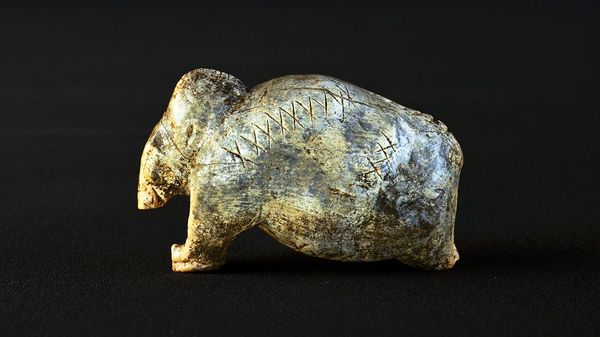
In caves of the Swabian Jura in southwest Germany, people living between 43,000 and 34,000 years ago left tools, jewelry, flutes, and figurines marked with geometric “signs.” The researchers digitized sign sequences on 260 artifacts and used linguistic and machine-learning methods to extract statistical fingerprints of frequency and recurrence.
They then benchmarked those results against 89 modern languages in 16 scripts and samples from three eras of proto-cuneiform, which originated around 3300BC. The cave signs differ sharply from modern writing by showing higher repetition and lower information density, yet their fingerprint significantly overlaps with the earliest proto-cuneiform and is more similar to it than proto-cuneiform is to modern writing.
These comparisons indicate that the complexity of human marking systems stayed roughly stable for tens of thousands of years, then shifted rapidly to true writing within a few centuries. As functional clues, dots appear on lion and human figurines but not on tools, and ivory figurines are the most information-dense, suggesting systematic, object-specific use whose exact meaning remains unresolved.
Source: Marks left by Stone Age humans were surprisingly complex
Subtitle: Their information density rivals the immediate predecessors of writing
Dateline: 2月 26, 2026 08:32 上午