天文学家利用詹姆斯·韦伯太空望远镜(Webb)与史匹哲太空望远镜的观测数据,针对极度罕见的「极端岩屑盘」展开深入研究。这类恒星系统靠近恒星处聚集了异常大量的温暖微细尘埃,且呈现出不规则的红外亮度变化,代表著类似早期太阳系中火星大小天体撞击原地球产生月球时的毁灭性剧烈碰撞现象。
研究团队分析矿物成分后,将这21个极端岩屑盘分为「富含二氧化矽」与「贫二氧化矽」两类。约三分之一的系统富含二氧化矽,仅出现在年龄低于3亿年的年轻恒星周围,源自火星大小天体的高能毁灭性撞击;其余三分之二则贫二氧化矽,分布于更广泛的恒星年龄层,可能由月球大小天体的擦撞或多重碰撞所产生。
这项发现为太阳系的演化历程提供了重要线索。富含二氧化矽的岩屑盘对应了类地行星在数亿年内成形的时期,与地月系统形成的剧烈碰撞历史高度吻合;而年代较老、贫二氧化矽的岩屑盘及其亮度变化,则可能反映了巨行星轨道迁移引发的小天体轨道扰动,与太阳系晚期重大撞击事件(Late Heavy Bombardment)的假说相符。
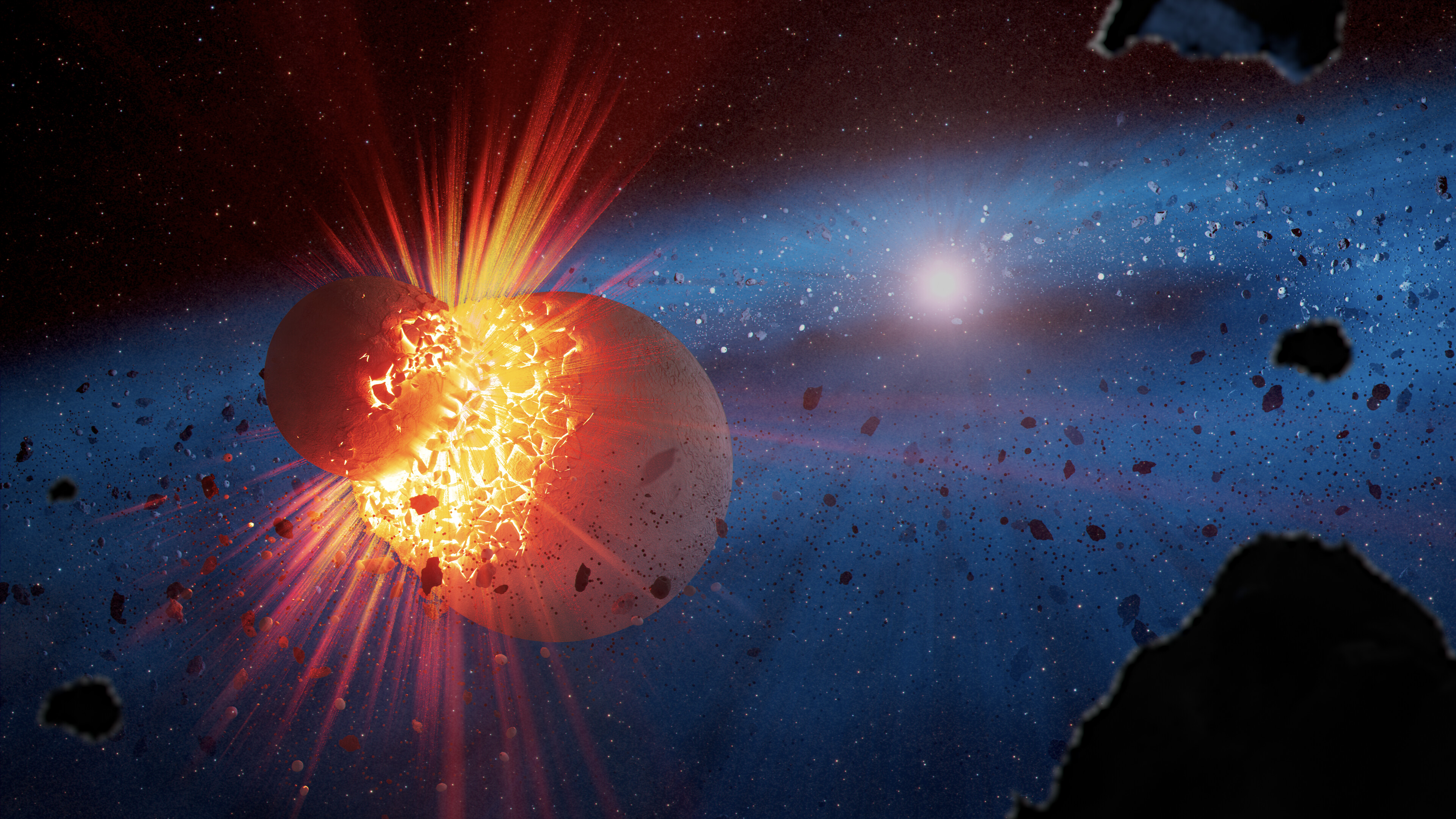
Astronomers utilized data from the James Webb Space Telescope (Webb) and the Spitzer Space Telescope to study extremely rare 'extreme debris discs.' These systems harbor unusually large amounts of warm, fine dust close to their stars along with irregular brightness variations, signaling catastrophic planetary collisions akin to the impact between the infant Earth and a Mars-sized object that formed the Moon.
By analyzing their mineralogical makeup, the team classified the 21 extreme debris discs into silica-rich and silica-poor categories. Roughly one-third are silica-rich, observed exclusively around stars younger than 300 million years and resulting from energetic collisions between Mars-sized bodies, while the remaining two-thirds are silica-poor, spanning a broader age range and arising from smaller-scale grazing or multiple impacts among Moon-sized objects.
These findings offer valuable insights into our own Solar System's evolutionary history. The younger silica-rich discs align with the timeframe for terrestrial planet assembly and the giant impact that formed the Moon, whereas the older silica-poor systems and their orbital instabilities support the Late Heavy Bombardment hypothesis, where migrating giant planets perturbed smaller bodies and triggered widespread collisions.