随着地缘政治不确定性加剧,西方盟国政府正加速推动公共采购的去美国化。例如德国石勒苏益格-荷尔斯泰因州在过去两年中已将约3万名公务员从微软协作工具迁移至开源替代方案,并正逐步转向Linux操作系统。国际刑事法院检察官邮箱受阻、美国政府强制AI机构Anthropic暂停海外访问以及多次暂缓对乌军援等事件,加剧了欧洲各国对美制技术“断供”风险的担忧。为此,欧盟委员会于6月公布了旨在加强“技术主权”的战略方案,西班牙去年取消了洛克希德·马丁F-35战机的订单,而英国政界亦呼吁终止与美国大数据企业Palantir的国民医疗服务合同。
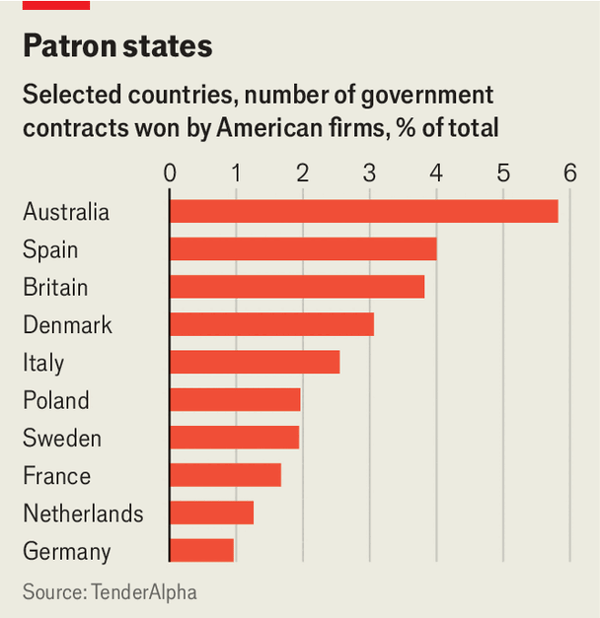
在总量层面上,美国企业在外国政府支出中所占份额看似有限。据《经济学人》测算,在去年美国上市企业25万亿美元的总销售额中,外国政府采购贡献了约5000亿美元(占比2%),相当于美国以外经合组织(OECD)国家政府总采购额的约7%。以合同数量计,澳大利亚(6%)和英国(4%)对美企依赖度较高,而法国(2%)和德国(1%)相对较低。然而,外国政府向美企采购的业务中约有五分之二高度集中于信息技术与国防等核心战略领域,包括云计算、企业级软件及前沿防空武器系统。
摆脱对美依赖面临巨大的技术劣势与高昂的转换成本。Alphabet、亚马逊与微软合计控制了全球三分之二的云计算市场,欧洲最大的云服务商法国OVHcloud的营收仅为亚马逊AWS的百分之一左右,且其底层依然依赖博通旗下的VMware软件。在军工与医疗领域,放弃F-35转向欧洲战机或更换医院患者数据库系统均涉及庞大的重组开支。与此同时,跨国供应链也存在深度的反向依赖:美国联邦政府广泛使用德国SAP软件,F-35后机身由英国BAE系统制造,而尖端云端芯片则高度依赖台湾台积电制造及荷兰阿斯麦(ASML)的光刻设备。
Spurred by geopolitical uncertainty and fear of potential technological embargoes, allied governments are accelerating initiatives to reduce dependence on American technology suppliers. In Germany's Schleswig-Holstein state, approximately 30,000 civil servants have migrated from Microsoft tools to open-source alternatives over the past two years, with plans to adopt Linux. Heightened friction—including the temporary restriction of Anthropic AI models abroad and paused US military aid to Ukraine—has intensified sovereign autonomy pushes. Consequently, the European Commission unveiled a technological sovereignty roadmap in June, Spain cancelled orders for Lockheed Martin F-35 fighter jets, and British lawmakers are demanding the termination of Palantir's NHS data contract.
In macroeconomic terms, American firms capture a relatively small slice of overall public procurement abroad. Out of $25trn in total revenue generated by listed US companies last year, foreign governments accounted for roughly $500bn (2%), representing approximately 7% of total procurement across non-US OECD nations. By contract volume, Australia (6%) and Britain (4%) show greater reliance than France (2%) and Germany (1%). However, about two-fifths of this foreign government spending is concentrated in critical information technology and defence segments, where American enterprise software vendors occupy between seven and nine of the top ten global market positions.
Transitioning away from American suppliers remains exceptionally difficult due to scale advantages and steep switching costs. Alphabet, Amazon, and Microsoft command two-thirds of the global cloud computing market, whereas Europe’s largest provider, France's OVHcloud, generates merely one-hundredth of AWS’s revenue and still relies internally on Broadcom's VMware software. Similarly, replacing F-35 fighter fleets or hospital database architectures entails immense operational costs, leading nations like Norway to maintain contracts with US healthcare software provider Epic. Nevertheless, mutual supply chain dependencies remain profound: the US federal government relies heavily on Germany's SAP, BAE Systems manufactures F-35 rear fuselages in Britain, and critical chips depend on TSMC fabrication and ASML lithography tools.
Source: America Inc has a tight grip on allied governments
Subtitle: Companies from Palantir to Lockheed account for a small share of spending, but are hard to shake
Dateline: 8月 20, 2026 03:30 上午