影像显示两道快速的极向光束切穿较早、较慢的同心尘埃弧,这种运动学对比支持多次喷发,而非单一爆发事件。形成这种几何结构的尘埃盘仅在几百年前被抛出,而整个前行星状阶段只持续几千年,因此该系统保留了异常新鲜的动力学证据。弧与瓣的形态规整性暗示至少有 1 颗隐藏伴星以重力进行塑形,而哈伯的解析度可进行跨时期的直接结构比较。
证据品质来自跨越数十年的成像时间线:1997 的可见光与近红外覆盖、2003 更广视野的 ACS 观测、2012 的高细节 WFC3 资料,以及 2026 将新观测加入既有资料集的合成影像。这为细尺度变化追踪建立了超过 10 years 的基线,并有助于为类似外流建立校准更佳的演化模型。更广泛的意涵涉及化学与行星形成:此类恒星产生的富碳尘埃会播种后续系统,而地球约在 4.5 billion years ago 形成;该研究也利用了哈伯超过 35 years 的运行时长,这是长期天体物理监测中的关键统计优势。
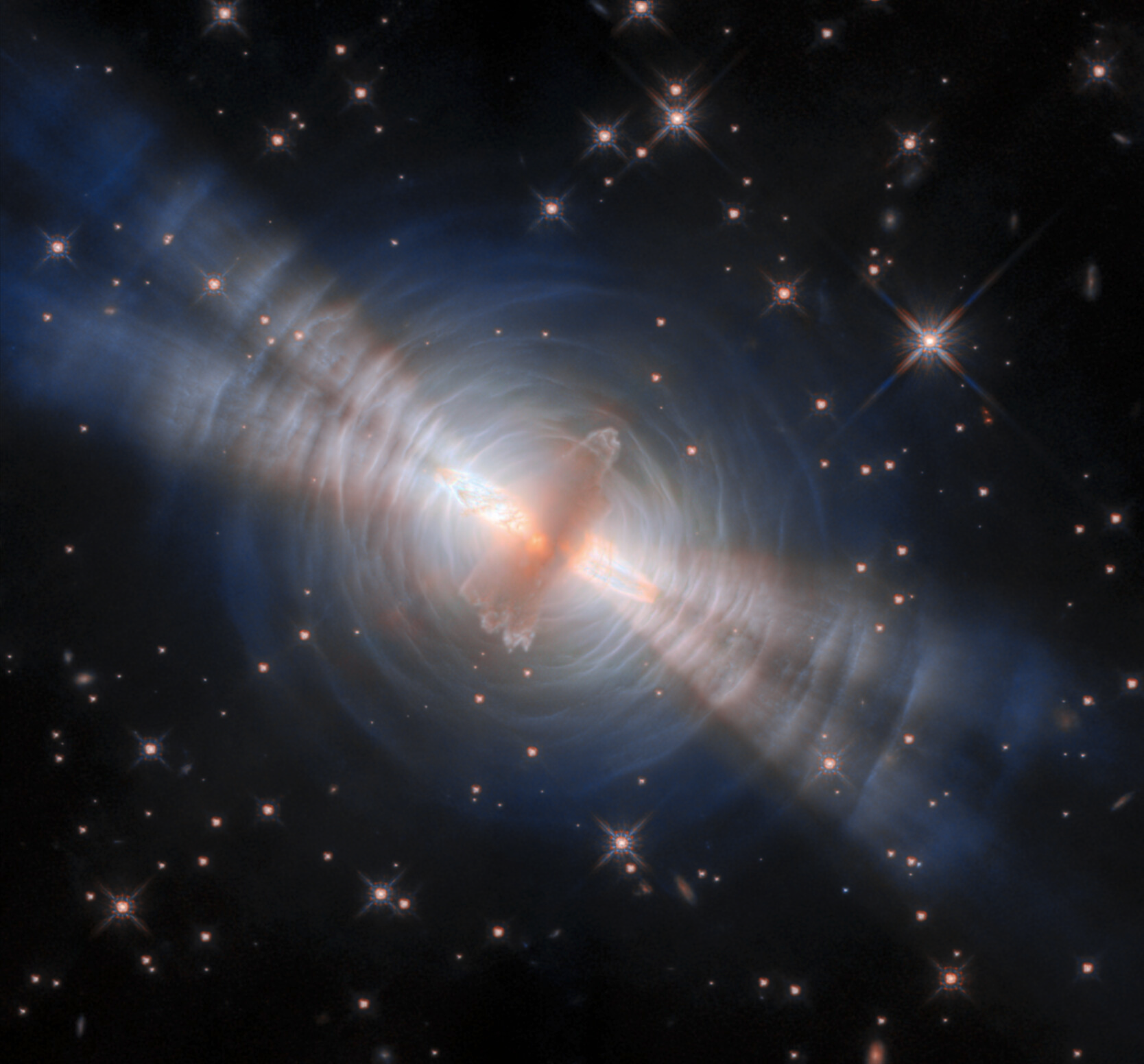
On 10 February 2026, ESA/NASA released a new Hubble image of the Egg Nebula (CRL 2688), a pre-planetary nebula about 1,000 light-years away in Cygnus, highlighting one of the youngest and closest known examples of this short-lived stellar phase. The central dying Sun-like star is hidden behind dense dust, while reflected light escapes through polar openings, making the object a rare laboratory for observing how stellar mass loss is structured before full planetary-nebula ionization begins.
The image shows twin fast polar beams cutting through older, slower concentric dust arcs, a kinematic contrast that supports multi-episode ejection rather than a single explosive event. The dusty disc feeding this geometry was expelled only a few hundred years ago, and the overall pre-planetary interval lasts just a few thousand years, so the system preserves unusually fresh dynamical evidence. Morphological regularity in the arcs and lobes suggests gravitational shaping by at least 1 hidden companion star, with Hubble’s resolution enabling direct epoch-to-epoch structural comparisons.
Evidence quality comes from a multi-decade imaging timeline: visible and near-infrared coverage in 1997, a broader ACS view in 2003, detailed WFC3 data in 2012, and the 2026 composite that adds new observations to earlier datasets. This creates a baseline of more than 10 years for fine-scale change tracking and contributes to better-calibrated evolution models for similar outflows. The broader implication is chemical and planetary: carbon-rich dust from such stars seeds later systems, while Earth formed about 4.5 billion years ago; the study also leverages Hubble’s operational span of over 35 years, a key statistical advantage for long-term astrophysical monitoring.