研究人员利用近红外干涉技术,对2021年观测到的两次新星爆发早期阶段进行了高分辨率成像,首次直接捕捉到爆发后数天内的结构演化。观测对象包括V1674 Herculis和V1405 Cassiopeiae,结果显示新星并非一次性、各向同性爆炸,而是涉及多股物质的复杂释放过程。这些成像突破了以往只能通过间接推断理解早期喷发阶段的限制。
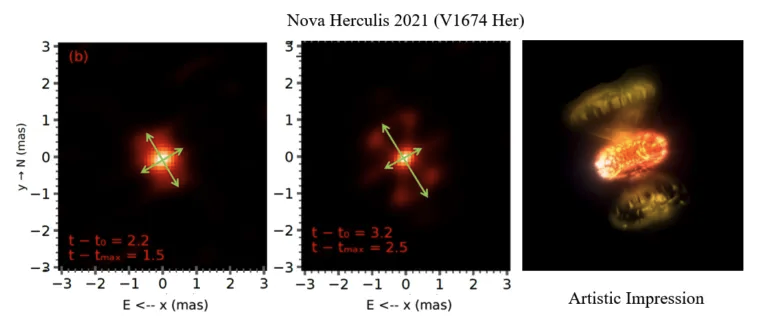
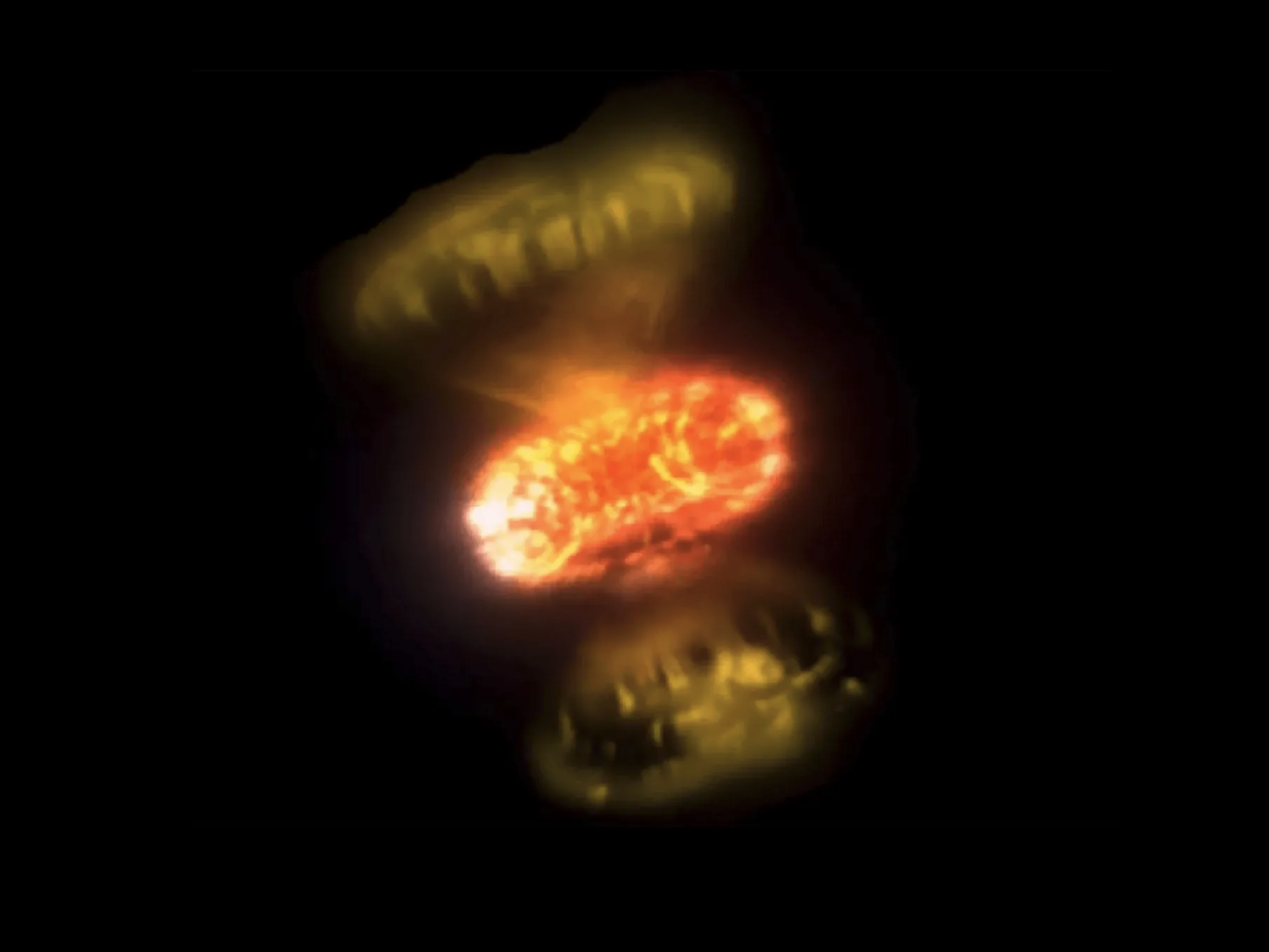
V1674 Herculis是已记录的新星中演化最快之一,在被发现后不到16小时即达到峰值亮度,并在数天内迅速变暗。图像显示其喷发明显不对称,存在两股方向不同的喷出流,并伴随近乎垂直的椭圆结构。光谱数据显示,不同阶段的物质速度差异显著:峰值前约为3,800 km/s,峰值后出现高达5,500 km/s的分量。这些不同速度流的碰撞与同步探测到的伽马射线信号一致,表明形成了高能冲击波。
相比之下,V1405 Cassiopeiae演化缓慢,花费53天达到峰值,并保持高亮度约200天。峰值期前两次观测仅显示直径约0.99毫角秒的中心光源,对应半径约0.85 au,远小于若在53天内完全抛射应达到的23–46 au。这一差距表明其外层物质在超过50天内并未完全释放,而是处于包裹双星系统的共同包层阶段。第三次观测中,中心辐射降至约50%,并出现约2,100 km/s的宽发射成分,进一步证实新星爆发是一个持续、多阶段的物理过程。
Researchers used near-infrared interferometry to produce high-resolution images of the early stages of two novae detected in 2021, directly capturing structural changes within days of explosion. The targets, V1674 Herculis and V1405 Cassiopeiae, reveal that nova eruptions are not single, spherical events but involve multiple interacting outflows. These observations overcome previous limitations where early ejecta could only be inferred indirectly.
V1674 Herculis was among the fastest novae ever recorded, reaching peak brightness less than 16 hours after discovery and fading within a few days. Imaging showed a highly asymmetric explosion with two distinct ejecta flows and an additional elliptical structure nearly perpendicular to them. Spectroscopy revealed multiple velocity components, with absorption lines around 3,800 km/s before peak brightness and later components reaching about 5,500 km/s. The interaction of these flows coincided with gamma-ray detections, indicating shock waves produced by colliding material.
V1405 Cassiopeiae evolved much more slowly, taking 53 days to peak and remaining bright for about 200 days. Early observations showed a compact central source about 0.99 milliarcseconds across, corresponding to a radius of roughly 0.85 au, far smaller than the expected 23–46 au if material had expanded freely over 53 days. This implies the outer layer remained bound in a common-envelope phase for over 50 days. By the third observation, the central source contributed only about 50 percent of the radiation, and a broad emission component near 2,100 km/s emerged, confirming that nova explosions unfold through prolonged, multi-stage dynamics rather than a single impulsive blast.