全球数字经济依赖于近700条海底通信光缆,这些光缆承载了99%的洲际互联网流量。然而,这些至关重要的命脉极易受到物理破坏和地缘政治紧张局势的影响。人工智能的热潮和地缘政治风险正在积极重塑亚洲海洋的基础设施,迫使私营运营商绕过有争议的水域(例如南中国海,北京要求在其九段线内进行维修必须获得批准)以及马六甲海峡等咽喉要道(马来西亚和印度尼西亚等沿岸国家在此实施限制性规则以榨取收入)。为了规避这些风险,新的光纤路线正在兴起,从中东和印度经过澳大利亚和太平洋群岛延伸至日本、韩国和美国。
这种地理上的转变是由光缆融资和所有权结构的根本改变所推动的。传统上,光缆是由国家电信公司组成的大型财团建造的;例如,1999年的SEA-ME-WE 3光缆造价13亿美元,需要92个合作伙伴,这推迟了规划并迫使光缆路线靠近沿海人口中心。如今,科技巨头和超大规模云服务商(如谷歌、Meta和微软)独立出资并建造光缆,以连接其数据中心而非人口枢纽。谷歌于2008年投资了其第一条光缆,此后又资助了至少34条,其中18条在没有合作伙伴的情况下独立拥有。在未来四年中,预计每年的海底光缆投资平均将达到40亿美元。
这种整合使科技公司能够跨越公海铺设光缆,从而规避了海床管辖权和国家干预。因此,关岛已成为连接美国在亚洲盟友的关键太平洋枢纽,而圣诞岛和科科斯群岛则成为印度洋的枢纽。这些发展反映了水下互联网基础设施日益分化的态势,自奥巴马政府以来,美中之间没有批准过任何新的光缆。尽管像星链这样的卫星互联网提供商正在发展,但海底光缆仍然是全球通信最具成本效益和最核心的基础设施,其地理分布正在永久性地撤离地缘政治热点地区。
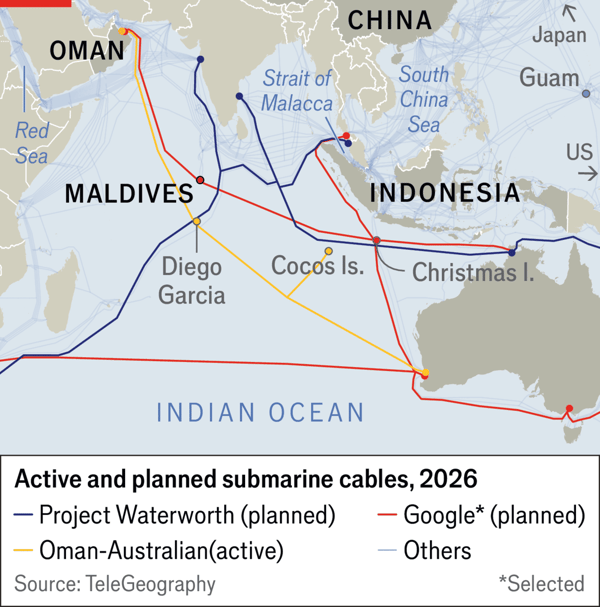
The global digital economy relies on nearly 700 undersea communications cables that carry 99% of intercontinental internet traffic. However, these vital arteries are highly vulnerable to physical disruption and geopolitical tension. The AI boom and geopolitical risks are actively rewiring Asia’s ocean infrastructure, pushing private operators to bypass contested waters such as the South China Sea—where Beijing demands approval for repairs within its nine-dash line—and chokepoints like the Strait of Malacca, where littoral states like Malaysia and Indonesia impose restrictive rules to extract revenue. To avoid these risks, new fiber-optic routes are emerging, running from the Middle East and India through Australia and the Pacific Islands to Japan, South Korea, and the United States.
This geographical shift is made possible by a fundamental change in cable financing and ownership. Traditionally, cables were built by large consortia of national telecom companies; for example, the SEA-ME-WE 3 cable in 1999 cost $1.3 billion and required 92 partners, which delayed planning and forced routes close to coastal population centers. Today, tech giants and hyperscalers (such as Google, Meta, and Microsoft) fund and build cables independently to connect their data centers rather than population hubs. Google invested in its first cable in 2008 and has since funded at least 34 more, owning 18 of them without partners. Over the next four years, annual undersea cable investments are projected to average $4 billion.
This consolidation allows tech firms to lay cables across the open ocean, avoiding seabed jurisdictions and state interference. Consequently, Guam has emerged as a key Pacific hub connecting American allies in Asia, while Christmas Island and the Cocos Islands serve as hubs in the Indian Ocean. These developments reflect an increasingly bifurcated undersea internet infrastructure, with no new cables between the United States and China approved since the Obama administration. Despite the growth of satellite internet providers like Starlink, undersea cables remain the most cost-effective and essential infrastructure for global communications, and their geography is permanently shifting away from geopolitical hotspots.
Source: The AI boom and geopolitics are rewiring Asia’s oceans
Subtitle: New cables between data centres are avoiding China and chokepoints
Dateline: Jul 02, 2026 10:24 AM | SINGAPORE