2027 年的这次日全食将让月影扫过多个地区,从摩洛哥和西班牙南部开始,随后依序穿越阿尔及利亚、突尼西亚、利比亚、埃及与沙乌地阿拉伯,最后在叶门与索马利亚海岸上空结束。全食最长时间将出现在埃及,尤其是卢克索与亚斯文一带,使这些地点相较于路径上的其他区域成为观测条件最佳的观赏点。
虽然日食经常引发各种阴谋论,NASA 强调它们对人类健康或地球环境没有任何有害影响。日食是太阳、月球与地球规律运行所产生的可预测天体排列,甚至在火星与我们的月球上也会发生。预测显示,2045、2060、2063、2078、2081 与 2096 年还会出现其他全食时间很长的日全食,全食持续时间大约介于 5 分 12 秒与 6 分 6 秒之间。
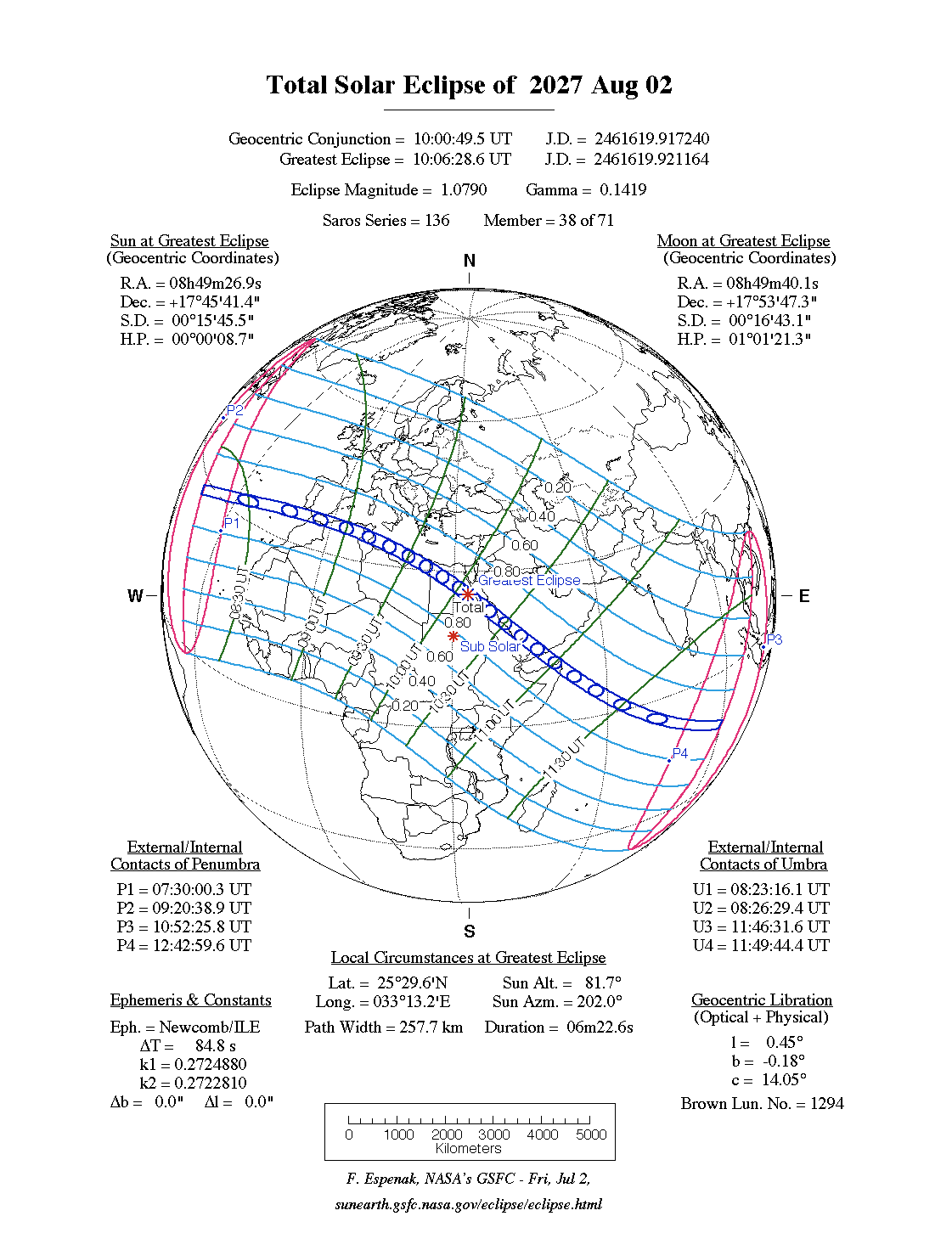
NASA predicts that the longest total solar eclipse in 100 years will occur on August 2, 2027, with totality lasting 6 minutes and 23 seconds. Recent solar eclipses have been much shorter: the April 2024 eclipse across North America lasted just 4 minutes and 28 seconds, while the August 2026 eclipse over Spain will last only 1 minute and 43 seconds, highlighting how exceptional the duration of 2027 is.
The 2027 eclipse will cast its shadow across multiple regions, beginning in Morocco and southern Spain, then crossing Algeria, Tunisia, Libya, Egypt, and Saudi Arabia before ending over Yemen and the coast of Somalia. Maximum totality will be observed in Egypt, especially near Luxor and Aswan, making these locations prime viewing sites compared to other points along the path.
Although solar eclipses often inspire conspiracy theories, NASA emphasizes they have no harmful effects on human health or Earth’s environment. They are predictable alignments of the sun, moon, and Earth, and even occur on Mars and our moon. Other very long total eclipses are forecast for 2045, 2060, 2063, 2078, 2081, and 2096, with totality durations between 5 minutes 12 seconds and 6 minutes 6 seconds.