在欧盟与中国于10月8日开启终轮贸易谈判之际,法德两国于10月5日向欧盟委员会递交联名信,提出旨在阻击中国出口激增的强硬贸易防御方案。促成欧洲立场转向强硬的关键在于德国的战略转变:面对中国质优价廉商品的冲击,德国工业界对华态度急剧恶化,且该国每月持续流失约1.5万个工业岗位,政客们深恐这会进一步助长极右翼德国选择党(AfD)的崛起。为彰显强硬决心,德国政府于10月7日断然叫停了一家中国国有航运巨头对德国某物流企业80%股权的收购案。
法德提案的核心创新在于构建“二次打击能力”,由法国总统马克龙与德国总理默茨共同倡议,主张赋予布鲁塞尔在遭遇第三国针对欧盟贸易救济措施的反制报复时迅速实施二次反击的法定权力。提案还要求创设“多元化工具”以打破欧洲企业对单一供应链的依赖,并敦促欧盟更激进地运用既有贸易救济武器,包括扩大反补贴关税适用范围至整个产业部门而非仅限于个别企业、改革针对进口激增的“保障措施”以精准遏制特定国家(主要针对中国),以及强化对包括中国直邮小包裹在内的进口消费品安全审查。此外,信中还提出了在战略领域推行“欧洲优先”采购的产业政策。
这一强硬举措引发了中欧之间的针锋相对。针对欧洲近期发起的3起反倾销调查,中国商务部于10月3日对欧洲化工产品启动反倾销调查作为警告,并奉劝欧洲切莫走入歧途导致反噬。尽管欧委会对法德提案表示支持,但内部传统自由贸易国仍对滑向过度贸易保护主义保持警惕。随着欧洲展现出应对能源冲击的经济韧性,而中国仍需依赖巨额基建投资提振经济,欧洲领导人寄望于通过德法联合展现的强硬战线在接下来的峰会上确立反制框架,从而迫使北京在贸易摩擦中做出实质性让步。
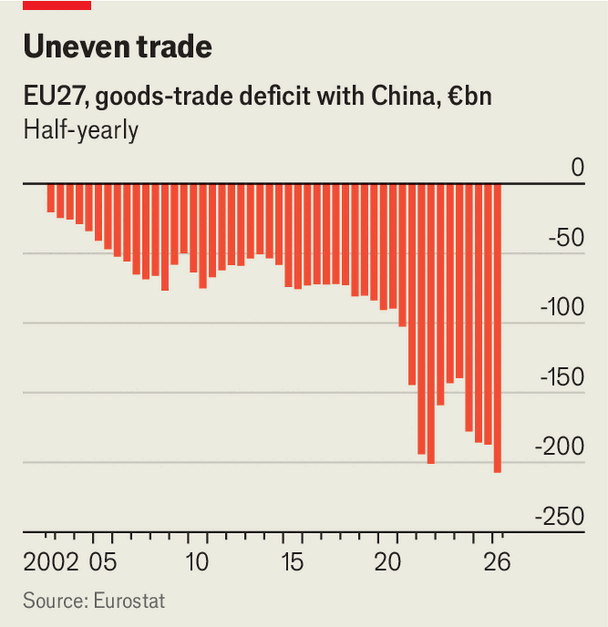
As the European Union entered its final round of trade talks with China on October 8th, France and Germany dispatched a joint letter to the European Commission on October 5th outlining aggressive defence mechanisms against Chinese export surges. This hawkish shift is underpinned by a profound strategic pivot in Germany, where surging Chinese imports are squeezing domestic manufacturing and contributing to the loss of roughly 15,000 industrial jobs per month—a bleed stoking electoral support for the far-right Alternative for Germany. Demonstrating this hardening posture, Berlin formally blocked a Chinese state-owned shipping giant from acquiring an 80% stake in a German logistics group on October 7th.
The centrepiece of the proposals by French President Emmanuel Macron and German Chancellor Friedrich Merz is a "second-strike capability" granting Brussels rapid-response powers to hit back against foreign retaliation when the EU levies tariffs on unfair competition. The initiative also introduces a "diversification instrument" to mitigate supply-chain bottlenecks and calls for an overhaul of existing trade-defence instruments. Crucially, the leaders urge broadening anti-subsidy duties across entire industrial sectors rather than evaluating individual firms, reforming global safeguard tariffs to target specific nations like China, tightening consumer-safety checks on Chinese parcels, and mandating "European preference" procurement clauses within strategic sectors.
This coordinated offensive has exacerbated bilateral frictions: Beijing's commerce ministry warned against self-defeating protectionism, launching an anti-dumping investigation into European chemicals on October 3rd after Brussels initiated three targeted probes of its own. While the Commission welcomed the Franco-German initiative, European free-trade advocates remain wary of drifting toward damaging autarky. Nevertheless, with European macro-resilience outperforming expectations while China deploys massive infrastructure stimuli to bolster growth, EU leaders entering upcoming summits hope Germany's newfound hawkishness will project unified resolve and constrain Chinese escalation across the global single market.
Source: Germany and France want EU storm gates for China’s trade surge
Subtitle: A bold joint letter suggests confrontation looms with China
Dateline: Oct 8th 2026\n