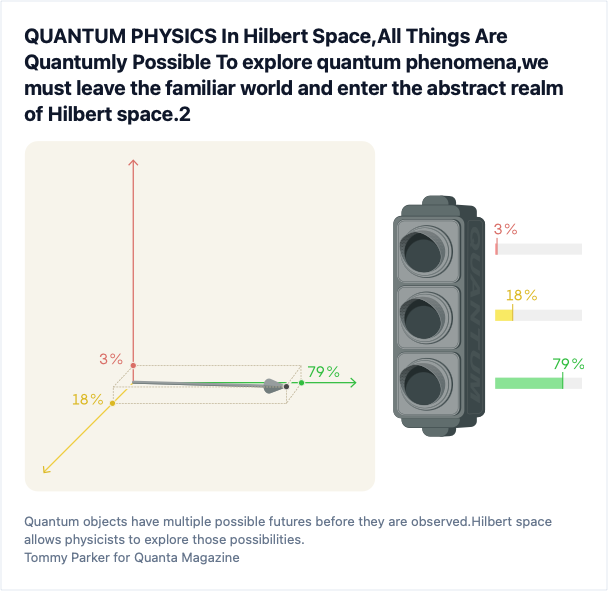
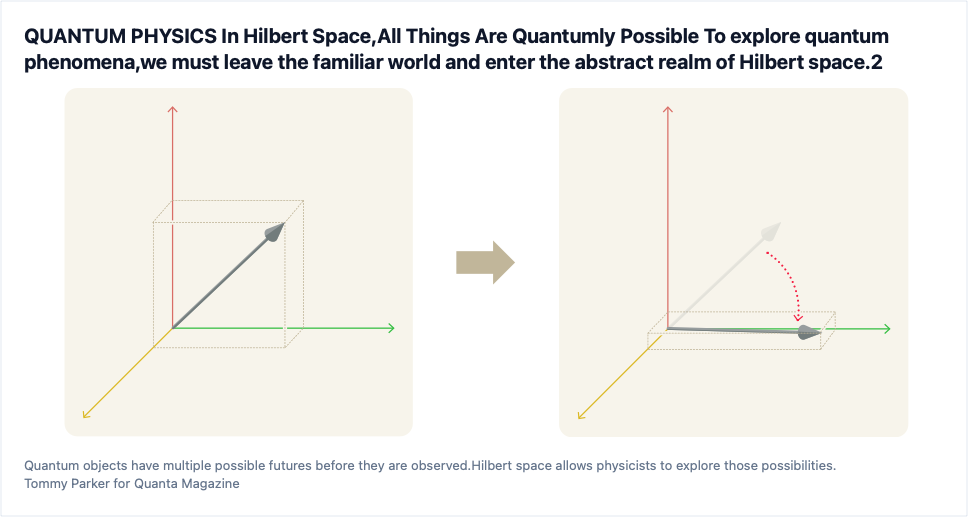
冯·纽曼的量子法则指出,在被观察之前,量子物件并不存在固定的属性,而是处于多种可能性的「叠加状态」。在希尔伯特空间中,这种量子态被描绘成一个指向特定方向的向量(箭头)。在尚未进行测量时,这个向量会随著时间在空间中平滑且可预测地旋转;然而,一旦我们对系统进行观察,向量就会瞬间且随机地坍缩到某个特定的坐标轴上,这时量子叠加态便不复存在,我们也就获得了确定的测量结果。
尽管希尔伯特空间在过去一个世纪中一直是量子力学的核心,物理学家对于它究竟是宇宙的基本现实,还是仅为一种实用的数学工具,仍存在分歧。一些学者认为希尔伯特空间是现实的根本舞台,而另一些研究量子引力或黑洞内部结构的物理学家,则开始转向更抽象的数学构造,例如冯·纽曼代数。有趣的是,就连冯·纽曼本人在晚年也曾试图寻找其他代数结构来取代希尔伯特空间,显示出量子物理的数学基础仍在不断演进与扩展。
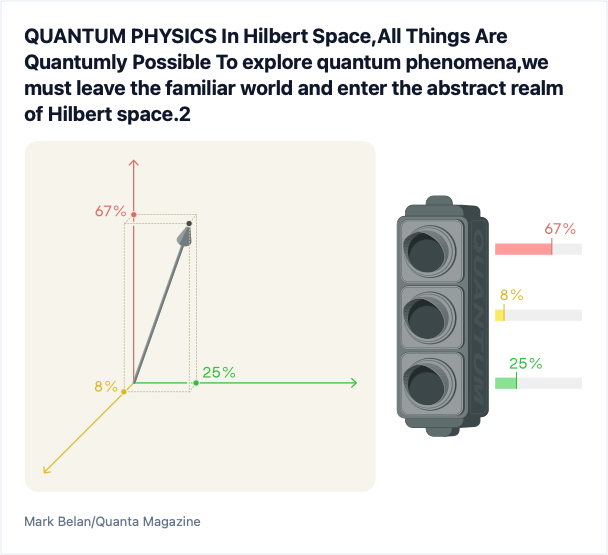
In quantum mechanics, exploring particle behavior requires entering an abstract mathematical realm known as Hilbert space. Early quantum physicists, such as Heisenberg and Schrödinger, independently developed matrix mechanics and wave mechanics to describe quantum phenomena, which yielded identical predictions despite their distinct forms. The mathematical physicist John von Neumann later realized that both theories were describing the same mathematical structure, and he formally defined this arena of all possible states as Hilbert space.
Von Neumann's quantum rules state that before being observed, a quantum object does not possess fixed properties but exists in a "superposition" of multiple possibilities. In Hilbert space, this quantum state is represented as a vector (an arrow) pointing in a specific direction. While unmeasured, this vector rotates smoothly and predictably through the space over time; however, once the system is observed, the vector instantly and randomly collapses onto a specific axis, ending the quantum superposition and yielding a definite measurement result.
Although Hilbert space has been the core of quantum mechanics for a century, physicists remain divided on whether it represents the fundamental reality of the universe or merely a practical mathematical tool. While some researchers argue that Hilbert space is the fundamental theater of reality, others investigating quantum gravity or black holes have turned to even more abstract mathematical constructs, such as von Neumann algebras. Interestingly, even von Neumann himself later sought alternative algebraic structures to replace Hilbert space, illustrating the ongoing evolution of the mathematical foundations of quantum physics.