全球肥胖危机正给各国公共卫生与宏观经济带来沉重负担,传统的劝导式健康干预已被证明彻底失效。世界卫生组织数据显示,哥伦比亚四分之一的国民患有肥胖症,该比例自1980年以来激增四倍;在美墨两国,超重或肥胖成人的比例分别高达72%与74%,OECD成员国每年因肥胖导致的医疗支出和生产力损失平均占GDP的3%。在英国,1992年至2020年间推出的14项国家计划包含689项具体政策,但其中仅有3%限制获取垃圾食品,仅0.3%(2项政策)采用了税收等经济制约手段,导致英格兰肥胖率自90年代初翻倍,目前约五分之一的11岁儿童陷入肥胖。
昂贵且需终身服用的GLP-1减肥药物难以惠及中低收入国家的大众,促使多国政府转向强制重构“食品环境”。哥伦比亚自2022年起对高糖、高盐及高脂肪加工食品加征10%赋税,并在2024年提升至15%、去年进一步升至20%。智利自2016年推行强制黑色警示标签,墨西哥自2020年实施类似法规后,促使售出热量下降15%、添加糖下降25%、饱和脂肪下降12%,其中90%的热量缩减源于食品制造商主动修改配方。此外,英国与葡萄牙已立法全面禁止垃圾食品的网络广告,苏格兰与加利福尼亚州则立法限制不健康食品在超市促销和货架摆放。
鉴于企业常利用货架规则漏洞(例如英国限制包装垃圾食品后其销量虽下降7%,但未受限制的高糖现烤点心迅速抢占入口),政策制定者正转向更系统的干预方案。英国正考虑对超市销售总量设定强制性健康评分指标,智库Nesta测算,若对典型英国购物篮中四分之一的商品进行配方微调,可使消费者平均热量摄入持续降低8.5%,进而将肥胖率腰斩。与此同时,全球已有100多个国家对含糖饮料征税(墨西哥自2014年征税后销量下降6%,今年更将税率翻倍提高至每升3.08比索),结合民调显示近70%的英国民众和51%的美国民众支持限制垃圾食品,通过增值税结构性调整抑制不健康食品正成为国际共识。
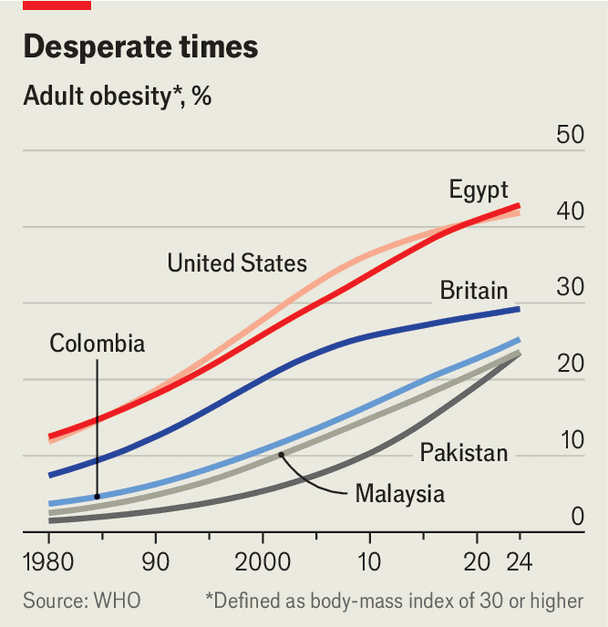
The escalating global obesity crisis imposes staggering public health and economic burdens, underscoring the absolute failure of traditional persuasive health campaigns. WHO figures show that a quarter of Colombians are obese—a fivefold increase since 1980—while adult overweight and obesity rates stand at 72% in America and 74% in Mexico, inflicting annual costs equivalent to 3% of GDP across OECD economies. In Britain, despite 14 successive national anti-obesity strategies comprising 689 distinct policies between 1992 and 2020, only 3% restricted junk-food access and just 0.3% (two policies) introduced financial penalties. Consequently, English adult obesity doubled over three decades, and 20% of 11-year-olds are clinically obese.
With costly GLP-1 weight-loss medications financially inaccessible for widespread use in developing countries, governments are aggressively transforming surrounding "food environments" through direct fiscal and regulatory interventions. Colombia established mandatory warning labels and levied a 10% junk-food tax in 2022, escalating to 15% in 2024 and 20% last year. Front-of-package warning systems have proven highly effective: Chile mandated black stop-sign alerts in 2016, while Mexico's 2020 rules spurred a 15% drop in calories sold, a 25% drop in added sugar, and a 12% drop in saturated fats, with 90% of calorie reduction driven by recipe reformulations. Concurrently, jurisdictions like California and Scotland are legally curbing junk-food retail positioning.
Because retail compliance challenges often prompt circumvention—such as British supermarkets shifting towards exempt freshly baked pastries despite a 7% drop in targeted impulse snacks—governments are exploring systemic interventions. British authorities are evaluating mandatory health-ratio targets across supermarket chains' gross sales; think-tank Nesta projects that reformulating just a quarter of typical basket items would reduce caloric intake by 8.5%, halving obesity rates. Moreover, with over 100 countries taxing sugary beverages—exemplified by Mexico, which recently increased its levy to 3.08 pesos ($0.16) per liter—and strong public backing (70% of Britons and 51% of Americans support grocery junk-food restrictions), structural VAT adjustments penalizing unhealthy products represent a powerful frontier.
Source: Nagging people to eat healthily does not work
Subtitle: Taxes, planning rules, limits on ads—anything to curb junk food
Dateline: Oct 8th 2026\n