突破来自MIT博士生Alex Cohen。他在2023年发表了一篇论文,成功将分形不确定性原理推广到所有更高维度,该论文于2025年发表在顶级期刊《数学年刊》上。Cohen的关键洞见源自Bourgain生前未发表的笔记,其中揭示了一种利用复分析(虚数函数的研究)来间接构造所需「阻尼函数」的方法。他还提出了「线多孔性」的新概念,巧妙地排除了高维情形中会导致原理失效的分形结构。这项成果使他在25岁时获得纽约大学助理教授职位。
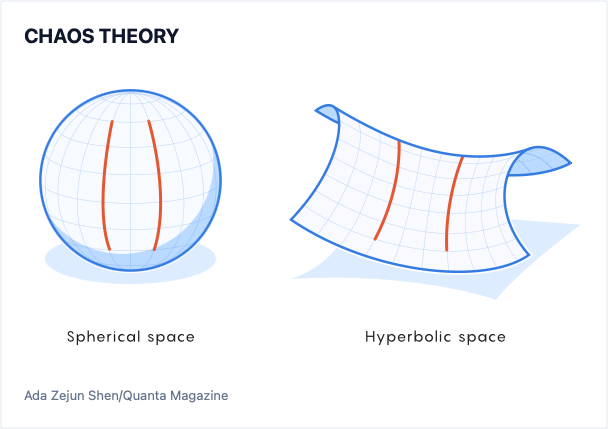
分形不确定性原理已经产生了重要应用。2025年,哈佛大学的Elena Kim与奥克拉荷马大学的Nicholas Miller利用Cohen的高维结果,证明了在高维双曲空间中波永远无法被困住,必然会扩散到每个角落。这一原理与Sarnak和Rudnick于1994年提出的著名猜想密切相关——该猜想认为经历混沌的波不仅会完全扩散,还会均匀地分布于整个空间。作为傅立叶分析的基础性成果,分形不确定性原理的影响预计将远超量子混沌领域,延伸到信号处理等多个数学和工程领域。
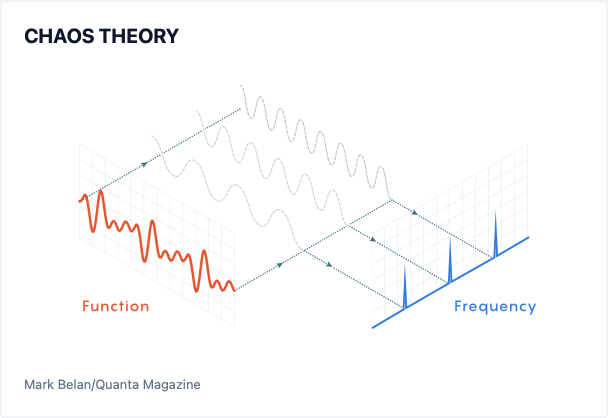
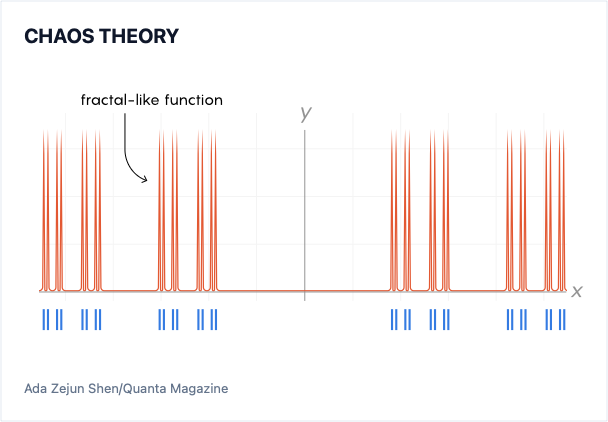
The quantum uncertainty principle states that the more precisely a particle's position is known, the less precisely its momentum can be determined, and vice versa. Mathematician Semyon Dyatlov at MIT began investigating whether quantum particles could become trapped on fractal-like paths in chaotic systems, as classical particles can. In 2016, he and the celebrated mathematician Jean Bourgain proved the fractal uncertainty principle for one-dimensional fractals, but efforts to extend the proof to higher dimensions stalled after a dedicated workshop, leaving the community skeptical that the generalization was achievable.
The breakthrough came from Alex Cohen, then a doctoral student at MIT, who posted his proof online in May 2023 and published it in the Annals of Mathematics in 2025. Cohen introduced the concept of "line porosity" to exclude higher-dimensional fractals that would violate the principle, and he drew critical inspiration from Bourgain's unpublished notes, which pointed toward a complex-analysis detour for constructing the essential "damping function." This indirect construction method, rooted in the classical Beurling-Malliavin theorem, allowed Cohen to build a flexible mathematical object that unlocked the entire proof. The result, hailed as a foundational achievement, earned him an assistant professorship at New York University at age 25.
The higher-dimensional fractal uncertainty principle has already yielded striking applications. In 2025, Elena Kim and Nicholas Miller used it to prove that waves in higher-dimensional hyperbolic spaces must spread out completely and cannot remain confined. The result connects to the famous 1994 Sarnak-Rudnick conjecture, which posits that waves in chaotic systems not only spread everywhere but do so uniformly—appearing random at microscopic scales yet simple at the macroscopic level. As a fundamental fact about Fourier analysis, the fractal uncertainty principle is expected to find applications well beyond quantum chaos, extending into signal processing and other mathematical disciplines.