最近,三位数学家将这项理论扩展到更不精确的日常洗牌方式,他们透过为每张牌分配由零与一组成的条码来追踪牌组中难以混合的「冷点」,证明了即使切牌不均匀,截断现象依然存在。
根据这项最新的数学证明,如果在每次洗牌时都随机切牌,大约需要十四次不精确的日常洗牌才能将一副五十二张的标准扑克牌彻底混合均匀。
In 1992, mathematicians proved that seven perfect riffle shuffles are enough to completely randomize a deck of cards through a cutoff phenomenon, but this proof relied on strict conditions requiring the deck to be cut exactly in half and interleaved evenly.
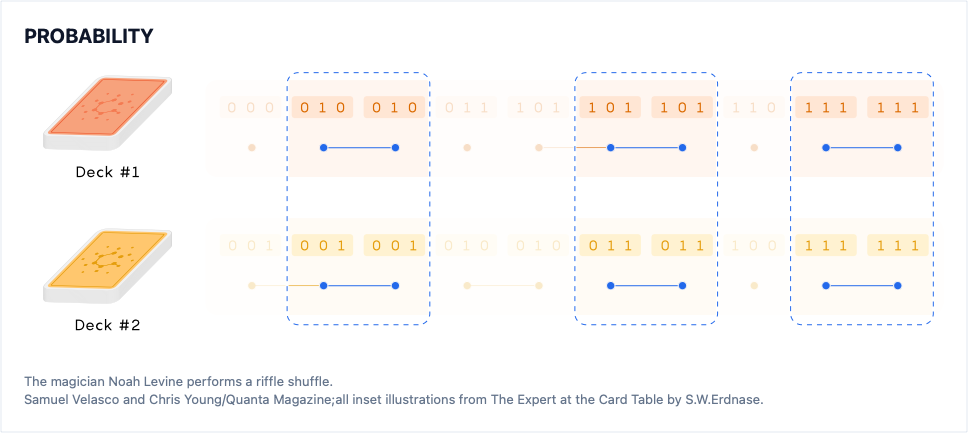
Recently, three mathematicians extended this theory to less precise, everyday shuffling methods by assigning barcodes of ones and zeros to each card to track unmixed "cold spots," proving that the cutoff phenomenon still occurs even with uneven cuts.
According to this latest mathematical proof, if the deck is cut at a random place during each shuffle, it takes roughly fourteen sloppy shuffles to thoroughly mix a standard deck of fifty-two cards.