关于科学进步是否放缓的争论由来已久。2023年,明尼苏达大学的迈克尔·帕克(Michael Park)等人在《自然》期刊发表了一项重磅研究,通过分析4500万篇科学论文和390万项专利的引用模式,指出自1950年代以来科研的“颠覆性”出现了断崖式下滑。该结论主要基于整合-颠覆指数(CD指数,取值范围为-1至1),若后续研究只引用某论文而不引用其参考文献,则该论文被评为高度颠覆。这项研究不仅引发了全球广泛关注,还被美国国会听证会和白宫官员在政策演讲中多次引用。
然而,2026年8月12日《自然》发表的一项跟进研究对这一悲观结论提出了有力挑战。布鲁塞尔自由大学的文森特·霍尔斯特(Vincent Holst)团队指出,帕克的研究数据中包含约97万篇论文和14.2万项专利的CD指数为满分1,其中绝大多数是因为数据库误将其记录为“零参考文献”。霍尔斯特等人随机抽样发现,多达93%的论文和98%的专利实际上都包含参考文献;由于数据库早期历史数据的错误率随时间推移而下降,剔除这些被错误标记为高度颠覆的早期成果后,科学颠覆性的所谓长期下滑趋势大部分消失了。
帕克团队对此提出反驳,坚称即使按照霍尔斯特的方法修正,颠覆性的下降趋势依然显著,并质疑霍尔斯特使用的替代数据库与重建方法存在缺陷。此外,其他学者也加入了辩论:加州大学默塞德分校的研究指出,“引用通胀”会自然拉低平均CD得分,重新分析后甚至发现2005至2015年间的颠覆性不降反升;但斯坦福大学经济学家的生产率研究则坚持认为各行业的技术突破成本正逐年攀升。这场围绕文献计量学方法和底层数据库质量的激烈争论表明,科学进步速度是否放缓的核心问题依然悬而未决。
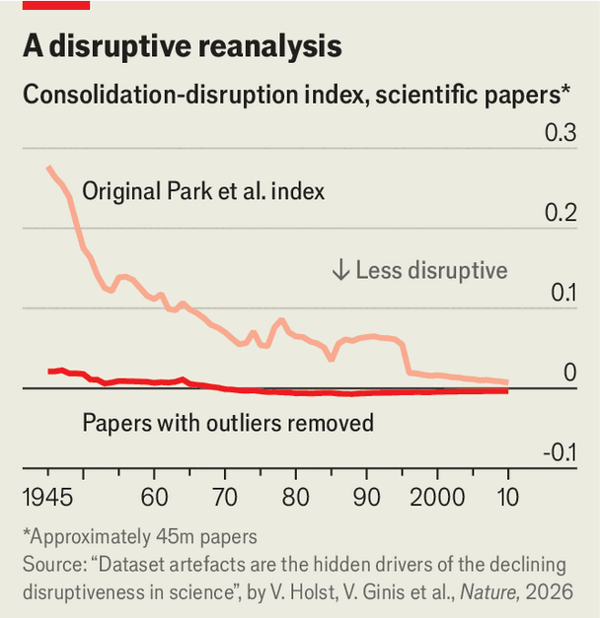
The debate over whether the pace of scientific discovery is decelerating gained significant traction in 2023 when Michael Park and colleagues published a landmark paper in Nature. Analyzing citation networks across 45m scientific papers and 3.9m patents, they concluded that the "disruptiveness" of research had collapsed dramatically since the 1950s. Their metric, the consolidation-disruption (CD) index ranging from -1 (consolidating) to 1 (disruptive), classifies a publication as disruptive if subsequent work cites it while bypassing its own cited references. The study garnered immense international attention and was widely cited in US Congressional hearings and White House policymaking discussions.
However, a follow-up critique published in Nature on August 12th by Vincent Holst and co-authors challenged these findings, arguing that the reported decline was primarily an artifact of database classification errors. Holst identified approximately 970,000 papers and 142,000 patents with a maximum CD score of 1 in the original dataset, mostly awarded because the database recorded zero cited references. Upon sampling, Holst found that 93% of those papers and 98% of those patents actually contained references that the database had omitted; because these missing-reference errors disproportionately affected older publications and diminished over time, correcting for them eliminates most of the apparent historical drop in disruptiveness.
While Park and his co-authors responded by maintaining that meaningful declines persist even under Holst’s corrections and questioning the dataset reconstructions, the critique reflects wider methodological scrutiny. Other scholars, such as researchers at the University of California, Merced, argued that systemic "citation inflation" artificially depresses CD scores over time, suggesting that scientific disruption may have actually expanded between 2005 and 2015. Conversely, economic analyses from Stanford University demonstrate that technological breakthroughs require exponentially greater research investments across industries, leaving the question of whether modern scientific innovation is truly stagnating an unresolved empirical issue.
Source: Maybe scientific progress isn’t slowing, after all
Subtitle: A new paper takes aim at the claim that science has become less disruptive
Dateline: 8月 13, 2026 03:44 上午