由高考试题泄露事件以及9月6日德里学生宿舍坍塌致死惨剧引发的大规模青年抗议,将公众目光聚焦于拥有近3亿在校生的印度教育体系。这一被称为“痛苦机器”的选拔体制驱使数千万学生争夺极少数名牌大学名额与公务员编制;尽管家庭在课外辅导和民办学费上倾注巨资,但阿齐姆·普雷姆吉大学数据显示,仅有7%的大学毕业生能在一年内找到正式工作,在文凭通胀的同时使企业面临严重的技能人才短缺。
基础教育的质效滑坡是这一危机的根源:尽管自1990年以来失学儿童比例从近25%骤降至目前的2%,但普及并未带来质量提升。2022年的一项乡村调查显示,五分之三的五年级学生无法阅读二年级课文。教师工会的选票势力削弱了考核问责,导致2024年农村初中教师每八天就缺勤一天;印度在2009年唯一一次参加的国际PISA评估中,在74个受测国家与地区中位列倒数前三。这种溃败促使近1亿印度儿童(占比从2015年的32%攀升至39%)流向收费私立学校,反向减弱了政客改善公立学校质量的紧迫感。
高等教育同样深陷无序膨胀,青年升学率在过去十年间从20%上升至30%,其中大部分由低种姓群体推动并被万余所新涌现的民办“附属学院”所吸纳。这些学院收取每年约4万卢比(约合420美元)的高额学费,正将教育演变为寻租温床:私立学校年营收高达约300亿美元,校外培训市场规模突破80亿美元,背后充斥着政界人士的利益勾结。当学历沦为衡量婚姻前景与社会地位的象征而非技能载体,贫困家庭背负沉重债务所换来的劣质文凭,进一步加剧了全社会的资本错配与阶层焦虑。
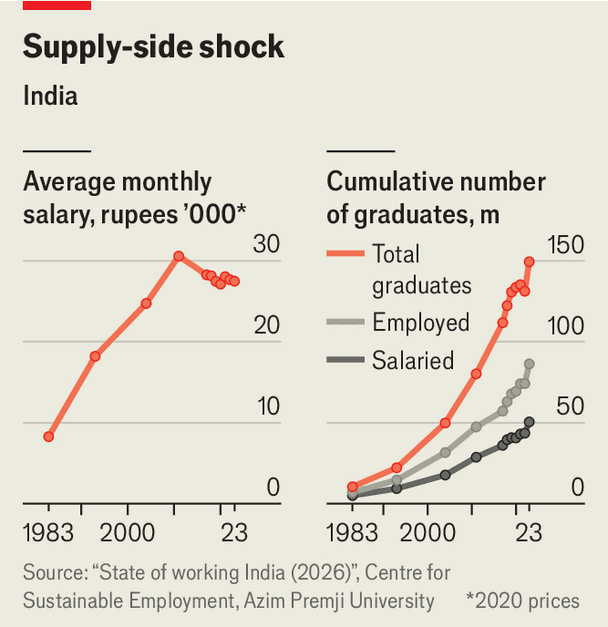
Widespread youth demonstrations sparked by exam leaks and the fatal collapse of a Delhi student hostel on September 6th have galvanized national scrutiny over India’s educational apparatus, which enrolls nearly 300m students. Termed a misery machine, this intensely competitive system produces tens of millions of credentialed applicants for minuscule quotas of elite university seats and civil service posts. Despite heavy household spending on supplementary coaching and private tuition, Azim Premji University reports that only 7% of graduates secure formal employment within twelve months of graduation, leaving employers with acute skill shortages despite record degree conferrals.
The underlying deterioration begins at primary levels, where access has vastly expanded but pedagogy has foundered. While the share of children missing primary school dropped from nearly 25% in 1990 to just 2% today, learning outcomes collapsed; a 2022 rural survey revealed that three in five fifth-graders could not read a second-grade text. Structural accountability is undermined by protected teacher unions, with rural secondary instructors absent one out of every eight days in 2024, mirroring India’s 2009 PISA performance when it ranked in the bottom three out of 74 participating territories. Consequently, fee-paying private schools now capture 39% of all pupils—roughly 100m children, up from 32% in 2015—draining political impetus to rehabilitate public facilities.
Similar commercialization has compromised the tertiary sector, where youth participation grew from 20% to 30% over the past decade, largely fueled by lower-caste matriculation into more than 10,000 newly formed private affiliated colleges charging around 40,000 rupees ($420) annually. The entire ecosystem functions increasingly as a commercialized racket: private schools generate approximately $30bn annually and coaching firms collect over $8bn, often established by political figures seeking economic rents. Because degrees function as cultural markers for matrimonial prospects and social status rather than practical human capital, families deplete lifetime savings on low-quality credentials that perpetuate severe economic misallocation.
Source: India’s education system is failing in new ways
Subtitle: A breakneck expansion has bred new dysfunction—and spurred young people to rebel
Dateline: Sep 24th 2026\n