8月26日上午8时37分,尼泊尔与西藏边境发生冰川崩塌及冰石雪崩,堵塞了伦德河(Lhende River),仅三分钟后天然堰塞湖溃决,滔天洪水泥石流席卷尼泊尔拉苏瓦地区的波特科西河与特里苏里河流域。灾害发生一周后,确认死亡人数超过1,000人,仍有4,000多人失踪,其中包括数辆前往西藏冈仁波齐峰朝圣的大巴上的数百名外国朝圣者。特大山洪彻底摧毁了约80座桥梁和40公里道路,冲毁14座水电站(部分仍在建),直接导致尼泊尔全国10%的发电产能瘫痪。
作为全球最易受灾的国家之一,尼泊尔位于印度洋板块与欧亚板块碰撞带,季风气候与脆弱地质交织,且该地区升温速度远超全球均值,冰川融化速率已达2000年时的两倍。然而面对频发的冰崩与溃决灾难,尼泊尔的国家应对能力极为薄弱。年仅36岁的前说唱歌手巴伦德拉·沙阿(Balendra Shah)上任总理仅六个月,面临高达50亿美元的重建资金缺口。与此形成鲜明对比的是,富裕国家正在大幅削减对外援助预算,美国承诺提供的援助仅为360万美元,不足其在2015年尼泊尔大地震时援助规模的3%。
区域防灾基础设施与多边协作机制的严重匮乏进一步加剧了次生灾害风险。兴都库什-喜马拉雅地区拥有超过63,700条冰川,却仅布设了38个监测站,其中达到国际标准的仅有7个。国际山地综合开发中心呼吁邻国提供传感器设备并开展实时水文数据共享,但中国常将跨境水文流量数据视为国家安全机密,使得下游邻国面临极大的预警盲区。在未来气候极端事件频发的严峻现实下,尼泊尔亟需更多国际资金支持与跨境水文透明度,以构建适应气候韧性的基础设施。
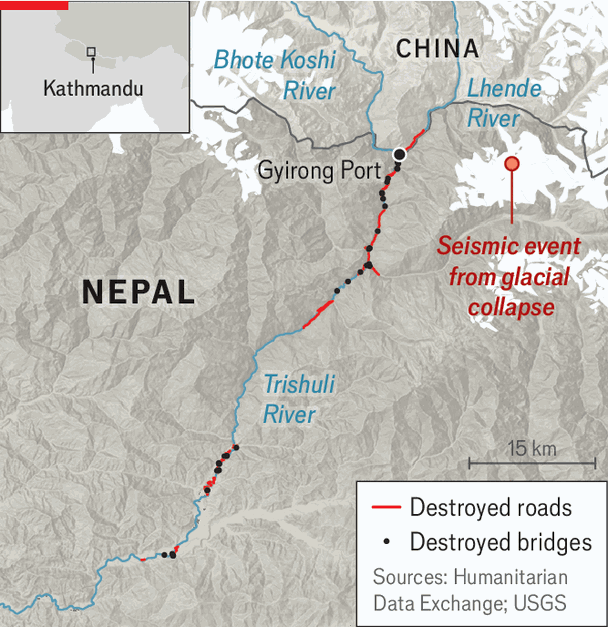
On August 26th at 8:37am, a collapsing glacier and ice-rock avalanche dammed the Lhende river along the Nepal-Tibet border, breaching three minutes later to unleash catastrophic flash floods across the Rasuwa district's Bhote Koshi and Trishuli river corridors. Within a week, verified fatalities exceeded 1,000 alongside more than 4,000 missing individuals, including several hundred foreign Hindu pilgrims traveling toward Mount Kailash. The hydrological deluge obliterated 80 bridges and 40km of highway networks, knocking out 14 hydroelectric facilities that abruptly eliminated 10% of Nepal's aggregate electricity-generating capacity.
Geological exposure along the Indo-Eurasian tectonic collision boundary renders Nepal uniquely vulnerable to climate disruption, with regional temperatures warming substantially faster than the global mean and glaciers melting at twice their 2000 velocity. However, institutional resilience remains desperately constrained: 36-year-old Prime Minister Balendra Shah, six months into office, confronts a reconstruction deficit reaching bn amidst retrenchment from traditional Western development donors. Illustrating this shortfall, the United States committed merely .6m in disaster assistance, representing under 3% of the aid volume it mobilized following Nepal’s catastrophic 2015 earthquake.
Regional hazard mitigation is critically compromised by severe observation deficits and geopolitical friction. Across the Hindu Kush-Himalaya's 63,700 glaciers, only 38 monitoring stations exist, with merely seven complying with rigorous international observation benchmarks. While the International Centre for Integrated Mountain Development advocates for shared sensor networks, downstream vulnerability is magnified because Chinese authorities treat transboundary hydrological flow statistics as state secrets. Securing climate survival against impending glacial-lake outbursts requires Nepal to mobilize dedicated multilateral infrastructure financing alongside mandatory cross-border hydrological transparency.
Source: Catastrophic floods warn Nepal of more disasters to come
Subtitle: It is woefully short of the resources and international help to cope with them
Dateline: Sep 3rd 2026