哈克定律背后至少有两种互补的解释。其一是由义大利水文学家安德烈亚·里纳尔多等人在1990年代提出的「最优水道网络」理论,认为河流在大尺度上呈现狭长形态,是因为这是将水向下坡输送最节能的方式。其二是景观演化模型:水流侵蚀岩石时,微小的地形差异导致某些水道捕获更多径流,进而加速侵蚀、吸引更多水流,经过数千年的局部调整,整个排水网络逐渐重组为能量耗散最小的最优配置。
2026年的一项新发现将哈克定律的适用范围进一步扩展。德克萨斯大学的田东及其合作者发现,哈克定律不仅适用于河流的支流网络,也适用于河口三角洲的分流网络——河道长度与其「滋养面积」的0.6次方成正比。支流网络与分流网络本质上是相反的过程,一个汇聚沉积物,一个分散沉积物,却遵循相同的数学规律。这种简单确定性与混沌随机性的共存,正是河流最优结构如此迷人的原因所在。
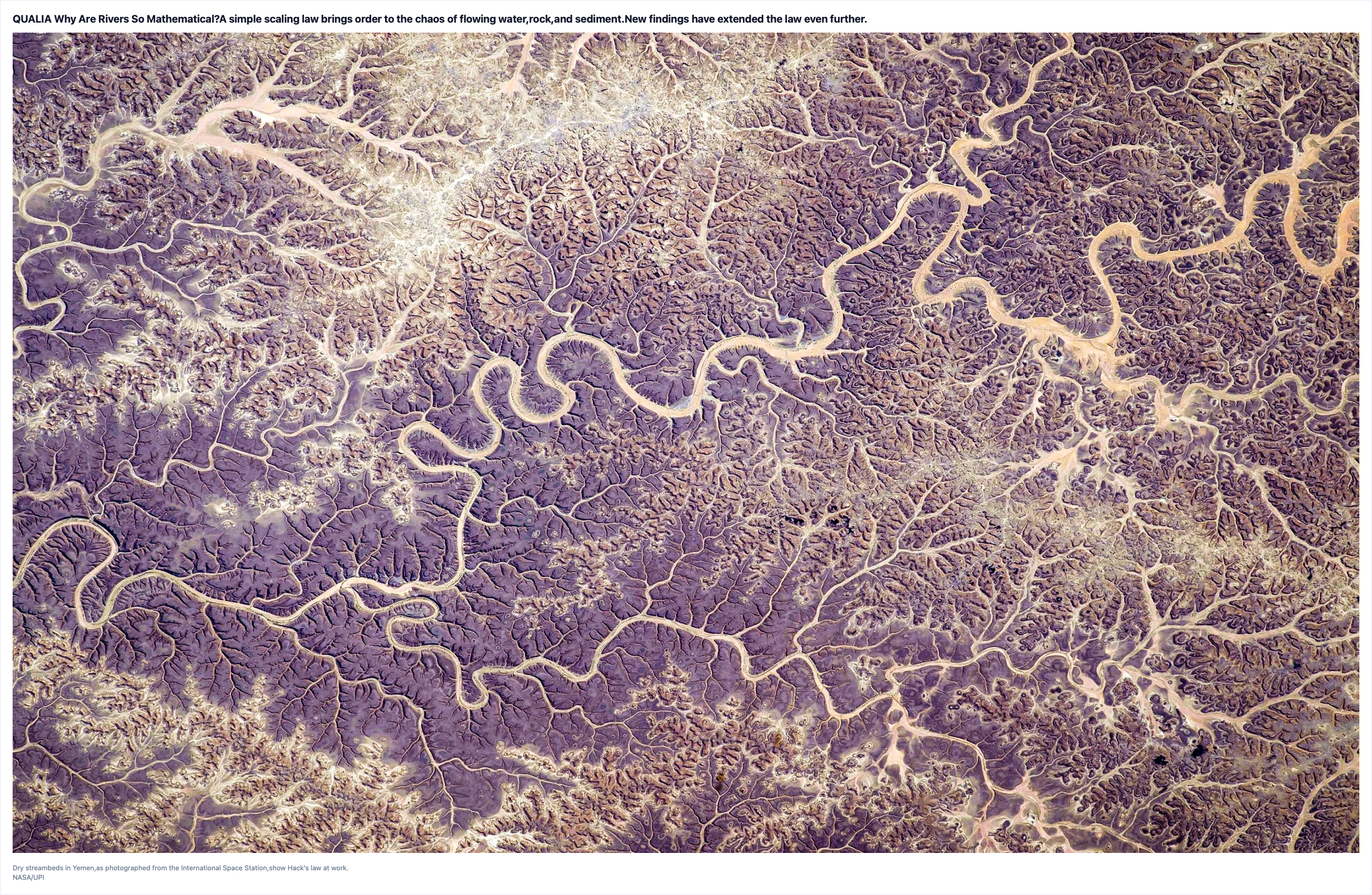
Rivers, like all transport networks, follow a universal mathematical structure that gives them a fractal-like appearance. In 1957, U.S. Geological Survey scientist John Hack discovered the most important law governing river networks: a stream's length is proportional to its drainage area raised to the power of 0.6 (L ~ A⁰·⁶). This relationship, known as Hack's law, holds worldwide regardless of geological characteristics, and reveals that larger basins become progressively more elongated rather than maintaining the same proportions as smaller ones.
At least two complementary explanations underlie Hack's law. The "optimal channel network" theory, proposed by Italian hydrologist Andrea Rinaldo and colleagues in the early 1990s, argues that elongated large-scale river networks represent the most energy-efficient configuration for transporting water downhill. Landscape evolution models provide the mechanism: as water erodes rock, small topographic irregularities cause some channels to capture more runoff, erode faster, and attract still more water. Over thousands of years, these local adjustments gradually reorganize the entire drainage network into a configuration that minimizes energy dissipation — one that conforms to Hack's law.
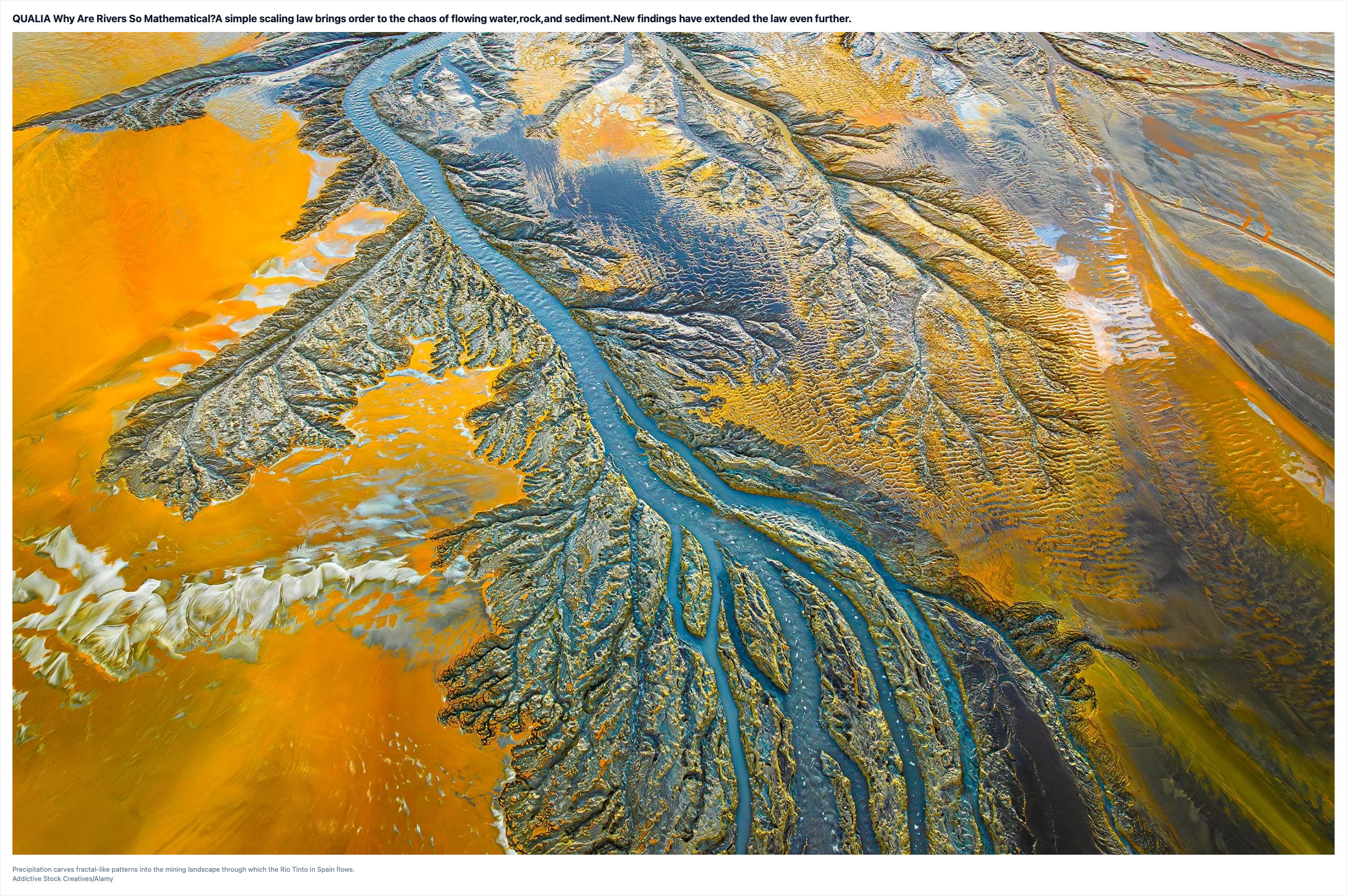
A 2026 discovery extended Hack's law into new territory. Tian Dong of the University of Texas, Rio Grande Valley and collaborators found that the law applies not only to rivers' tributary networks but also to their deltas — the fan-shaped structures formed where rivers meet the sea. In deltas, channel length scales with nourishment area (the area supplied with sediments) raised to the power of 0.6. Tributary and distributary networks are essentially opposites — one collects sediment while the other distributes it — yet both obey the same mathematics. This coexistence of simplicity and determinism with chaos and randomness is what makes the optimal structure of rivers so captivating.