在人工智能领域的资本开支上,美中两国呈现出极其鲜明的对比。根据彭博行业研究(Bloomberg Intelligence)的数据,美国科技巨头今年在数据中心上的资本支出预计将超过7400亿美元,包括英伟达谈判为OpenAI的5000亿美元数据中心项目提供2500亿美元担保,谷歌母公司Alphabet将今年AI支出增加至2050亿美元。相比之下,2026年中国科技巨头在数据中心上的投资预计不足美国的十分之一。然而,中国AI模型的性能却紧追美国同类产品,例如月之暗面(Moonshot AI)推出的K3模型在基准测试中的性能达到了Anthropic公司Fable 5模型的95%,阿里巴巴8月3日发布的最新模型也在多项指标中名列前茅。
中国AI资本效率较高的原因部分源于土地、设备与研发人员的较低成本,以及利用“蒸发/提炼”(distillation)技术借鉴美国模型的开发成果。更关键的是,美国的技术出口管制严重限制了中国获得英伟达顶级芯片与台积电先进代工产能的能力,华为与中芯国际(SMIC)受限于制裁和制造设备缺口无法大规模补足高端芯片供应。同时,中国企业在IT预算上普遍较为繁琐克制,全社会软件支出不足美国企业的十分之一(尽管中国GDP按购买力平价计算已比美国大三分之一)。此外,中国官方政策更侧重于将AI技术在实体经济中广泛扩散,而非像美国数十家企业那样倾力追求通用人工智能(AGI),在上海人工智能协会的统计中中国仅有不足十家公司专注于AGI研发。
然而,过度的资本节约与计算资源瓶颈也制约了中国AI产业的进一步突破。由于算力严重不足,字节跳动旗下的顶尖AI视频生成工具部分剪辑需要长达10小时的处理时间,智谱AI(Zhipu AI)与阿里云的相关服务不得不实施严格限量并常在几分钟内售罄,K3模型也积压了大量的候补用户。尽管中国投资者对AI领域的过度过度投入持谨慎态度并频繁惩罚挥霍行为,但过度受限的算力供给可能阻碍中国AI企业的创新转化与商业化兑现,表明极端的算力约束依然会成为产业长期发展的缚缚。
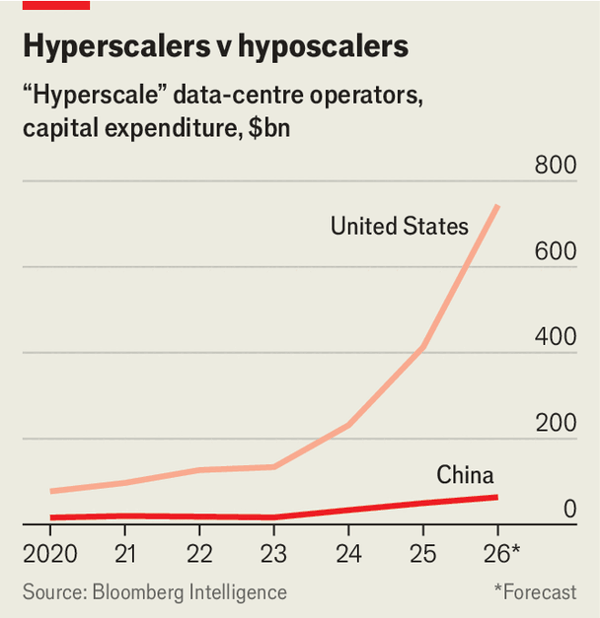
A stark contrast has emerged between American and Chinese capital investment in artificial intelligence. According to Bloomberg Intelligence, American tech giants are projected to spend over $740bn on data centres this year, highlighted by Nvidia considering underwriting $250bn for OpenAI’s $500bn data centre project and Alphabet raising its AI budget to $205bn. In contrast, Chinese tech firms in 2026 are forecast to invest less than one-tenth of that amount in data centres. Despite this frugality, Chinese AI models perform remarkably close to American frontier systems; Moonshot AI’s K3 model achieves 95% of the benchmark performance of Anthropic’s Fable 5, while Alibaba’s recent release scores among global leaders.
China's cost-efficiency stems partly from lower land, equipment, and labor expenses, alongside techniques like model distillation that leverage existing outputs. More decisively, American export controls block access to top Nvidia chips and TSMC manufacturing, forcing firms like Huawei and SMIC to rely on costly workarounds hampered by sanctions on equipment. Domestically, Chinese corporate IT spending is less than one-tenth of American software expenditure despite China’s economy being one-third larger on a purchasing-power-parity basis. Furthermore, official policy prioritizes industrial AI diffusion over frontier Artificial General Intelligence (AGI), with fewer than ten Chinese firms pursuing AGI compared to dozens in America.
Nevertheless, severe computing bottlenecks threaten to restrict the scalability of China's AI industry. Computing constraints force ByteDance's top-ranked video-generation model to take up to ten hours to process certain clips, while services from Zhipu AI and Alibaba Cloud operate under strict metering and sell out within minutes. Although Chinese investors historically penalize AI overspending, unlike the historical enthusiasm of Wall Street, acute hardware shortages may ultimately prevent domestic AI leaders from fully commercializing their innovations. While practical AI diffusion requires less raw compute than AGI, an overly restrictive hardware diet still poses significant risks to long-term growth.
Source: How China gets better bang for its buck than America in AI
Subtitle: Its investment lags far behind America’s. Its models do not
Dateline: 8月 06, 2026 04:02 上午 | SHANGHAI