中国国有航空公司集体推出日本航线免费退改措施,适用时间为11 月 15 日至 12 月 31 日,涵盖东京、大阪、名古屋等航点,涉及国航、南航、东航、川航、海航等至少 5 家航司。该举措紧随北京对日本首相高市早苗涉台表态的强烈反弹之后,包括发布“避免赴日旅行”提醒与召见日本大使。尽管日航与全日空称暂未出现大规模取消,JAL 旗下春秋日本也称预订“未有明显变化”,但部分酒店(中国客占国际客约 30%)预计下周或起出现团队退订。
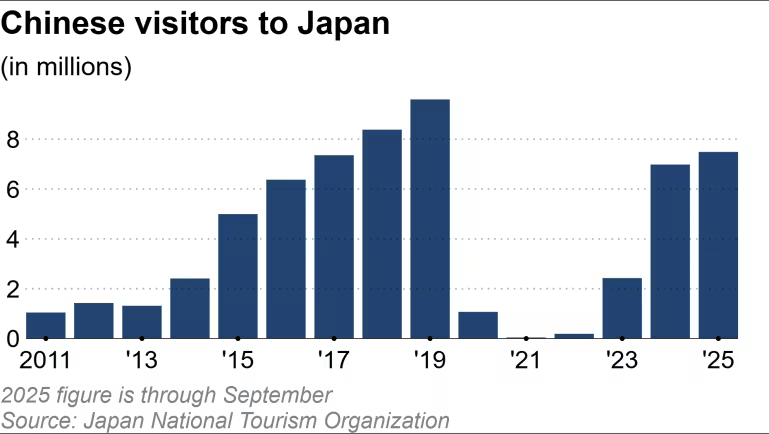
中国游客是日本入境消费核心来源:2024 年中国游客消费 1.73 万亿日元,为前一年的 2.3 倍,占总额 21.2%;2025 年 1–9 月访日 748 万人次,已超 2024 年全年 698 万。高岛屋百货 2024 财年免税销售中,中国客占 58%。企业层面已出现连锁反应:在华日企与政府关联机构的商务洽谈“暂停”,部分企业停止在中国社媒推广。
历史数据显示政治摩擦可显著冲击访日需求:2010 年撞船事件后次年中国访日人数同比跌 26%;2012 年钓鱼岛国有化引发大规模抵制期间,中国赴日游客一度年减 40% 以上。学者指出,中国自由行占比虽高于以往、对政策号召相对不敏感,但旅游长期被两国政府视为外交工具,本轮影响的广度与持续性取决于外交关系的后续走向。
Chinese state-owned airlines have introduced free cancellation and rerouting for Japan-bound flights from Nov. 15 to Dec. 31, covering Tokyo, Osaka and Nagoya. At least five carriers (Air China, China Southern, China Eastern, Sichuan Airlines, Hainan Airlines) issued notices after Beijing urged citizens to avoid travel to Japan over PM Takaichi’s Taiwan remarks. ANA, JAL and Spring Japan report no major cancellations yet, but some hotels—where Chinese visitors represent ~30% of international guests—expect group booking cancellations next week.
Chinese travelers are Japan’s largest inbound spending group: in 2024 they spent ¥1.73 trillion, 2.3× the previous year, accounting for 21.2% of total inbound spending. From Jan–Sept 2025, 7.48 million Chinese visitors already exceeded the 6.98 million recorded in all of 2024. At Takashimaya, Chinese customers made up 58% of duty-free sales. Business impacts are emerging: Japanese subsidiaries in China report stalled talks with government-affiliated entities, and some firms have halted promotion on Chinese social media.
Past frictions show travel demand is highly sensitive to bilateral tensions: after the 2010 boat collision, Chinese arrivals fell 26% the following year; during the 2012 anti-Japan protests over the Senkaku nationalization, annual Chinese arrivals plunged over 40%. Analysts note individual travel from China is now higher than before—reducing sensitivity to official calls for restraint—but tourism remains a diplomatic lever for both governments, making the scale and duration of this shock dependent on future geopolitical developments.