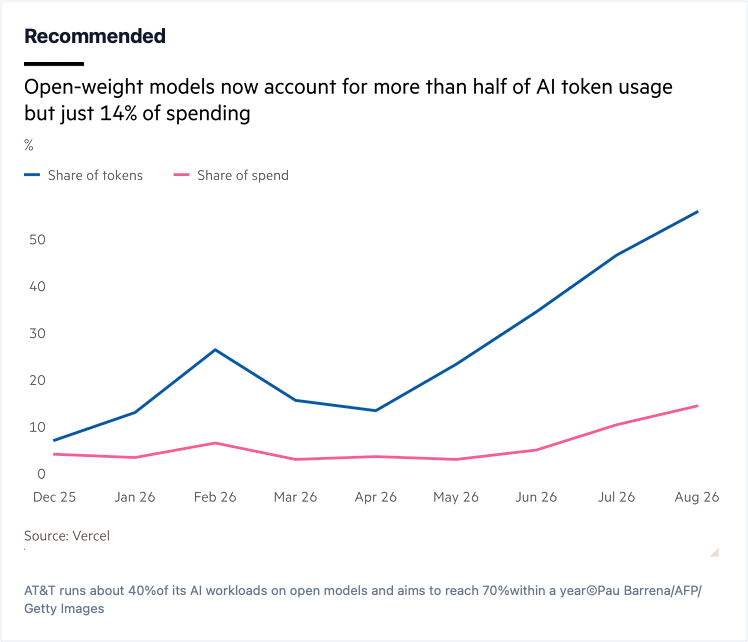
产业数据显示这一转向正实质发生,例如 Vercel 的 AI Gateway 上开放权重模型的 Token 处理比例从去年底的 7% 跃升至 56%,其中以中国团队所开发的模型最受欢迎。包含 Tinder 与 AT&T 在内的企业皆因应成本倍增问题,将大量非核心或日常流量分流至开源模型。AT&T 目前已有约 40% 的 AI 工作负载运行于开源模型,并计划在一年内提升至 70%,借由专有资料微调达到甚至超越闭源模型的效能。
除了显著降低营运成本外,资料主权与安全性亦是企业拥抱开放模型的核心动机。如资料中心营运商 Digital Realty 等企业,透过在私有基础设施上运行开放权重模型建立内部介面,确保高度敏感与客户机密资料绝不上传至外部的前沿模型伺服器,并根据任务复杂度与机密性灵活混用开源与闭源系统。
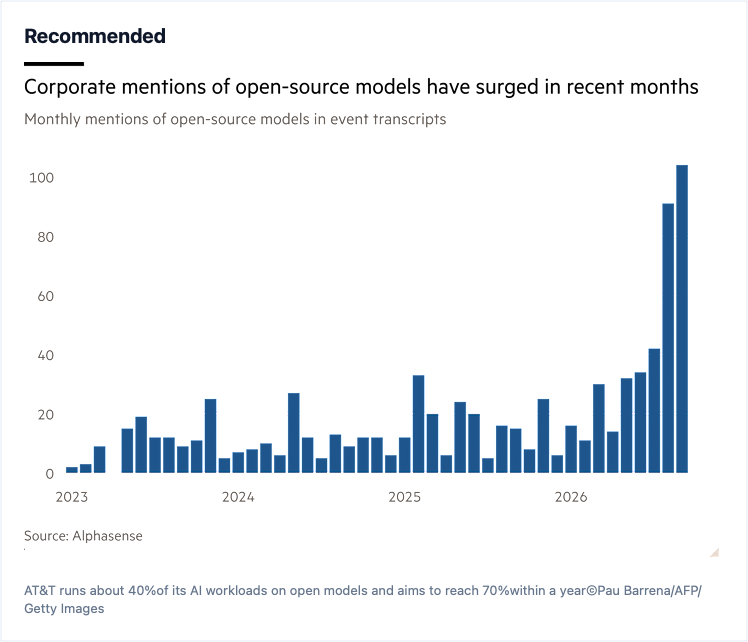
Facing spiralling IT expenses, corporate America is increasingly adopting lower-cost open-weight artificial intelligence models as alternatives to expensive frontier systems developed by OpenAI and Anthropic. Open-weight models enable enterprises to customize and deploy systems on their own infrastructure, significantly lowering per-token operational costs. This trend has expanded beyond tech firms into finance, logistics, and manufacturing, posing potential challenges to the revenue growth of frontier AI labs preparing for high-valuation IPOs.
Supply chain data confirms that this shift is rapidly materializing, with open-weight models accounting for 56 percent of tokens processed through Vercel's AI Gateway in August, up from 7 percent in December, with Chinese labs dominating usage. Companies like Tinder and AT&T are actively routing queries to open systems to control skyrocketing expenses; AT&T currently runs roughly 40 percent of its AI workloads on open models with plans to reach 70 percent within a year, fine-tuning them on proprietary data to match or exceed proprietary model performance.
Beyond major cost reductions, data sovereignty and security represent crucial drivers for businesses embracing self-hosted open models. Operators such as Digital Realty deploy open-weight models on private infrastructure to run internal applications, ensuring that sensitive enterprise and customer data is strictly kept away from external frontier models while dynamically utilizing a mix of open and proprietary solutions based on task confidentiality and complexity.