ASML 以极低的出货量建立了极端稳固的垄断地位。公司每年仅销售略高于 40 台最先进的 EUV 光刻机,但其股价在过去 6 个月上涨约 80%,市值超过 5,000 亿美元。每台设备起售价约 2.2 亿美元,2025 年第三季度毛利率达到 52%。尽管亚洲在芯片制造、材料和资本投入方面具备显著优势,但全球不存在任何具有商业可行性的替代供应商。
EUV 光刻的技术复杂度构成了核心壁垒。该系统需要通过激光击中微米级熔融锡滴,产生温度高于太阳表面的等离子体,从而生成自然界不存在的极紫外光。光线需经过多块原子级精度的反射镜传导后,才能将图案刻写到硅片上。最关键的光学组件由唯一供应商 Carl Zeiss SMT 提供,其技术源于与 ASML 数十年的深度协同研发,几乎无法复制。
即使技术可复制,经济性仍不可行。新进入者每年销量过低,无法覆盖研发成本,但芯片厂仍要求设备从第一天起接近零故障率。像台积电这样年收入超过 1,200 亿美元的企业,其晶圆厂停工一天即可造成数亿美元损失。ASML 自 2006 年交付首台 EUV 设备、2013 年实现量产,累计运行时间已达数百万小时。缺乏真实生产数据,使潜在竞争者无法改进产品,这也是尼康和佳能在商业化前十多年即退出 EUV 研发的原因,表明在该技术门槛之上,市场机制已无法修正垄断。
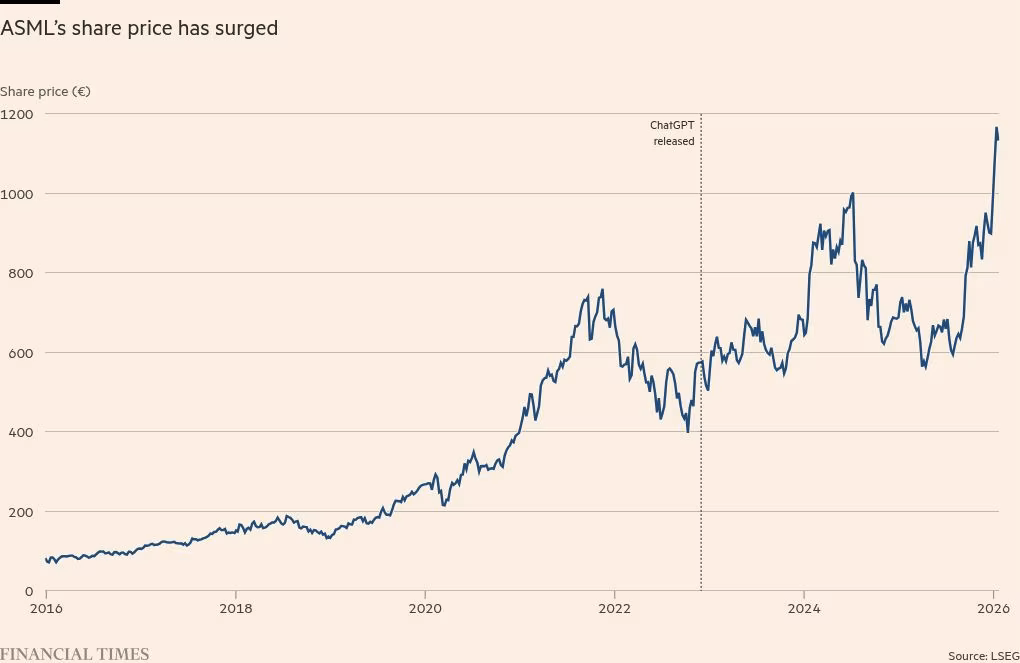
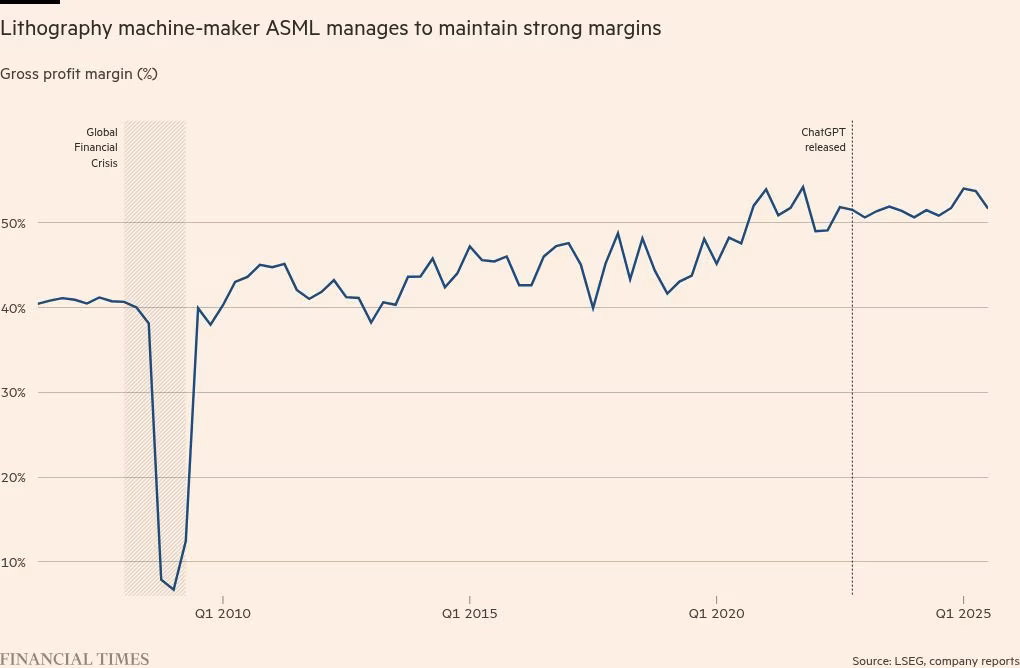
ASML has built an extraordinarily durable monopoly on extremely low volumes. The company sells just over 40 of its most advanced EUV lithography machines per year, yet its share price has risen about 80 percent over the past six months, pushing its valuation above $500 billion. Each machine starts at roughly $220 million, and gross margins reached 52 percent in the third quarter of 2025. Despite Asia’s dominance in chips, materials, and capital spending, there is no commercially viable alternative supplier.
The core barrier is technological complexity. EUV lithography requires firing lasers at microscopic droplets of molten tin to create plasma hotter than the surface of the Sun, producing extreme ultraviolet light that does not occur naturally. That light is then guided by mirrors made to atomic-level precision before patterns are printed onto silicon wafers. The most critical optics are supplied by a single company, Carl Zeiss SMT, reflecting decades of tightly integrated development with ASML that is effectively impossible to replicate.
Even if the technology could be matched, the economics fail. Any entrant would sell too few machines to recover development costs, yet chipmakers demand near-perfect reliability from day one. At firms like TSMC, which generates more than $120 billion in annual revenue, a single day of lost production can cost hundreds of millions of dollars. ASML shipped its first EUV tool in 2006 and its first production system in 2013, accumulating millions of operating hours. The lack of real-world data prevents rivals from improving, explaining why Nikon and Canon exited EUV development more than a decade before commercialization and why, beyond this threshold, markets no longer correct monopolies.