现在全球地热能仅占能源供应的1%,但技术创新带来巨大增长潜力。例如Fervo公司通过10座钻井平台每年可新增1吉瓦输出,相当于一个核电站,足以供应100万户家庭。Fervo已获得超过50吉瓦的地热矿权,计划与壳牌和加州公用事业公司合作,先期实现500兆瓦发电,这是地热行业最大商业合同。到2035年,全球对地热的累计投资预计可达1万亿美元,远高于2024年的10到20亿美元。
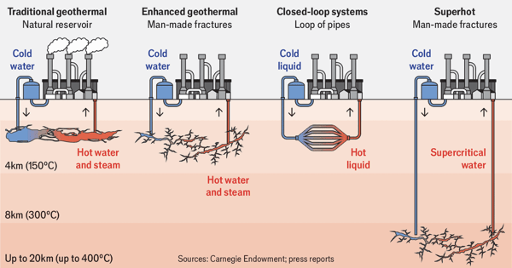
新一代地热采用增强型地热系统(EGS)和闭环系统(CLS),突破传统需要自然裂隙的局限。借助页岩油时代发展出的水力压裂和多分支水平钻井技术,EGS可在无天然裂隙的岩石中创造人工储层,并已实现钻井时间同比缩短70%,大幅降低成本。CLS虽更复杂成本更高,但适用于水资源短缺或禁用压裂的地区,德国项目已将侧钻时间减半,目标发电8兆瓦,供热64兆瓦。
未来,“超热地热”能从8到20公里深处、400℃高温下提取高达7.5太瓦的清洁电力。超临界流体能量密度是普通热水井的5到10倍。美国CATF建模显示仅开发北美1%的超热地热就足以提供7.5太瓦。虽然高温下设备损耗大、钻井难度高,但行业新技术如毫米波能束已显著提升钻进效率。新项目在330℃岩层已无下井事故,预计很快能突破超临界门槛。
Globally, geothermal energy supplies less than 1% of current power, but innovation is driving rapid growth. Fervo’s 10 rigs can add 1 gigawatt yearly—equal to a nuclear reactor and enough for 1 million homes. With over 50 gigawatts in geothermal rights, Fervo’s first-in-industry 500-megawatt contract marks the largest in geothermal history. By 2035, global cumulative investment in geothermal is projected to reach $1 trillion, a dramatic rise from $1–2 billion in 2024.
Next-generation geothermal uses Enhanced Geothermal Systems (EGS) and Closed-Loop Systems (CLS), overcoming dependence on natural fractures. Leveraging fracking and horizontal drilling from shale oil, EGS creates artificial reservoirs and has cut drilling time by 70% year-on-year, slashing costs. CLS, though complex and costly, works in arid regions or where fracking is banned. Germany’s project halved lateral drilling time, targets 8MW power and 64MW of heating.
Looking forward, “superhot geothermal” may extract vast power—up to 7.5 terawatts—by drilling 8–20km deep at 400°C. Supercritical fluids there yield 5–10 times more energy per well. Modelling shows tapping just 1% of North America’s superhot resource could deliver this capacity. Despite technical challenges, new tools like millimetre-wave drilling beams are boosting speed. New test wells have reached 330°C with no downhole failures and could soon hit supercritical status.