面对国内需求疲软与通货紧缩阴霾,中国启动了规模高达25万亿元人民币(约3.7万亿美元)的“六大网络”新基建计划,投资涵盖水利(6万亿元)、电力(5.5万亿元)、地下管网(5万亿元用于新建改造77万公里管网)、算力基础设施(4万亿元)、物流(2.7万亿元)以及5G/6G通信网络(至少1.3万亿元)。该计划相当于至2030年中国累计GDP的3%,首年预计投放7万亿元,旨在为半导体、商业航天、机器人及低空经济等支柱产业和量子计算、核聚变等未来产业搭建底座。横琴地下管廊等标杆工程集中展现了整合电力、光纤与防洪传感器的集约化设计,而“东数西算”工程则将算力中心向宁夏、甘肃等西部能源富集区布局。
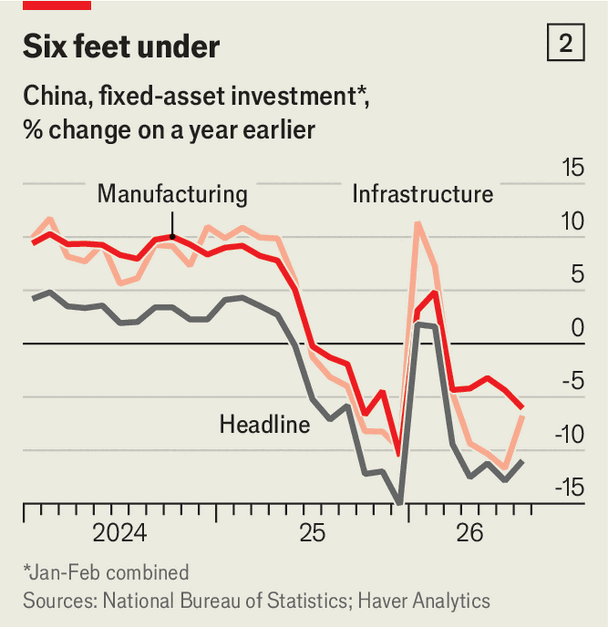
本轮投资潮的核心推力在于对冲严峻的国内需求缺口:8月份中国社会消费品零售总额名义同比仅微增0.4%,剔除在校生后的青年失业率逼近19%,金融机构人民币贷款同比增速仅为4.9%且居民房贷出现萎缩。自2021年房地产泡沫破裂以来,居民财富中金融资产占比从31%攀升至45%,导致银行体系流动性淤积;与此同时,地方政府受制于化解隐性债务、回购存量土地及清偿企业账款,导致制造业与传统基建固定资产投资出现罕见骤降。通过超前启动具备逆周期调节属性的宏观工程,决策层力求在夯实4.5%至5%年度增长目标的同时,防范因海外需求降温引发的二次通缩冲击。
在制度与融资设计上,本轮基建汲取了2008年金融危机后“四万亿”刺激(实际拉动约9.5万亿元额外负债)遗留地方隐性债务的教训。随着地方政府融资平台(LGFV)已有70%被清理或市场化转型,加之地方官员终身追责制与财政高压监管的确立,资金来源转向中央长期国债、地方专项债以及央企自筹(如国家电网与南方电网五年拟投5万亿元,三大运营商年内投入2600亿元)。此外,中国中央政府十年期国债利率低于1.7%,政策性银行先行投放8000亿元资本金并可撬动商业银行四至五倍杠杆,这种低成本直接融资不仅提升了资本利用效率,更通过提振内需与扩大国内吸收,有望结构性收窄庞大贸易顺差并缓解外部经贸摩擦。
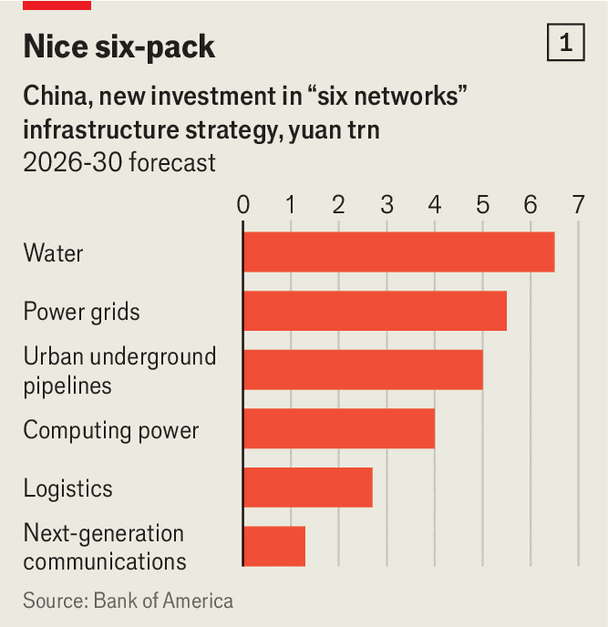
To counteract domestic macroeconomic stagnation and persistent deflationary pressures, China unveiled an expansive 25trn yuan ($3.7trn) infrastructure initiative targeting "six networks" over five years, allocating 6trn yuan to water conservancy, 5.5trn yuan to smart power grids, 5trn yuan to build or upgrade 770,000km of municipal pipelines, 4trn yuan to computing infrastructure, 2.7trn yuan to logistics, and over 1.3trn yuan to 5G and 6G telecommunications. Representing 3% of cumulative GDP through 2030, with up to 7trn yuan deployed in year one, the framework provides the foundational hardware for strategic industries including semiconductors, robotics, and low-altitude aviation. Flagship utility tunnels, such as Hengqin's multi-tier underground corridor, integrate fiber optics and civil defense, while massive data clusters in western regions like Ningxia and Gansu optimize spatial computing distribution.
The acute urgency stems from chronic domestic demand weakness: August nominal retail sales expanded by an anemic 0.4% year-on-year, urban youth unemployment neared 19%, and renminbi bank lending growth slowed to 4.9% alongside falling household mortgage balances. Following the 2021 property crash, households redirected capital into savings, driving the financial share of household balance sheets from 31% to 45% while fixed investment in traditional infrastructure plummeted. Constrained by supplier arrears, inventory buybacks, and balance-sheet deleveraging, local governments curtailed capital works. Consequently, Beijing deployed this centrally coordinated Keynesian public-works blueprint to guarantee its 4.5–5% annual growth target while insulating domestic industries against potential external demand shocks.
Crucially, this campaign repudiates the off-balance-sheet leverage of the post-2008 stimulus—which generated roughly 9.5trn yuan in liabilities—imposing strict lifetime accountability upon municipal cadres while restructuring or closing 70% of local government financing vehicles. Capitalisation now relies on long-term central bonds (yielding under 1.7% against 5% nominal GDP growth), local government special bonds, and balance-sheet outlays from state-owned enterprises, including 5trn yuan from power-grid operators and 260bn yuan from telecom giants. Policy banks are deploying 800bn yuan in first-loss equity to unlock four to five times that volume in commercial bank co-financing, generating an intensive, high-tech infrastructure cycle that elevates domestic absorption while mitigating international trade tensions.
Source: China is giving its economy a big shot in the arm
Subtitle: A massive infrastructure scheme may give the country a sorely needed boost—and help rebalance the world economy
Dateline: Oct 1st 2026\n