六任美国总统遏制朝鲜核计划的努力悉数告终,唐纳德·特朗普正计划借11月亚太经合组织(APEC)峰会之机重启美朝元首外交,甚至可能提议在平壤举行历史性会晤。然而,金正恩明确要求美方放弃“彻底去核化”的谈判前提;即便特朗普单方面缩减美韩联合军演以示示好,金正恩仍高调视察了新型高超音速导弹试射。朝鲜在1985年加入《不扩散核武器条约》(NPT)后秘密研发核武,在2006至2017年间完成六次核试验,并于2023年将核武国地位正式写入宪法。目前特朗普称朝鲜拥有57枚核弹头,独立机构估算其规模已高达120枚(接近英国的225枚),加之宁边新扩建的浓缩铀设施,平壤每年生产的裂变材料足以新增10至20枚核弹,美国对伊军事打击更使其坚信唯有不可逆的核武库方能避免政权倾覆。
在地缘经济层面,俄朝结盟彻底削弱了西方制裁的围堵效果。朝鲜向俄罗斯战场输送了大批火炮炮弹、弹道导弹及约16,000名作战士兵,并借此获取了关键粮食、能源及常规资金补偿;今年9月图们江首座跨境公路桥正式通车,俄罗斯去年向朝方签发了超3.5万份学生签证以输送劳工参与无人机生产,且不排除向平壤转让核潜艇关键技术的可能。韩国央行测算显示,在俄方经济反哺下,朝鲜GDP在2022至2025年间实现了年均3.4%的强劲增长,俄罗斯外长更公开宣称朝鲜核地位已是“定论”,这使得金正恩在面对华盛顿与北京时拥有了空前的战略底气。
面对制裁失效的既成事实,美韩对朝战略正在发生危险的妥协转向。韩国左翼总统李在明主张阶段性接触,提议以核冻结换取和平;包括乔治·W·布什政府前首席谈判代表车维德在内的美国战略学者亦建议放弃不切实际的完全弃核诉求,转向军备控制与建立“冷和平”,特朗普本人甚至在公开场合将朝鲜直称为“核大国”。然而,与从未签署NPT的印度和巴基斯坦截然不同,朝鲜是打着和平利用民用核能幌子签署该条约后公然违约的拥核国,对其实际核地位的任何追认都将彻底瓦解国际核不扩散秩序,并极大刺激日本与韩国寻求自主研发核武器,从而在亚太地区引发灾难性的多米诺核扩散连锁反应。
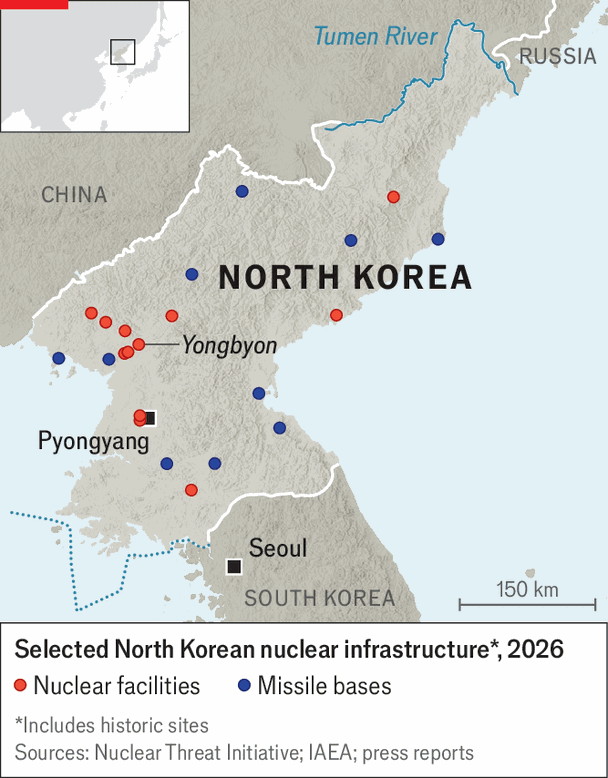
Six consecutive American administrations have failed to resolve North Korea’s nuclear impasse, and Donald Trump is currently exploring another summit with Kim Jong Un, potentially utilizing November’s APEC gathering to propose an unprecedented presidential meeting in Pyongyang. Kim, however, explicitly preconditions any diplomatic re-engagement on Washington abandoning its longstanding demand for full denuclearisation, puncturing American overtures by testing an advanced hypersonic missile just weeks after Trump curtailed joint military exercises with South Korea. Having signed the Nuclear Non-Proliferation Treaty (NPT) in 1985 before illicitly conducting six nuclear tests between 2006 and 2017, North Korea formally codified its nuclear status into its constitution in 2023. Trump cites North Korea’s stockpile at 57 warheads while independent monitors estimate up to 120 (comparable to Britain’s 225), and newly expanded uranium enrichment facilities at Yongbyon yield sufficient fissile material to manufacture ten to 20 additional warheads annually, with American military intervention in Iran reinforcing Kim’s regime-survival calculations.
Pyongyang’s diplomatic intransigence is underpinned by a transformative wartime alliance with Russia that has fundamentally neutralized Western sanctions. By supplying Moscow with artillery shells, ballistic missiles, and roughly 16,000 troops for the war in Ukraine, North Korea secured crucial reciprocal flows of food, hard currency, energy, and dual-use aerospace technology, alongside potential technical assistance for nuclear-powered submarines. A newly opened road bridge across the Tumen river and Russia’s issuance of over 35,000 student visas for industrial munitions labour have energized the North's economy, driving average annual GDP growth to 3.4% between 2022 and 2025 according to South Korea's central bank. With Russian diplomats declaring North Korea's nuclear status a "closed issue" and China acquiescing, Kim possesses unprecedented regional leverage.
Consequently, diplomatic frameworks are shifting toward de facto recognition, with South Korean President Lee Jae Myung advocating a phased nuclear freeze and prominent American strategists like Victor Cha urging a transition toward traditional arms control and "cold peace." Trump himself increasingly refers casually to North Korea as an established "nuclear power." However, unlike non-signatories India or Pakistan, legitimising a state that exploited the NPT to acquire civilian technology while cheating would permanently gut the global non-proliferation architecture. Furthermore, any bilateral accommodation that leaves North Korea’s thermonuclear arsenal intact while exposing regional allies risks triggering rapid domestic nuclear proliferation across both South Korea and Japan, fracturing the postwar Pacific security umbrella.
Source: Will Donald Trump meet Kim Jong Un again?
Subtitle: North Korea wants America to drop demands for disarmament
Dateline: Oct 1st 2026\n