西欧正经历今年的第五轮热浪,莱茵河和多瑙河的水位降至自1880年有官方记录以来的最低水平。作为全长1230公里的莱茵河水深基准,考布镇的测量计在8月12日显示最大水深仅为12厘米,远低于2018年创下的25厘米纪录,甚至可能跌至个位数并切断航道。与此同时,多瑙河布达佩斯段的水位降至26厘米,打破了2018年33厘米的低位纪录;这严重威胁了能源供应,导致供应匈牙利30%电力的帕克斯核电站和罗马尼亚切尔纳沃德核电站因冷却水不足而部分或全部停运,迫使奥迪和达契亚等车企缩减生产,并使沿岸裸露出历史“饥饿石”、二战军车、猛犸象遗骸以及1944年自沉的200多艘纳粹战舰。
这两条河流承载着关键的经济命脉:莱茵河占欧盟内河货运总量的约三分之二以及集装箱水运的99%以上,而多瑙河承担着约8%的欧盟货运总量。为了避免搁浅,目前的驳船运载量仅为其常规装载量的15%至20%,例如海尔布隆运往科隆的岩盐驳船载重从2200吨骤降至280吨,极大地推高了物流成本。莱茵河对德国经济尤为重要,每天约有600艘货船穿越德荷边境将大宗商品运往鹿特丹港,沿河集聚了拜耳、巴斯夫等化工和制药巨头。
在过去十年中,企业通过增加库存、改用浅水船只或转向公路与铁路来适应常态化的枯水危机,德国水路货运占比已从2017年的4.7%降至2024年的4.1%。持续的干旱重创了两大河流的游轮观光业,并引发了农业和渔业生计的普遍担忧。鉴于2018年的干旱使德国GDP缩减了约0.4%,分析师预计如果当前创纪录的低水位持续到10月,可能会使德国GDP损失0.5%,其对中欧整体经济的全面冲击仍有待进一步评估。
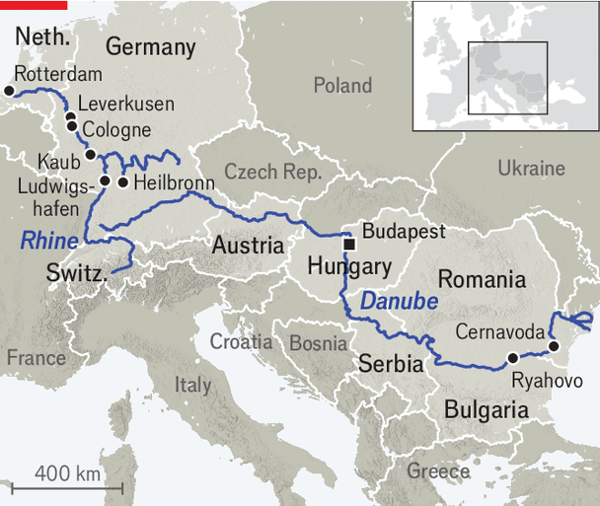
Western Europe is enduring its fifth heatwave of the year, driving water levels on the Rhine and Danube rivers to their lowest depths since official record-keeping began in 1880. At the critical Kaub gauge along the 1,230km Rhine, maximum water depth plummeted to 12cm on August 12th, well below the previous 2018 drought record of 25cm, threatening to split the navigable waterway. Similarly, the Danube in Budapest reached a record low of 26cm compared to 33cm in 2018. This crisis forced cooling-dependent nuclear facilities—including Hungary's Paks plant generating 30% of national power and Romania's Cernavoda—to curtail operations, prompting energy rationing, auto manufacturing cuts at Audi and Dacia, and exposing historic hunger stones, mammoth fossils, and scuttled Nazi fleets from 1944.
These river systems serve as indispensable European commercial arteries: the Rhine accommodates roughly two-thirds of the European Union's inland freight traffic and over 99% of its waterborne container shipping, while the Danube carries approximately 8% of total volume. To prevent grounding, barges are currently operating at merely 15% to 20% of their standard capacity, such as salt shipments dropping from 2,200 tonnes to 280 tonnes per vessel, which significantly elevates logistics costs. The Rhine remains vital for Germany's industrial heartland, where 600 vessels cross the Dutch border daily toward Rotterdam, supplying multinational conglomerates including Bayer and BASF.
Over the past decade, corporations have adapted by maintaining larger inventories and shifting freight to rail and road, causing German inland waterway transport shares to decline from 4.7% in 2017 to 4.1% in 2024. Nevertheless, the prevailing drought has brought river cruise tourism to a virtual standstill while stoking agricultural and fishery distress. Given that the 2018 drought shaved roughly 0.4% off German gross domestic product, economists estimate that if the current severe conditions persist through October, it could reduce German GDP by 0.5%, with the broader macroeconomic fallout across Central Europe yet to be fully realized.
Source: Europe’s dry rivers are exposing mammoths and Nazi warships
Subtitle: Record heat and drought are crippling
Dateline: 8月 13, 2026 05:16 上午 | BERLIN