向选民推销资料中心并不容易,因为大部分产值由美国的晶片与软体巨头获得,但澳洲政府要求新站点必须配套充足能源,预估到 2030 年需投资 1000 亿美元,这有助于提振疲软的本土经济;同时澳洲拥有近乎无限且廉价的风能与太阳能资源,太阳能成本甚至比美国低了约 35%。
过去澳洲尝试透过氢能出口绿能至液化天然气市场的经济效益不佳,但将充沛的再生能源转化为资料中心算力并出口至全球,特别是针对需要庞大投资的 AI 模型训练任务,能有效分担澳洲从煤炭过渡到绿能的高昂成本,是兼顾能源转型与经济效益的实用策略。
Australia is grappling with growing local pushback from "Bananas" against data centre expansions, even as its current AI compute capacity sits at a mid-ranking 1.4GW. Nevertheless, global developers are actively pursuing opportunities, highlighted by Anthropic anchoring a A$30bn project near Brisbane and extensive discussions in New South Wales for 13GW of capacity, which could drive data centres to consume up to 12 percent of the national power supply by 2050.
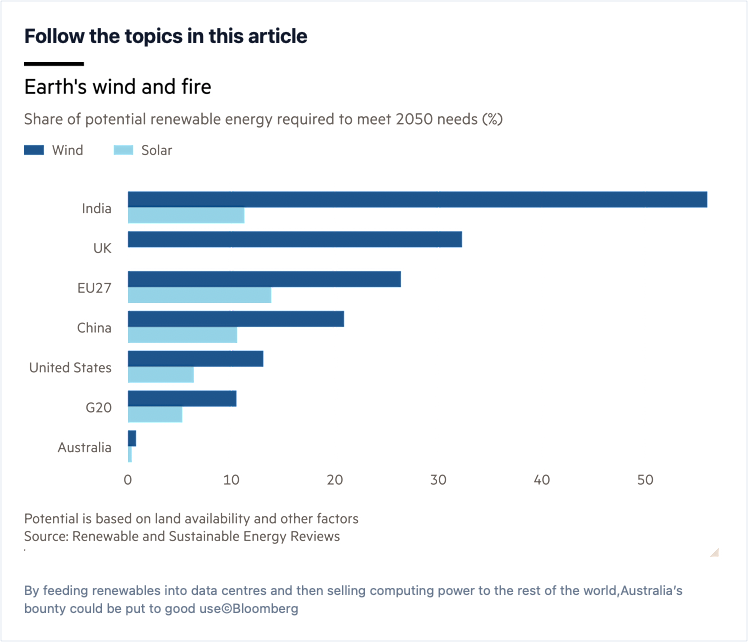
Persuading skeptical voters remains difficult since much of the economic value accrues to American chip and software providers; however, Canberra's mandate requiring new sites to provide matching power will channel an estimated $100bn into domestic infrastructure by 2030 to bolster a slowing economy, heavily leveraging Australia's vast and cost-effective solar and wind resources.
While earlier attempts to export renewable power through green hydrogen proved economically unviable, utilizing cheap green energy to power data centres and export computing capacity globally offers a practical solution; although unsuitable for low-latency tasks, it is ideally tailored for capital-intensive AI model training, helping distribute the massive financial burden of phasing out coal.