富裕国家的劳动力市场整体表现强劲。过去三年,经合组织国家的平均失业率多次触及历史低点,劳动年龄人口的就业率创下新高。更引人注目的是,各国长期存在的就业刻板印象正在瓦解。爱尔兰曾长期高失业,如今与英国和美国的失业率大致相当;智利曾是低失业典范,却在2010年代末成为经合组织中失业率较高的国家之一。
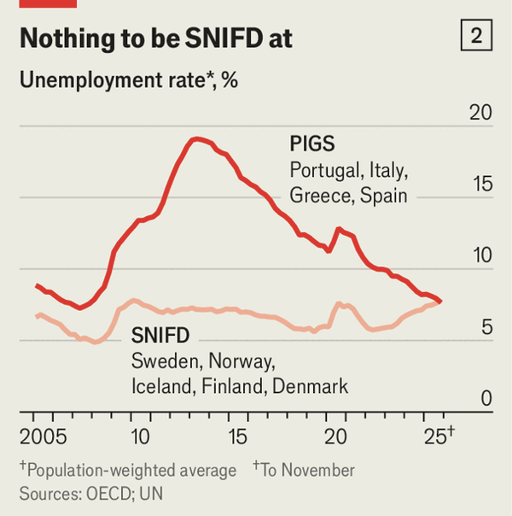
这种颠倒仍在加速。澳大利亚过去几十年的失业率平均比新西兰高0.5个百分点,如今却低1个百分点,因新西兰正消化房地产泡沫破裂。哥斯达黎加的失业率已从长期高于10%降至5.8%。近月加拿大失业率显著上升,而美国保持稳定。变化最剧烈的是南欧:2012—2013年欧债危机高峰期,葡萄牙、意大利、希腊和西班牙的平均失业率接近20%。如今,这些国家的失业率反而低于北欧五国;希腊为8.2%,而芬兰的失业率近期首次自1990年代以来超过10%。
更深层的趋势是趋同。2000年代,经合组织中失业率最高与最低国家之间的差距平均达14个百分点;如今仅约8个百分点。教育改善、招聘技术进步以及更严格的福利制度,使各国劳动力市场更相似。尽管如此,北欧仍可向南欧学习:意大利的终身学习计划、希腊疫情后的改革,以及西班牙2021年改革后临时就业的显著下降,均有助于降低失业率。传统标签需要更新。
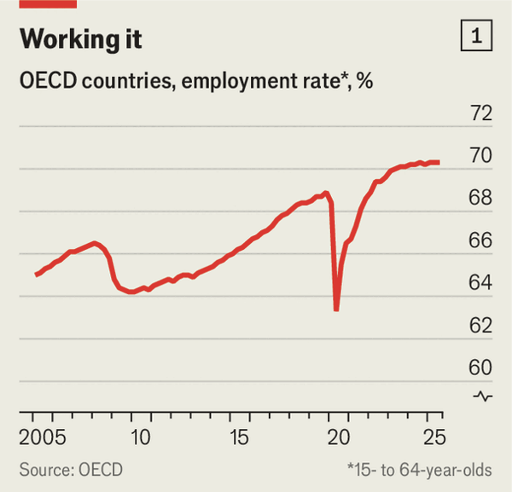
The rich world’s labour market is strong. Over the past three years, average unemployment across OECD countries has repeatedly hit record lows, while the employment rate of working-age people is at an all-time high. More striking is the erosion of long-standing job stereotypes. Ireland, once plagued by high unemployment, now has rates similar to Britain and America; Chile, long a low-unemployment haven, became one of the OECD’s higher-unemployment countries by the late 2010s.
The reversal has accelerated. Australia’s jobless rate, historically 0.5 percentage points above New Zealand’s, is now 1 point lower as New Zealand absorbs a housing-bubble bust. Costa Rica has cut unemployment from persistent double digits to 5.8%. Canada’s rate has climbed in recent months even as America’s has stayed steady. The biggest shift is in southern Europe: after averaging nearly 20% unemployment in 2012–13, Portugal, Italy, Greece and Spain now collectively post lower joblessness than the Nordics; Greece is at 8.2%, while Finland’s recently exceeded 10% for the first time since the 1990s.
A deeper convergence underlies these shifts. In the 2000s the gap between the most and least jobless rich countries averaged 14 percentage points; today it is about eight. Better education, improved matching via platforms like LinkedIn, and tougher benefits policies have narrowed differences. Even so, the Nordics could learn from the south: Italy’s lifelong-learning programmes, Greece’s post-pandemic reforms, and Spain’s 2021 labour reform that sharply reduced temporary work have all helped lower unemployment. Long-held labels no longer fit.