在美国大流行后的城市格局演变中,旧金山与迈阿密的命运发生了显著逆转。2021年旧金山曾因人口外流损失了近7%的人口,但这一外流潮目前已明显放缓;相比之下,迈阿密-戴德县在2025年因国内人口外流损失了3%的人口,成为全美人口流失比例最大的大型县。旧金山的复苏主要得益于两股力量:一是自2022年起选民罢免激进派检察官并在2024年选出务实派市长丹尼尔·卢里,转向以解决预算赤字和优化营商环境为核心的实用主义路线;二是人工智能产业的蓬勃发展,根据世邦魏理仕(CBRE)的数据,在2019年至2026年期间,旧金山与硅谷占全美六大主要人工智能市场中AI企业租赁总面积的三分之二(约66.7%)。
与此同时,此前充分享受疫情红利的迈阿密正面临严峻的生活成本危机与人口流失压力。尽管迈阿密的净人口迁移量曾从2021年的-2.5万人飙升至2023年的5万人,但随着联邦移民政策收紧,其国际移民量在2023年至2025年间缩减了一半。自2020年以来,迈阿密-戴德县的住房价格暴涨了58%,远高于44%的全美平均涨幅,使其居住成本占收入比居全美各大城市首位。美国国税局(IRS)的最新数据显示,2023年迁出迈阿密-戴德县的家庭平均收入比新迁入家庭低约40%,显示出富豪涌入与中低收入群体被挤出的双重趋势。
相比之下,税务数据表明旧金山新迁入居民的平均收入比迁出者低约25%,但其高端房地产市场依然活跃,如太平洋高地等富人区的房价在过去一年里上涨了14%。两座城市目前均面临贫富分化加剧及住房负担能力恶化的挑战。迈阿密新任市长艾琳·希金斯试图通过增加公共交通周边的廉租房建设来缓解危机,但私营开发商仍倾向于面向亿万富翁群体建造超级豪宅。如何避免城市演变为仅供极少数富豪享乐而普通劳动者无力负担的“富人避税所”,成为了摆在旧金山与迈阿密决策者面前的共同难题。
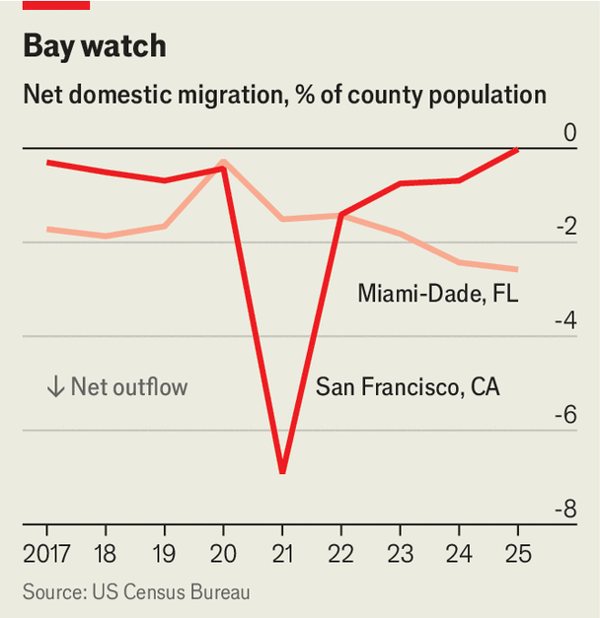
In the evolving post-pandemic urban landscape of the United States, the fortunes of San Francisco and Miami have undergone a striking reversal. While San Francisco suffered an out-migration equivalent to nearly 7% of its population in 2021, that population exodus has largely stabilized; conversely, Greater Miami lost 3% of its population to domestic out-migration in 2025, marking the highest relative loss among all large American counties. San Francisco's turnaround is driven by political moderation under Mayor Daniel Lurie and a booming artificial intelligence sector. According to real estate firm CBRE, between 2019 and 2026, San Francisco and Silicon Valley accounted for two-thirds (66.7%) of all office square footage leased by AI companies across the six largest American AI markets.
Conversely, Miami is grappling with severe housing affordability pressures and shifting demographic trends following its pandemic boom. Although Miami's total net migration surged from -25,000 in 2021 to 50,000 in 2023, international migration into the metropolitan area halved between 2023 and 2025 under tighter federal border policies. Furthermore, home prices in Miami-Dade County have surged by 58% since 2020, significantly outpacing the national average growth rate of 44%. According to Internal Revenue Service (IRS) data, the average household moving out of Miami-Dade County in 2023 earned approximately 40% less than the average incoming resident, reflecting an accelerating influx of high-net-worth individuals alongside the displacement of middle-class families.
Tax data from San Francisco present a contrasting dynamic, showing that incoming residents earn roughly 25% less than those leaving, even as luxury real estate in neighborhoods like Pacific Heights appreciated by 14% over the past year. Both municipalities now confront widening economic inequality and potential social polarization. While Miami's newly elected mayor, Eileen Higgins, advocates for expanding affordable housing near transit corridors, private developers remain focused on constructing ultra-luxury megamansions on Miami Beach. Consequently, municipal leaders in both California and Florida face the shared challenge of implementing pragmatic policy reforms to ensure their metropolitan economies remain accessible to working-class residents rather than exclusive enclaves for plutocrats.
Source: The tide turns for a Florida darling and California loser
Subtitle: Miami faces new problems as San Francisco makes a comeback
Dateline: 7月 30, 2026 05:37 上午 | San Francisco and Miami