火山口湖的长期监测数据揭示其对气候变暖的敏感性。作为无河流汇入、无农业或城市污染源的封闭系统,它自 1965 年起的平均表层水温已上升 3°C。过去 60 年中,夏季夜间气温升幅快于白天,最冷夏夜已不如以往寒冷;湖区“夏季天气日数”增加了 33 天,反映春季提前、暖季延长的显著趋势。纯净水体使这些变化几乎完全归因于气候驱动,而非外部人为变量。
监测依赖一套高频剖面系统:每晚 20:00,一台管状剖面仪沿 585 米定点钢缆上下移动,并以每秒 2 次频率记录导电度、温度、氧、盐度,辅以光学传感器测量叶绿素荧光与浮游植物颗粒密度。这一连续序列使水体物理结构、化学分层与生物变化的细尺度趋势得以量化,而非仅停留在单点观测。
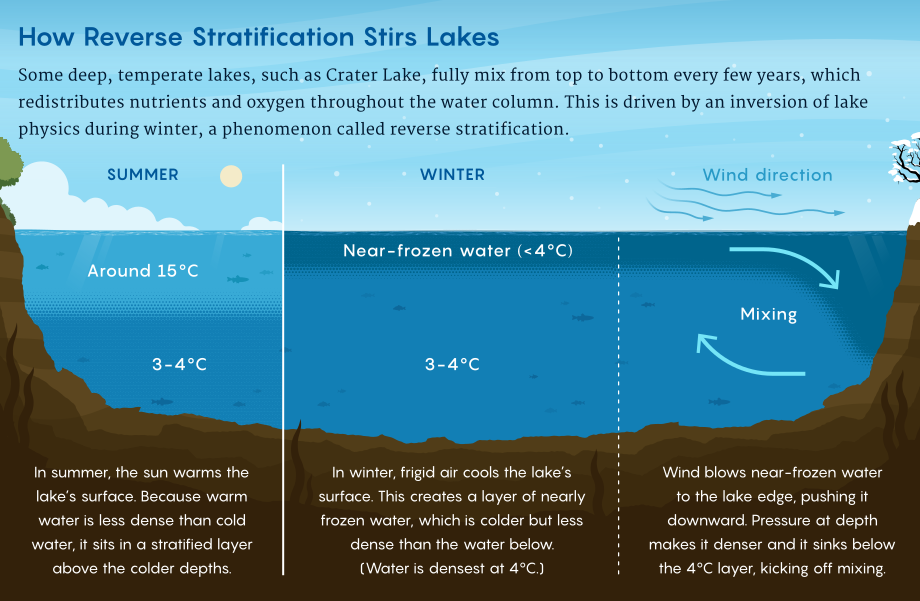
这些指标共同构成湖泊混合动力变化的背景条件。随着水温升高、夜间冷却减弱与季节延长,深水—浅水之间的密度差增大,可能削弱湖体垂向混合强度,进而影响溶解氧补给与生态系统稳定性。作为几乎未受人类干扰的大型深湖之一,火山口湖为量化全球深湖对气候强迫的物理响应提供了罕见基线。
Crater Lake’s long-term monitoring data reveal its sensitivity to warming. As a closed, pollution-free system with no inflowing rivers, its average surface temperature has risen by 3°C since 1965. Over the past 60 years, summer nighttime warming has outpaced daytime trends, the coldest summer nights are warmer than before, and the lake has gained 33 additional summer-like days as spring arrives earlier. Its purity makes these trends attributable almost entirely to climate forcing rather than external human disturbance.
Monitoring relies on a high-frequency profiling system: each night at 8 p.m., a tube-shaped profiler traverses a fixed 585-meter cable, recording conductivity, temperature, oxygen and salinity at 2 Hz, complemented by optical measurements of chlorophyll fluorescence and phytoplankton particle density. This continuous sequence enables fine-scale quantification of physical stratification, chemical structure and biological shifts rather than isolated snapshots.
Together, these metrics frame changes in deep-lake mixing dynamics. Elevated temperatures, weakened nocturnal cooling and an extended warm season increase density gradients between deep and surface waters, potentially reducing vertical mixing, diminishing deep-water oxygen renewal and altering ecosystem stability. As one of the few minimally disturbed deep lakes worldwide, Crater Lake provides a rare baseline for quantifying deep-lake physical responses to climatic forcing.