研究围绕极小曲面奇点的维数阈值展开,核心量化基准来自 Federer 1970 年的定理:n 维空间中极小曲面的奇点维数至多为 n−8,因此在 8 维中奇点必须为 0 维。团队通过反设与叠加构造在 8 维情形重新证明该结果:若扰动后奇点始终存在,则叠加可形成 1 维奇点线,此与 n−8=0 的限制矛盾,故奇点可通过扰动消除。此方法在 9 维与 10 维中通过“分离函数”得以推广,该函数量化不同扰动下奇点间的距离,并用于证明某些扰动可使奇点间距变大至消失。
进入 11 维后出现三维奇点类型,原方法失效。团队与 Wang 合作强化分离函数,使其适用于此类奇点,从而首次建立 11 维极小曲面的“泛正则性”。该结果将先前仅能处理至 8 维的多项几何与拓扑猜想推至 9–11 维,也为正质量定理在 9–11 维提供独立且较直观的验证路径。
未来走向取决于维数上限:要么泛正则性可继续扩展至更高维,要么 11 维后将出现无法被扰动消除的奇点。无论哪种,都将重塑高维极小曲面理论,影响从曲率问题到相变模型(如冰融化)的相关研究。
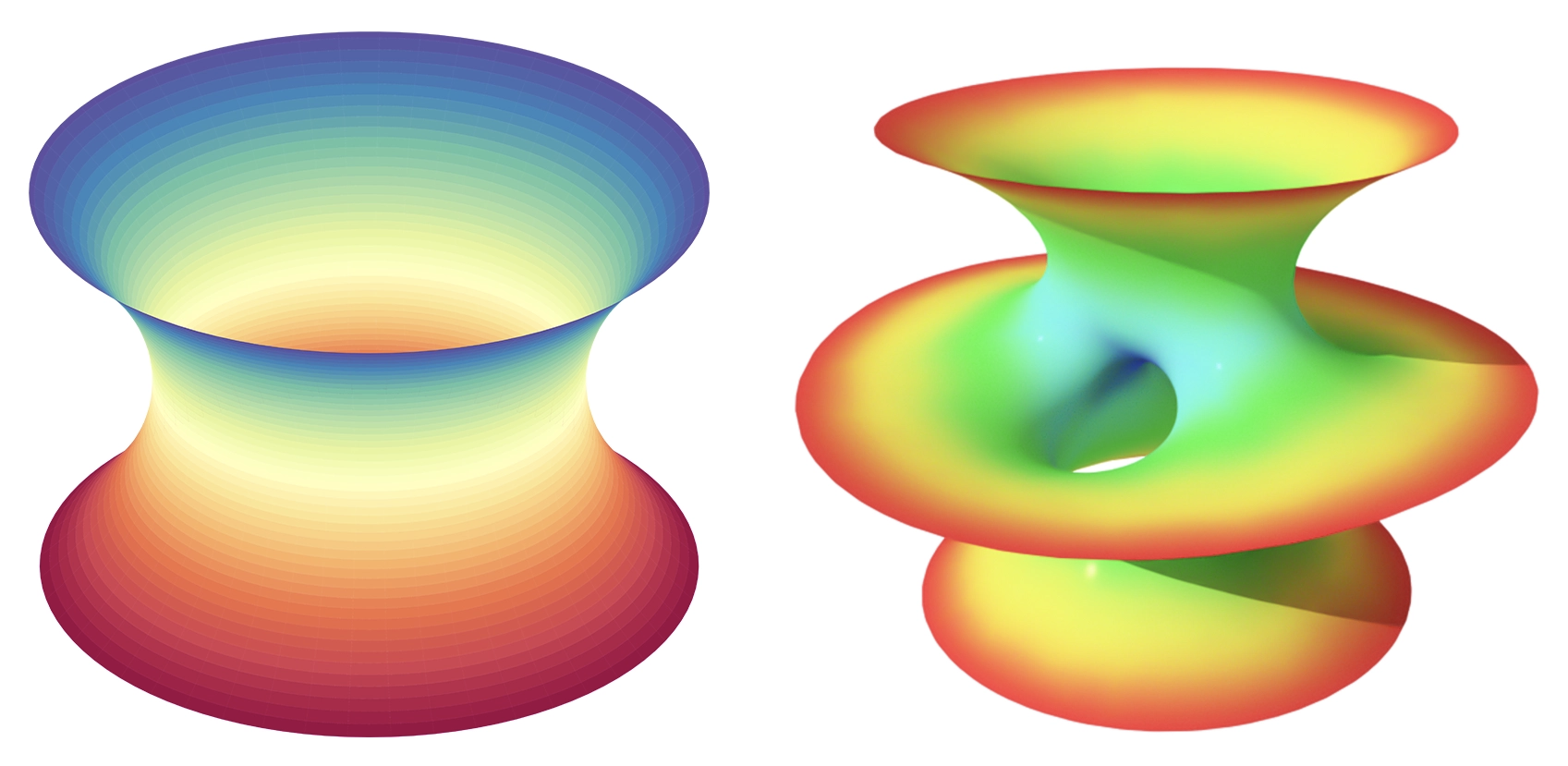
The work analyzes dimensional thresholds for singularities on minimal surfaces, grounded in Federer’s 1970 result that singularities in n dimensions have dimension at most n−8, forcing 0-dimensional points in 8D. Using contradiction and stacking, the team re-proved the 8D case: assuming singularities persist under perturbation yields a 1D line of singularities, contradicting n−8=0, so perturbations can eliminate them. A “separation function,” quantifying distances between singularities under perturbations, allowed extension to 9D and 10D by showing some perturbations enlarge separation enough for singularities to vanish.
In 11D, a problematic 3D singularity type broke the earlier method. Collaboration with Wang refined the separation function to handle this class, yielding the first proof of generic regularity for minimal surfaces in 11D. This extends many geometric and topological conjectures from the previous ceiling of 8D to dimensions 9–11, and offers an independent, more intuitive route to confirming the positive mass theorem in 9–11D.
Future progress hinges on dimensional limits: either generic regularity continues beyond 11D, or dimensions above 11 admit irreducible singularities. Either outcome will reshape high-dimensional minimal-surface theory and influence related domains, from curvature questions to phase-transition models such as ice melting.