硅谷正越来越多地受到“僵尸”独角兽的困扰,这些是曾经估值超过10亿美元但如今难以证明其过去巅峰估值合理性的初创公司。到2026年5月,在斯坦福大学追踪的1900只独角兽中,有332只以等于或低于其巅峰估值的价格筹集了资金,其中212只完全跌破了10亿美元的门槛。此外,383家初创公司在三年内没有披露任何新融资。这一低迷是由利率上升和风险投资募资急剧下降所驱动的,募资金额从2022年的2230亿美元暴跌至去年的仅660亿美元。
融资干旱迫使了显著的估值减记,例如Cameo从2021年的10亿美元暴跌至8200万美元,以及知乎海外版Quora在2024年以5亿美元的估值筹集资金,低于其2017年17亿美元的巅峰。退出这些投资已变得非常复杂,因为后期风险投资协议通常会授予投资者否决权,他们希望阻止低估值的首次公开募股,以期未来能够复苏。此外,风险资本家现在正优先考虑人工智能初创公司,这让那些老化的、陷入困境的公司除了接受苛刻的折价融资条款外几乎别无选择。
随着投资者面临从明年年底开始套现的压力,PitchBook预计全球估值8.6万亿美元(若排除前十家最大公司则为5万亿美元)的独角兽群体将面临5000亿至1万亿美元的估值减记。这一收缩导致近期的风险投资基金表现明显落后于公开市场,目前仅有5%的风险投资公司产生了该行业90%的利润。作为回应,风险投资人正在采用持续型基金并利用二级市场,希望成功的人工智能首次公开募股最终能重新激发对知名度较低的科技公司的兴趣。
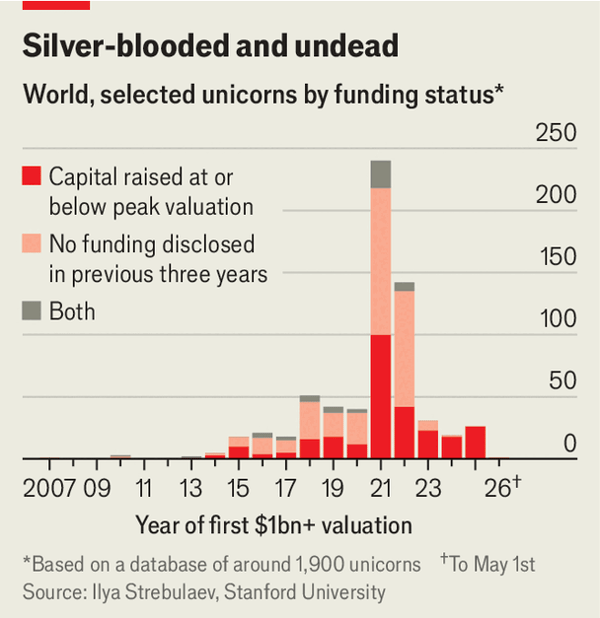
Silicon Valley is increasingly haunted by "zombie" unicorns, which are startups once valued at over $1 billion that now struggle to justify their past peak valuations. By May 2026, out of 1,900 unicorns tracked by Stanford University, 332 had raised money at or below their peak valuation, with 212 falling below the $1 billion threshold entirely. Furthermore, 383 startups had not disclosed any new funding for three years. This downturn is driven by rising interest rates and a sharp drop in venture capital fundraising, which plunged from $223 billion in 2022 to just $66 billion last year.
The fundraising drought has forced notable valuation write-downs, such as Cameo plummeting from $1 billion in 2021 to $82 million, and Quora raising capital at a $500 million valuation down from its $1.7 billion peak in 2017. Exiting these investments has become highly complicated, as late-stage VC agreements often grant veto rights to investors who want to block lower-valued initial public offerings in hopes of a future recovery. Moreover, venture capitalists are now prioritizing artificial intelligence startups, leaving older, struggling companies with few options other than accepting harsh down-round funding terms.
As investors face pressure to cash out starting in late next year, PitchBook projects valuation write-downs of $500 billion to $1 trillion across a global unicorn pool valued at $8.6 trillion (or $5 trillion excluding the ten largest). This contraction has caused recent VC funds to underperform public markets significantly, with just 5% of VC firms generating 90% of the industry's profits. In response, VCs are adopting continuous funds and utilizing secondary markets, hoping that successful AI IPOs might eventually revitalize interest in lesser-known tech firms.
Source: Zombie unicorns are haunting Silicon Valley
Subtitle: Years of frothy valuations have created a nightmare
Dateline: 6月 25, 2026 03:29 上午 | PALO ALTO