到2024年,全球在用工业机器人约470万台,密度仅为每1万名制造业工人177台;年度安装量在疫情期激增后趋于平台期,2024年为54.2万台。国际机器人联合会预计年度安装量将从2024年的54.2万台升至2026年的61.9万台,被视为下一轮增长的拐点之一。
更广泛的工厂自动化设备市场(传感器、执行器、控制器等)近几年需求疲软,且自2024年初以来主要供应商股价落后于其他富裕经济体公司。罗兰贝格预测,工业自动化设备整体的实际销售增速将从2025年的1–2%提高到2026年的3–4%,并在此后十年余下时间达到6–7%。
在工厂层面,西门子安贝格工厂可生产1500种控制器变体,自1989年投产以来产量约增长20倍而工人数大致相同;机器人硬件从典型的三轴发展到六轴并显著降价。软件与“数字孪生”提升了可重编程性与回报率,西门子去年以100亿美元收购Altair,且软件已占其工业自动化部门销售额的三分之一。
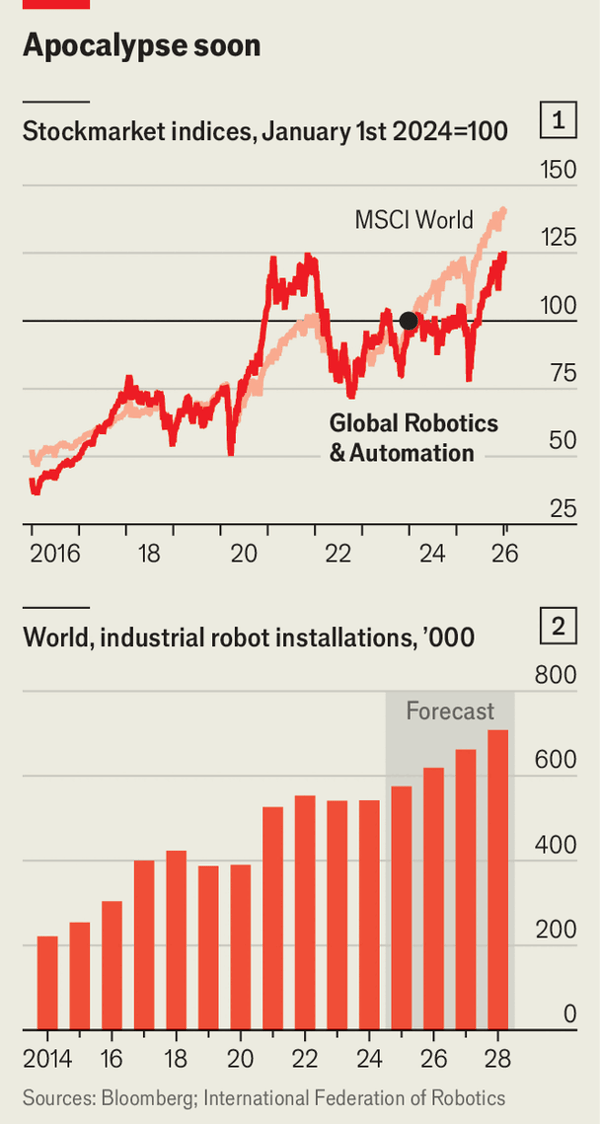
As of 2024, about 4.7 million industrial robots were operating worldwide, a density of just 177 per 10,000 manufacturing workers; after a pandemic-era surge, annual installations flattened, reaching 542,000 in 2024. The International Federation of Robotics projects annual installations rising from 542,000 in 2024 to 619,000 in 2026, seen as a key inflection point.
The wider factory-automation equipment market (sensors, actuators, controllers) has faced tepid demand for several years, and since the start of 2024 big suppliers’ shares have lagged other rich-world firms. Roland Berger forecasts inflation-adjusted sales growth for industrial-automation equipment rising from 1–2% in 2025 to 3–4% in 2026, then running at 6–7% for the rest of the decade.
On the factory floor, Siemens’s Amberg plant makes 1,500 variants of machine controllers and produces about 20 times its 1989 output with roughly the same headcount; robot arms have shifted from typical three-axis motion to six axes and have fallen sharply in price. Software and “digital twins” raise reprogrammability and returns, exemplified by Siemens’s $10bn Altair deal last year and software now accounting for one-third of sales in its industrial-automation division.
Source: The “ChatGPT moment” has arrived for manufacturing
Subtitle: Artificial intelligence promises to transform how and where things are made
Dateline: 1月 08, 2026 05:48 上午 | Amberg and Erlange