当前硅谷软件工程师已普遍通过语音指令驱动人工智能代理自动编写代码,但其他白领行业的技术普及速度仍显滞后。根据《经济学人》的初步测算,为了支撑云巨头和前沿AI实验室在数据中心上的巨额资本开支,全球来自AI应用的年收入必须从目前的约1500亿美元激增至本年代末的2.5万亿美元。目前,编程领域是AI应用最成功的桥头堡:Stack Overflow调查显示五分之四的程序员正在使用AI编程工具;SemiAnalysis估计编程已占到Anthropic和OpenAI合并年度经常性收入(ARR)的半数以上;Cognition、Cursor、Lovable和Replit四家代码初创公司的总ARR更是在过去一年内从8亿美元暴增至60亿美元。
资本市场和科技企业正积极将AI拓展至法律、金融和客户服务三大传统白领领域。在法律领域,Harvey、Clio和Legora三家初创公司的总ARR在过去一年翻番至10亿美元,且Harvey用户的使用时长每月成倍增长;在金融领域,面向机构的AI工具开发商Rogo上个季度新增了100家企业客户,ARR录得50%的增幅;在客户服务赛道,Sierra的年化收入在6月达到2亿美元,较去年11月翻倍。风险投资家今年已向客服类AI初创公司注资30亿美元,超过了其他任何应用门类。
然而,编程领域的巨大成功主要得益于四大难以复制的独特属性。首先,互联网上存在海量开源代码供模型训练,部分模型中开源代码占比高达五分之一,而商业谈判和客服记录缺乏同等规模的公开数据;其次,软件工程拥有成熟的自动化测试机制,代码可由测试程序自我验证并反馈纠错,而在法律审阅和金融估值中判断微妙的人际意图极其复杂;第三,编程所需上下文几乎完全数字化并集成于代码库或API接口,而非隐藏于员工头脑中;最后,习惯于技术迭代的程序员天然具备自下而上尝试新工具的自由度,而客服、律师和银行家则受到工作权限、合规审查及监管框架的严格约束。
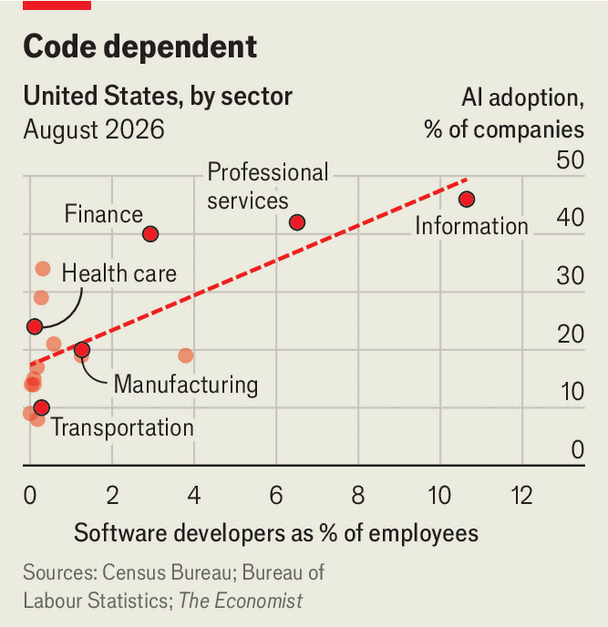
Software engineers in Silicon Valley increasingly generate code by speaking instructions to artificial intelligence agents, establishing programming as the primary enterprise showcase for generative models. Broadening this adoption across the wider white-collar economy is urgent: calculations by The Economist indicate that justifying the massive data-centre infrastructure build-out will require global annual AI revenues to surge from approximately $150 billion today to $2.5 trillion by the end of the decade. Currently, software engineering remains a massive outlier. Four-fifths of developers report utilising AI coding tools according to Stack Overflow, while SemiAnalysis calculates that programming generates over half of the combined annual recurring revenue (ARR) for OpenAI and Anthropic. Furthermore, four specialized coding startups—Cognition, Cursor, Lovable, and Replit—surged from a combined ARR of roughly $800 million in June 2025 to $6 billion today.
Technology vendors and investors are targeting law, finance, and customer support as the next major growth vectors. In the legal sector, specialized AI platforms Harvey, Clio, and Legora doubled their aggregate ARR over the past year to reach $1 billion, with user engagement hours on Harvey doubling monthly. In financial services, startup Rogo expanded its enterprise roster by 100 corporate clients last quarter, elevating its ARR by 50%. Meanwhile, conversational customer-service provider Sierra reached $200 million in ARR by June, doubling its November tally. Bullish venture capitalists deployed $3 billion into customer-service AI startups during 2026, representing the single largest allocation across all generative software categories.
Replicating the widespread success of AI coding across other professional sectors remains difficult due to four structural divergences. First, software tools leveraged vast repositories of public open-source code—comprising nearly one-fifth of all training corpora in certain frontier models—whereas equivalent training datasets do not exist for private contractual deliberations or sensitive complaints. Second, code outputs are subject to deterministic automated verification through pre-existing unit tests, providing immediate programmatic feedback that cannot be replicated when assessing nuanced legal clauses or delicate client negotiations. Third, necessary engineering contexts are digitally centralized in codebases and APIs, unlike proprietary institutional expertise stored in employees' minds. Finally, software engineers possess the technical latitude to embrace tools bottom-up, unlike call-center staff and heavily regulated legal and financial professionals bound by rigid compliance frameworks.
Source: Will anybody use AI as much as coders do?
Subtitle: The answer will have big implications for the investment boom
Dateline: Sep 3rd 2026