作为购买专业AI芯片并向外转租的中间商,“新型云服务商”(neoclouds)已成为人工智能行业增长最快但也最脆弱的参与者。凭借由加密货币挖矿转型而来的数据中心以及对AI算力的纯粹专注,CoreWeave、Nebius、IREN、Applied Digital和Core Scientific等五大上市新型云巨头迅速崛起,直接向OpenAI等大模型开发商以及自身算力紧缺的传统超大规模云厂商出租计算资源,并获得了英伟达的大力资金扶持。在截至2026年年中的过去12个月内,这五家公司的合并年收入从2024年的30亿美元飙升至180亿美元。据Dell’Oro估算,新型云企业合计拥有1.5至2.5吉瓦(GW)的数据中心容量,尽管仍远低于四大科技巨头的20至24吉瓦,但其容量正以每年翻倍的速度狂飙,扩张速度约为传统超大规模企业的近三倍。
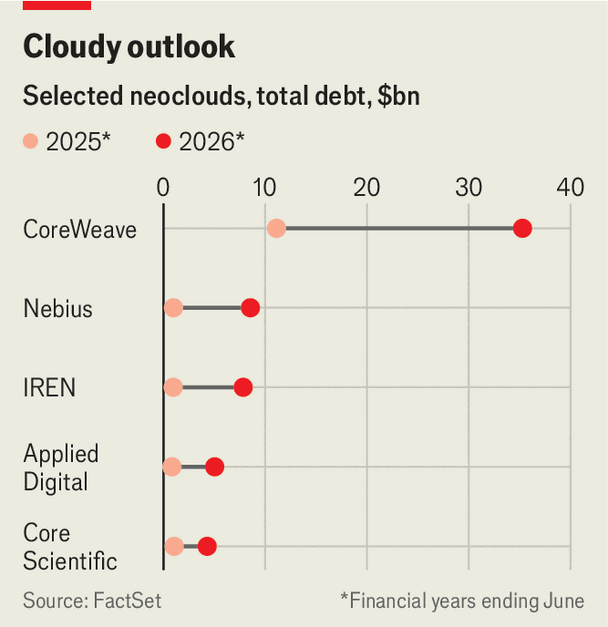
然而,这种超常规扩张完全建立在巨额债务杠杆之上。五大上市新型云服务商的资产负债表上已累积了高达610亿美元的有息负债,较一年前激增三倍,此外还承担着180亿美元的经营租赁义务。目前没有一家企业实现营业盈利,计入沉重利息开支后更是深陷巨额亏损:在最近一个季度,Nebius的利息支出占其总收入的五分之一,而CoreWeave的利息负担更是吃掉了整整四分之一的收入。雪上加霜的是,市场竞争正全面激化,全球已有约200家新型云公司参与角逐,甲骨文今年以借贷为主的资本支出预计达到770亿美元,软银亦推出了SB Neo业务,其控股并与OpenAI合作建设俄亥俄数据中心的SB Energy更于9月1日提交了IPO申请。
激烈的行业内卷放大了新型云公司面临的两大系统性风险。首当其冲的是信贷市场震荡风险,随着借贷成本上升以及新型云债券与整体高收益垃圾债利差的持续走阔,其微薄的资金链面临严重挤压;更大的威胁则在于算力供需格局的逆转,一旦企业端AI普及速度放缓,自建数据中心陆续落成的传统巨头将迅速削减外包算力租约。面对沦为过剩运力炮灰的危险,CoreWeave和Nebius等头部玩家正全力求变,一方面向对美国科技巨头心存顾忌的西方政府推销“主权云基础设施”,另一方面加速开发专有软件服务,力图摆脱单纯算力倒爷的脆弱定位。
Specialist compute intermediaries known as "neoclouds" have emerged as rapid beneficiaries of the artificial intelligence investment boom, purchasing advanced graphics processors to lease capacity to third parties. Capitalising on infrastructure repurposed from cryptocurrency mining and unencumbered by legacy cloud operations, operators like CoreWeave, Nebius, IREN, Applied Digital, and Core Scientific provide critical compute to model developers like OpenAI while benefiting from financing backing by Nvidia. Over the past 12 months, the collective annual revenue of these five publicly listed neoclouds surged to $18 billion, up from $3 billion in 2024. Research firm Dell'Oro estimates neoclouds command 1.5 to 2.5 gigawatts (GW) of data-centre capacity, compared to 20 to 24GW deployed by Alphabet, Amazon, Microsoft, and Meta combined; however, neocloud capacity is doubling annually, roughly triple the expansion velocity of incumbent hyperscalers.
This breakneck capital deployment is financed by precarious levels of leverage. The five listed neoclouds have accumulated $61 billion in balance-sheet debt—a fourfold increase over twelve months—alongside $18 billion in operating leases. None generates an operating profit, and net losses widen considerably once debt-servicing costs are factored in; during the latest financial quarter, interest payments consumed 20% of revenue at Nebius and 25% at CoreWeave. Concurrently, competitive pressures are intensifying from established players. Meta is evaluating a third-party compute offering, Oracle projects debt-fuelled capital expenditures of $77 billion this year, and SoftBank launched SB Neo while its affiliate SB Energy—partnered with OpenAI on a massive Ohio facility—filed for an initial public offering on September 1st, alongside 200 smaller regional compute brokers worldwide.
Escalating saturation accentuates two existential hazards for the neocloud model. First, debt vulnerabilities expose providers to capital-market shocks; yields on neocloud debt are currently widening relative to benchmark high-yield corporate bonds. Second, any demand deceleration across end-user applications could prompt hyperscalers and frontier labs to terminate external capacity rentals abruptly. To avoid insolvency during an infrastructure retrenchment, leading providers are attempting to diversify beyond commoditised hardware reselling. CoreWeave and Nebius are developing proprietary software management layers, while positioning themselves as dedicated sovereign infrastructure partners for Western governments seeking sovereign compute independence from American tech conglomerates.
Source: Neoclouds like CoreWeave are getting much bigger—and riskier
Subtitle: The mountain of debt funding their expansion is growing rapidly
Dateline: Sep 3rd 2026