奥尔班的“竞争性威权主义”模式——以胜选取得合法性、却借国家权力、媒体控制和制度重画巩固执政——在匈牙利4月12日议会选举中遭遇最严峻考验。其对手彼得·马加尔在欧洲议会选举中让提萨党获30%后,从前奥尔班内部分子转向反对派核心人物,但结果仍未定;亲奥尔班民调显示奥尔班平均领先约7个百分点,而反对派联手民调平均领先约13个百分点,且在偏向奥尔班的选区格局下,提萨要赢得多数恐怕需接近5个百分点优势,奥尔班在2022年仅拿到54%选票却赢得68%席位。
真正的压力来自经济:匈牙利GDP在2023年下滑0.8%,“上年”仅增长0.4%,而波兰同期增长3.6%,通胀在2023年冲到欧盟最高的17%。匈牙利福林从2022年初兑欧元360升到2025年初415,央行基准利率维持6.25%,比欧洲央行高4个百分点以上,抬高信贷成本;同时欧盟因法治与审计问题冻结了超过160亿欧元复苏与区域援助,奥尔班另有约1000亿美元对乌援助搁置,财政可用现金同步收紧。
腐败与治理结构性问题在关键指标上被放大:布达佩斯腐败研究中心称与奥尔班盟友相关的单一招标政府合同比例已从2022年的39%升至75%,透明国际亦将匈牙利列为欧盟“最腐败国家”。医疗支出仅占GDP的6.5%,低于捷克、波兰、斯洛伐克均在8%以上的水平,现有全科医生约5,000人、平均年龄61岁,却缺口6,000人;首都布达佩斯贡献约40%全国GDP却因“团结税”向贫困地区转移资金而加剧财政风险,选民正以“现在或永远”抉择是否继续现状。

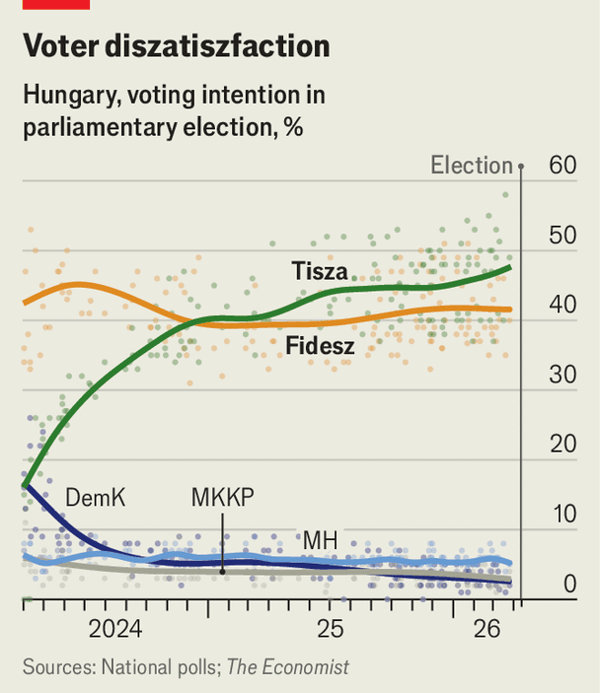
Orban’s competitive-authoritarian model—elected legitimacy combined with state capture, media control, and redrawn rules—is facing its sharpest test in Hungary’s Apr. 12 parliamentary election. His rival, Péter Magyar, rose from a former ruling-party insider to opposition focal point after Tisza took 30% of the European Parliament vote, yet the race is still uncertain: pro-Orban polls put him up by about 7 points while opposition-linked polls show him down about 13, and district gerrymandering means Tisza likely needs a near 5-point lead for a majority despite Orban’s 2022 54% vote translating into 68% of seats.
The sharper pressure is economic. Hungary’s GDP fell 0.8% in 2023 and rose only 0.4% last year versus Poland’s 3.6%, inflation peaked at 17%, and the forint moved from 360 per euro in early 2022 to 415 in early 2025; the policy rate of 6.25% is more than 4 points above the ECB’s, pushing borrowing costs up, while over €16bn in EU recovery and cohesion aid has been frozen and roughly $100bn in Ukraine support is being blocked.
Corruption is visible in hard numbers: state contracts awarded without open bidding to firms linked to Orban allies rose from 39% in 2022 to 75%, and Transparency International ranks Hungary as the EU’s most corrupt country. Public services are strained as health spending is only 6.5% of GDP (with neighboring Visegrád states at or above 8%), there are 5,000 general practitioners against a need for 6,000 with average age 61, and Budapest, which generates about 40% of GDP, faces post-election insolvency risk after transfers to poorer municipalities—so voters are deciding whether this model stays or “now or never” breaks it.
Source: Might Hungary’s election sweep away MAGA’s favourite foreign leader?
Subtitle: Whether Viktor Orban wins or loses, the world’s populists and their opponents are watching
Dateline: 4月 02, 2026 02:09 上午 | Hodmezovasarhely