过去五年左右,美国生产率增速已升至约二十年来最快水平:无论按人均产出还是每小时产出计算,年增速都约为2%,而2010年代大部分时间只有约1%。这推动美联储把美国长期GDP增长中值预测从1.8%上调至2%,也让“长期停滞”的叙事迅速失色。
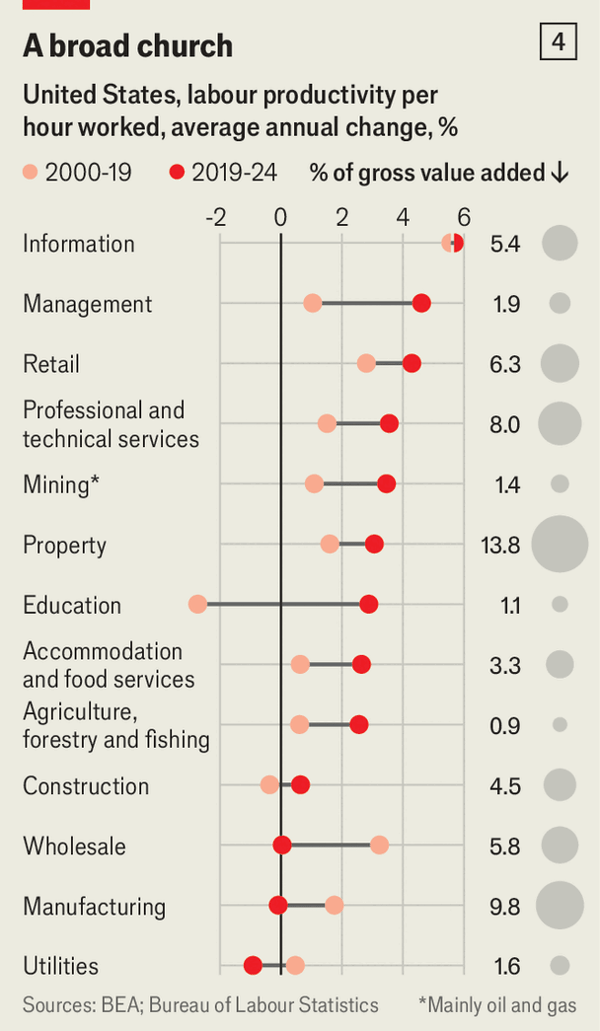
但目前还不能把这一复苏归功于人工智能,因为生产率在2020年代初就已回升,而大语言模型真正进入商业应用只是过去一年左右的事。数据显示,主要拉动来自行业内部变化:2019—2024年“信息”行业年均增速约6%,并非高于2000—2019年的平均值,而且其占美国总产出的比重始终仅在5.3%—5.5%之间。
更显著的跃升出现在专业服务和管理业,这些行业约占美国经济的十分之一;它们并不创造新技术,却是技术的重度使用者。油气业也因页岩革命和液化天然气出口而提速,美国电价平均约为欧洲的一半、比日本低三分之一,整体经济因此更具韧性。
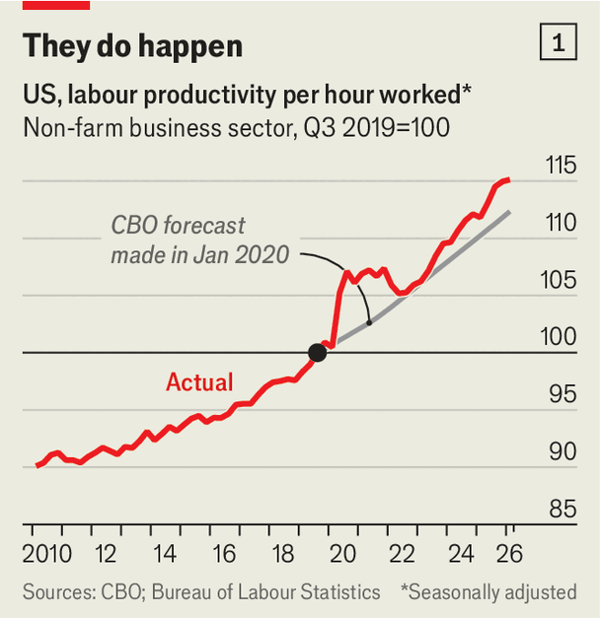
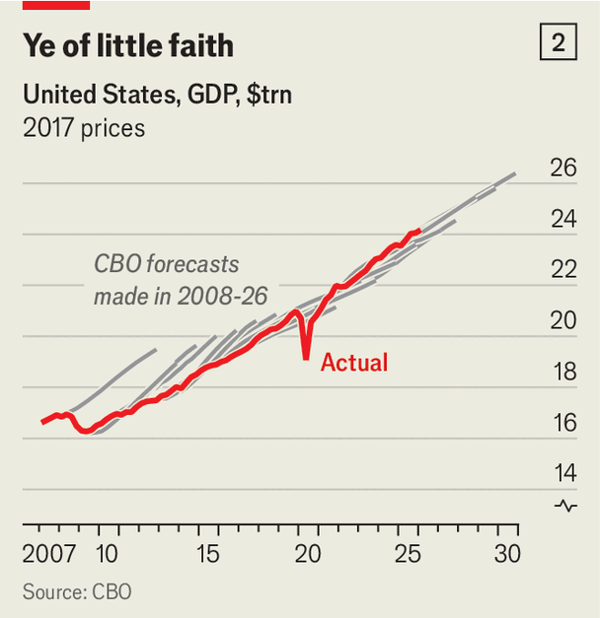
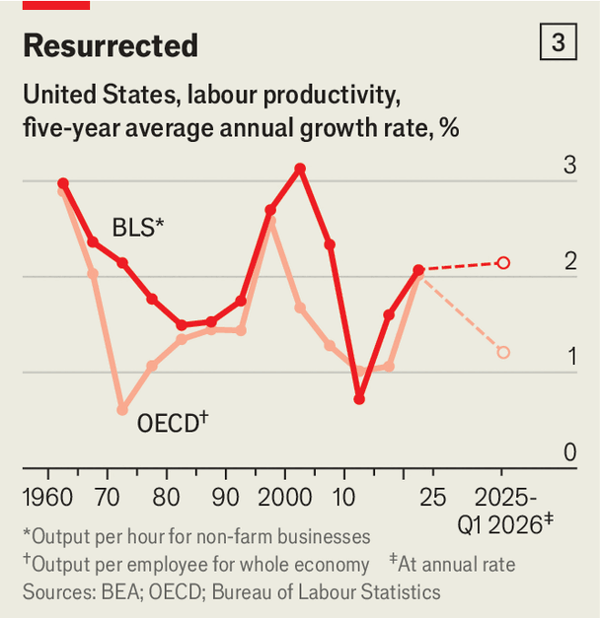
Over the past five years or so, American productivity growth has reached its fastest rate in around two decades: by output per worker or per hour, it has risen at about 2% a year, versus roughly 1% for most of the 2010s. That has pushed the Federal Reserve’s median forecast for America’s long-run GDP growth from 1.8% to 2%, and quickly weakened the case for chronic stagnation.
It is not yet possible to credit artificial intelligence for the rebound, because productivity began improving in the early 2020s while large language models have only come into real commercial use in the past year or so. The biggest sectoral signal instead comes from “information,” which grew at about 6% a year in 2019-24 but was no faster than its 2000-19 average, and whose share of total output stayed between 5.3% and 5.5%.
Larger gains have come in professional services and management, which make up about a tenth of the economy and have become more effective users of smartphones, cloud computing and videoconferencing. Productivity also sped up in oil and gas; with electricity costing Americans about half as much as Europeans and one-third less than Japanese households, energy-intensive industries have stayed comparatively resilient.
Source: America is experiencing a productivity miracle
Subtitle: AI hasn’t—yet—got much to do with it
Dateline: 5月 14, 2026 11:25 上午 | Washington, DC