全球发达经济体正面临自1990年代或2000年代以来最高的主权借贷成本,公共债务占GDP比重已较世纪之交翻倍,引发严峻预算危机。即便在近轮抛售潮之前,主要富裕国家今年净利息支出已预计占到税收收入的8%,而人口老龄化与国防支出更加剧了财政负担。虽然美国年化经济增速超3%、失业救济申请处于低位以及人工智能产业对数据中心建设的巨大资本竞争推高了中性利率,但伊朗战争引发的能源冲击再度推高通胀,叠加民粹政治对央行信誉的侵蚀,使投资者对政府“通过通胀稀释债务”的风险保持警惕。
主权债券抛售对各大经济体的冲击呈现出高度异质性。美国约6%的年度财政赤字占GDP比重在长期内不可持续,人工智能带来的扩张难以抵消水涨船高的利息成本,但凭借美元的核心储备货币地位,收益率上升反而推动美元汇率急剧走强,使其暂时推迟了财政清算。日本十年期国债收益率自1996年以来首次突破3%,尽管通胀与小幅赤字暂使其债务与GDP之比有所缩减,但未来减持巨额外汇资产的潜在动作仍可能震慑全球市场。欧洲面临的系统性风险最为致命,其缺乏美国式的AI增长驱动,同时受制于高昂的进口燃料成本和即将到来的液化天然气短缺。
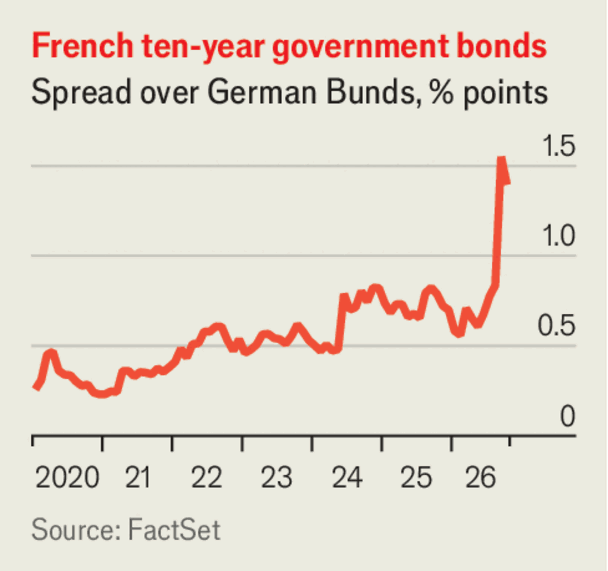
在欧洲内部,英国推迟养老金改革致债务率持续攀升,意大利净债务占GDP比重高达129%,而法国处境最为危急。法国今年财政赤字预计达GDP的5.4%,按当前五年期国债收益率测算,若想稳定债务需紧缩超4%的GDP,而议会目前连十分之一的紧缩规模都难以通过。法国十年期借贷成本对德利差已升至1.5个百分点的欧债危机以来新高;尽管在2027年大选中领先的极右翼领袖勒庞承诺到2032年紧缩3%的GDP并削减半数债务比,但其坚持降低退休年龄的承诺严重缺乏可信度。若法国国债遭遇挤兑并迫使欧洲央行进行不设前提的救助,央行独立性将沦陷,从而可能引爆全球长期债券更猛烈的抛售潮。
Advanced economies face their highest borrowing costs since the 1990s or 2000s, with public-debt-to-GDP ratios doubling since the turn of the century and pushing budgets toward crisis. Even prior to the latest market rout, rich-world governments were projected to allocate 8% of tax revenues to net debt interest this year amid mounting pressures from ageing populations and security spending. While rapid economic expansion—highlighted by American GDP growth exceeding an annualized 3%, low jobless claims, and massive AI capital demand—has lifted neutral rates, energy disruptions from the war in Iran and populist attacks on central bank autonomy have heightened fears that inflation will erode debt obligations.
The macroeconomic repercussions of surging yields diverge significantly across major sovereign borrowers. Although America's annual fiscal deficit of roughly 6% of GDP is unsustainable, its role as the primary global reserve currency issuer has triggered dollar appreciation alongside rising yields, deferring an immediate reckoning. In Japan, ten-year sovereign yields breached 3% for the first time since 1996, yet low inflation-adjusted rates and modest deficits have temporarily contained its debt-to-GDP ratio, even as the risk of future overseas asset liquidations looms. Conversely, Europe faces severe vulnerability, constrained by sluggish AI adoption, expensive energy imports, and impending liquefied natural gas shortages.
European fiscal fragility is acute, with Britain postponing pension cuts, Italy carrying public debt at 129% of GDP, and France confronting immediate peril. France's budget deficit is projected at 5.4% of GDP this year; stabilizing debt under prevailing five-year refinancing costs would require fiscal austerity exceeding 4% of GDP, yet its parliament struggles to pass cuts worth a tenth of that amount. The French ten-year yield spread over German bunds widened to 1.5 percentage points, the highest since the euro crisis. While far-right frontrunner Marine Le Pen pledged to trim budgets by 3% of GDP by 2032, her refusal to reform retirement ages undermines credibility, threatening ECB interventions that could further destabilize long-term debt markets.
Source: Will bonds blow up?
Subtitle: A government-debt crisis is looming
Dateline: Oct 8th 2026\n