除了股权投资外,辉达还透过信用担保和租赁承诺等方式扩大对客户的支持。该公司已为部分客户提供总计35亿美元的贷款担保,并可能为OpenAI提供高达2500亿美元的信用支持。执行长黄仁勋更进一步承诺在德州租赁价值500亿美元的资料中心,该中心将搭载辉达自家晶片,并保留转租服务的选项,这实质上是另一种形式的担保。
供应商融资对辉达而言比对汽车制造商或百货公司更具意义,因为AI产业发展迅速,企业难以从市场筹集足够资金来建设所需的算力规模。若AI产业整体发展顺利,辉达可从晶片销售和股权投资中获得双重收益。然而,信用担保也放大了风险:一旦客户出现问题,估值损失可能演变为偿付能力危机。尽管辉达目前拥有800亿美元流动资产和每年约2000亿美元的营运现金流,但随著涉及金额不断攀升,这家过去对债务持保守态度的公司风险特征正在发生改变。
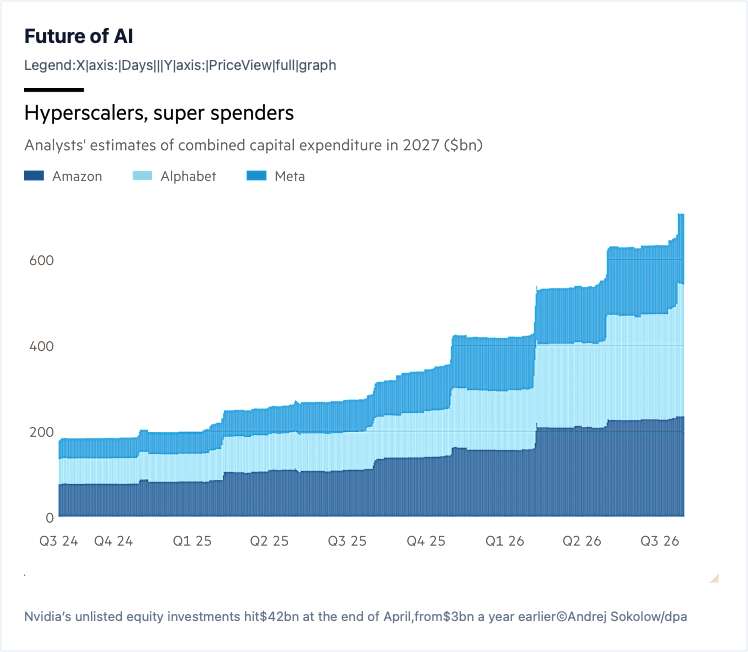
Nvidia has dramatically expanded its vendor financing activities, with unlisted equity investments surging to $42 billion by the end of April 2025 from just $3 billion a year earlier. Rather than making traditional loans, the chipmaker has invested directly in customers such as OpenAI ($30 billion) and Anthropic ($10 billion), enabling them to purchase more of its AI chips than they could otherwise afford. These transactions are characterized as back-to-back rather than truly circular, as equity investments are not necessarily funnelled directly back into chip purchases, and Nvidia retains both revenue and ownership stakes.
Beyond equity investments, Nvidia is extending its customer support through credit guarantees and lease commitments. The company already backstops $3.5 billion in customer loans and may soon offer OpenAI credit support of up to $250 billion. CEO Jensen Huang has also committed to $50 billion in data centre leases in Texas that will host Nvidia's own chips, with the option to sublet services — effectively functioning as yet another form of guarantee. If structured as credit derivatives, these guarantees may have limited impact on the company's balance sheet.
Vendor financing carries both significant upside and considerable risk for Nvidia. If AI bets pay off, the company stands to profit from both chip sales and appreciating equity stakes. However, credit guarantees amplify the downside: a misjudged equity investment merely wastes capital, but assuming a customer's debts can transform a valuation problem into a solvency crisis. While Nvidia currently holds $80 billion in liquid assets and generates roughly $200 billion in annual operating cash flow, the escalating scale of its financial commitments is fundamentally altering the risk profile of this formerly debt-averse company. (Key numbers: 800, 2000)