ChatGPT 以三年时间积累每周逾 8 亿用户,月度访问量在 10 月达 11 亿,而 Google Gemini 仅为 1.53 亿,差距约 7.2 倍;近月增长速度亦由 ChatGPT 领先。OpenAI 为支撑至 2029 年预计达 1150 亿美元的支出,正以高频迭代强化用户黏性,包括“持续记忆”、个性设定、年龄分级后的情欲对话、群组聊天等,目标是扩大用户池并将免费用户转化为每月 20 美元订阅者。相比之下,Gemini 虽在基准测试中暂时跃升,并依托搜索、Android 等分发能力,但其用户参与度仍不足以触发类社交网络的规模化扩散。
Google 的弱点在于长期难以形成强网络效应,其多项社交化产品(Google+、Wave、Buzz)皆因设计混乱与缺乏习惯性机制而失败,反映其优势在工具型业务,而非用户留存算法。Gemini 的产品路线聚焦“助理功能”,如短提示意图识别、与 Docs 与 Calendar 的结合,更倾向企业与效率场景;OpenAI 则沿用硅谷“极速扩张”逻辑,将 ChatGPT 塑造为具情感外观的对话伙伴,以顺应消费端对聊天式 AI 的使用偏好。
在搜索与云业务稳健支撑下,Google 可容忍 Gemini 以渐进方式增长;OpenAI 则需维持高速扩张以支撑巨额资本需求。约 20% 的 OpenAI 员工来自深谙“黏性设计”的 Meta,体现其战略取向:不是比对手更聪明,而是更难被用户放弃。由此,ChatGPT 在可预期未来仍维持领先,而 Gemini 多半将保持“体面但遥远”的第二名。
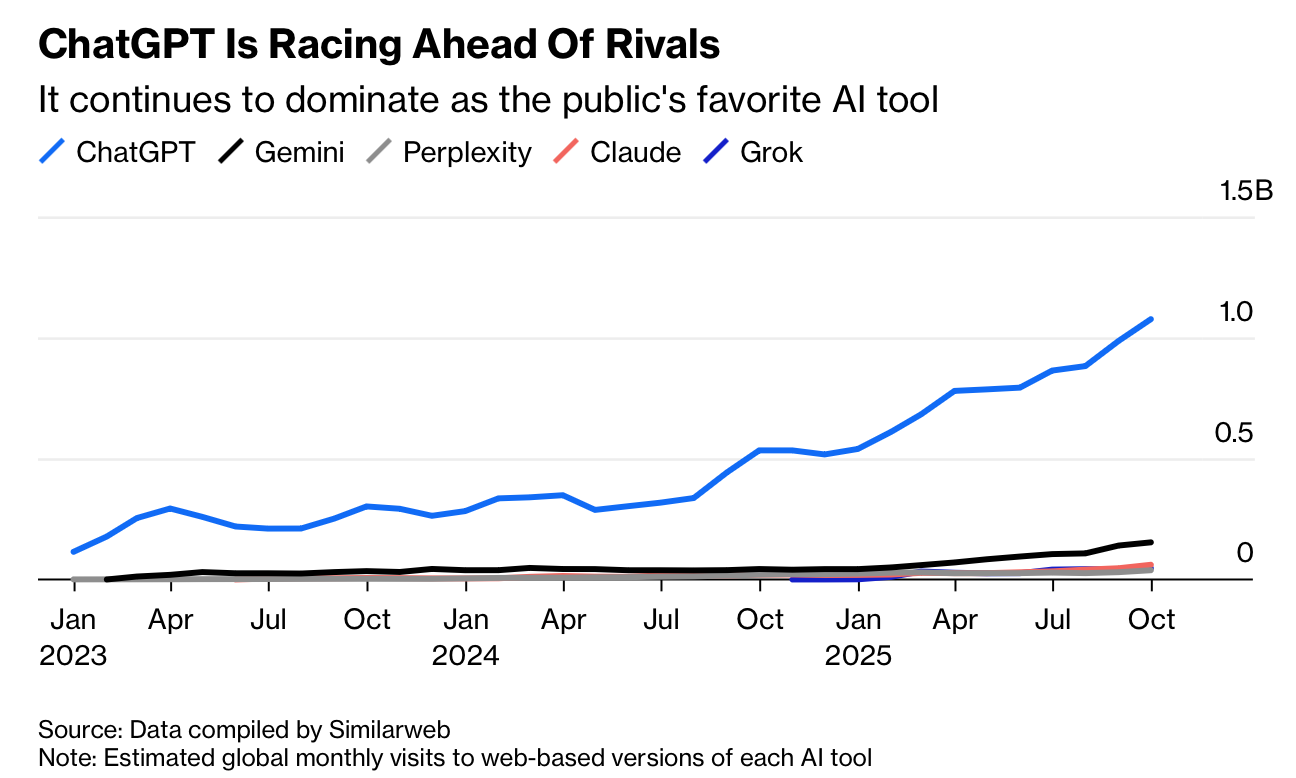
ChatGPT has amassed more than 800 million weekly users in three years, with 1.1 billion monthly visits in October compared with Gemini’s 153 million—a roughly 7.2× gap—and recent growth rates also favor ChatGPT. To underwrite projected spending of $115 billion through 2029, OpenAI is aggressively deepening engagement via persistent memory, personality settings, age-gated erotic dialogue, and group chats, aiming to expand its base and convert free users into $20-per-month subscribers. Gemini, despite benchmark gains and powerful distribution via Search and Android, still lacks the engagement dynamics needed to trigger social-network–like scaling.
Google’s weakness lies in its chronic inability to generate strong network effects; past social products (Google+, Wave, Buzz) failed due to confusing design and weak habit formation, reflecting Google’s strength in utilities rather than retention algorithms. Gemini’s roadmap emphasizes assistant capabilities—short-prompt intent inference and integration with Docs and Calendar—aligning more with productivity use cases, whereas OpenAI follows a blitz-scaling strategy, positioning ChatGPT as an emotionally resonant conversational companion aligned with consumer adoption patterns.
With search, cloud, and AI chips providing stability, Google can tolerate gradual Gemini growth; OpenAI must accelerate to meet capital demands. Roughly 20% of its staff hail from Meta, reflecting its focus on stickiness: not being smarter than competitors, but harder to quit. As a result, ChatGPT’s lead is set to persist, while Gemini will likely remain a distant but respectable second.