根据古德哈特定律,当一项指标变成控制目标时,它便不再是一个良好的衡量标准,这一规律在中国尤为明显。中国自2018年开始发布基于人口调查的月度城镇调查失业率,但该指标表现出异乎寻常的稳定性:7月的失业率为5.2%,且在过去115个月中有99次处于5%至6%之间;即便在新冠疫情期间,该数据也从未超过6.2%。这种停滞状态一方面源于调查仅涵盖城镇劳动力,农民工进出城市的流动性起到了自稳调节器的作用;另一方面则源于政府设定的年度失业率控制目标(通常在5.5%左右,2020年升至6%),促使官方对其进行平滑管理以降低波动。
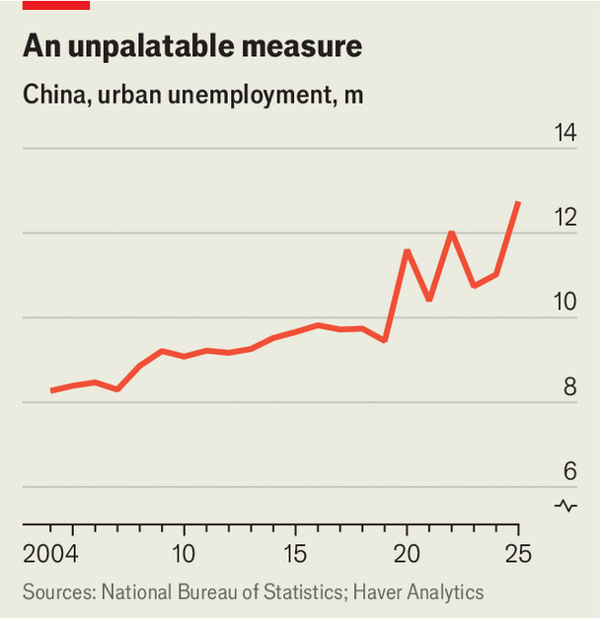
这种人造的稳定性掩盖了世界最大就业市场的真实困境。当前经济学家难以确证中国强劲的出口繁荣是否创造了充足的制造业岗位、人工智能是否冲击了初级白领岗位,以及工资增速是否足以抵御通缩风险。由于官方调查失业率缺乏弹性,加维科龙洲经讯(Gavekal Dragonomics)的安德鲁·巴特森(Andrew Batson)建议重新审视自1978年设立的传统登记失业指标。在该指标不再作为政府考核目标后,官方仅低调公布登记失业的绝对人数,而该数据在2025年底跃升至1270万人,同比激增近16%。
巴特森指出,2020年放宽异地登记的规则调整无法解释近期的大幅攀升,这反映了劳动力市场的实质性承压,并印证了“当指标不再是目标时便重新成为好指标”的巴特森推论。然而,如果登记失业数据引发过多关注与尴尬,中国政府可能会重蹈2023年暂停发布青年失业率的覆辙,再次停止更新这一数据。
According to Goodhart's law, when a statistical measure becomes a target for control, it ceases to be a reliable gauge—a dilemma acutely visible in China. Since 2018, China has published a monthly surveyed urban unemployment rate that remains uncannily stable: July's figure stood at 5.2%, falling between 5% and 6% for the 99th time in the past 115 months, and never exceeding 6.2% even during the covid-19 pandemic. This stasis partly reflects survey limitations that exclude rural areas, allowing migrant worker flows to act as a homeostatic buffer, alongside persistent administrative pressure to meet annual government targets (typically around 5.5%, rising to 6% in 2020) by dampening volatility.
Such artificial stability obscures real conditions in the world's largest labour market, making it difficult to assess whether export booms generate manufacturing jobs, if artificial intelligence threatens entry-level white-collar employment, or whether wage growth is sufficient to avert deflation. To bypass these rigid survey figures, Andrew Batson of Gavekal Dragonomics highlights China's older registered unemployment metric, tracked since 1978. Having ceased to be an active government target, this gauge no longer publishes percentage rates but still records raw figures, which surged nearly 16% year-on-year to 12.7m by late 2025.
Mr Batson argues that 2020 registration rule changes cannot account for this recent jump, indicating severe underlying labour-market stress and illustrating "Batson's corollary": once a measure ceases to be a target, it becomes useful again. Nonetheless, tracking China's economy remains precarious; if registered unemployment numbers attract excessive scrutiny, authorities may simply suspend them, just as they halted youth-unemployment reporting in 2023.
Source: However you measure it, China’s job market is weak
Subtitle: Some workers are going back to the farm
Dateline: 8月 20, 2026 04:27 上午