全球主权债券市场动荡加剧,借贷成本飙升令发达经济体政策制定者深感不安。8月18日,美国10年期国债收益率创下自2025年1月以来的最高点,30年期国债收益率一度突破5.3%,触及2007年以来的最高水平。与此呼应,英国、法国和德国的长期国债收益率均攀升至十多年来的高位,日本30年期国债收益率亦逼近历史峰值。为平抚市场恐慌,美国财政部于8月19日宣布自次月起扩大对长期国债的自身回购规模,反映出官方对借贷成本失控的极度担忧。
推动债券收益率居高不下的短期因素在于中东霍尔木兹海峡持续关闭带来的通胀黏性,以及企业发债潮对资本的分流。高企的能源成本推升了通胀预期,例如英国7月份消费者价格指数(CPI)同比涨幅从6月的2.6%反弹至2.9%。同时,科技巨头为资助人工智能数据中心建设,近几个月发行了约750亿美元债券,高盛测算这使其合计发债规模接近去年的两倍;而在投资级发行人超过100亿美元的大额发债中,约40%来自科技以外行业,海量的高评级企业债供应加剧了全球资金争夺并推高了无风险利率。
深层次的结构性危机则源于日益膨胀的政府债务与财政赤字。8月19日美国财政部披露联邦债务总额历史性突破40万亿美元,占去年国内生产总值(GDP)的130%,且财政赤字率维持在约6%的极高水平。在欧洲与亚洲,法德10年期国债利差走阔至2012年以来最大,日本国债收益率甚至反常地高于中国国债。随着国债持有者从价格不敏感的官方机构加速转向价格敏感的私人投资者,美英日等国虽试图通过增发低息短期国债来缓释压力,但这显著加剧了债务再融资滚动的利率冲击风险,央行干预亦难以从根本上扭转市场对财政可持续性的长期疑虑。
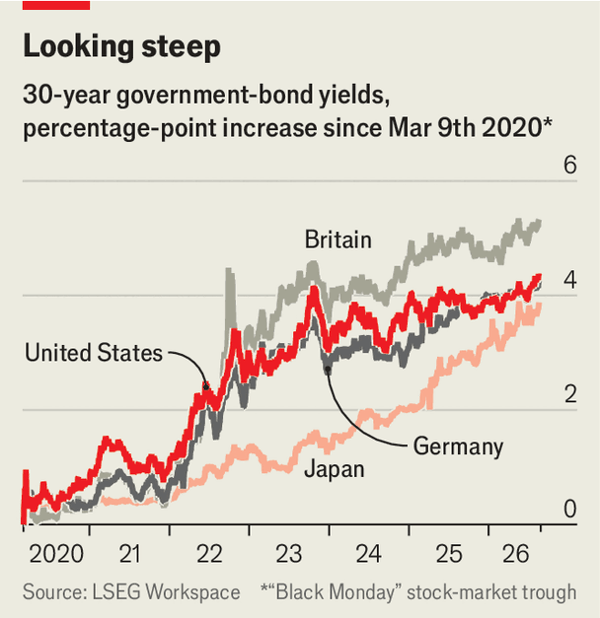
Global government bond markets are experiencing severe turbulence, unsettling policymakers across advanced economies as borrowing costs escalate. On August 18th, the US ten-year Treasury yield reached its highest level since January 2025, while the 30-year yield briefly breached 5.3%, its highest mark since 2007. Long-term sovereign yields in Britain, France, and Germany reached multi-decade highs, and Japanese 30-year yields hovered near historic records. To alleviate liquidity strains, the US Treasury announced on August 19th that it would increase purchases of longer-dated debt, signalling profound administrative anxiety over rising yields.
Persistent inflation risks and aggressive corporate bond issuance continue to drive yields upward. With the Strait of Hormuz largely shut, surging transport fuel prices are feeding inflationary pressures; Britain’s consumer price index rose to 2.9% in the year to July, up from 2.6% in June. Concurrently, sovereign issuers face fierce competition from private capital demand: large technology firms have issued approximately $75bn in bonds to finance AI data centres, nearly doubling their total debt volume from last year according to Goldman Sachs. With 40% of large-scale investment-grade deals originating outside tech, bondholders have abundant corporate alternatives, intensifying capital competition and lifting yields.
The dominant structural driver remains unsustainable fiscal expansion and ballooning government debt burdens. The US Treasury revealed that federal debt surpassed $40trn for the first time—reaching 130% of GDP—alongside an annual deficit hovering around 6% of GDP. Sovereign risk divergence has widened the French-German 10-year yield spread to its widest level since 2012, while Japanese yields now exceed Chinese equivalents. As sovereign debt ownership shifts toward price-sensitive private investors demanding higher term premiums, governments in America, Britain, and Japan have relied more heavily on short-dated paper. This shortening maturity profile sharply amplifies rollover risks at higher interest rates, rendering official buyback programs unable to permanently placate investor concerns.
Source: Why bond markets are unnerving rich-world politicians
Subtitle: As stocks rise ever higher, yields have been climbing ominously
Dateline: 8月 20, 2026 05:59 上午 | NEW YORK